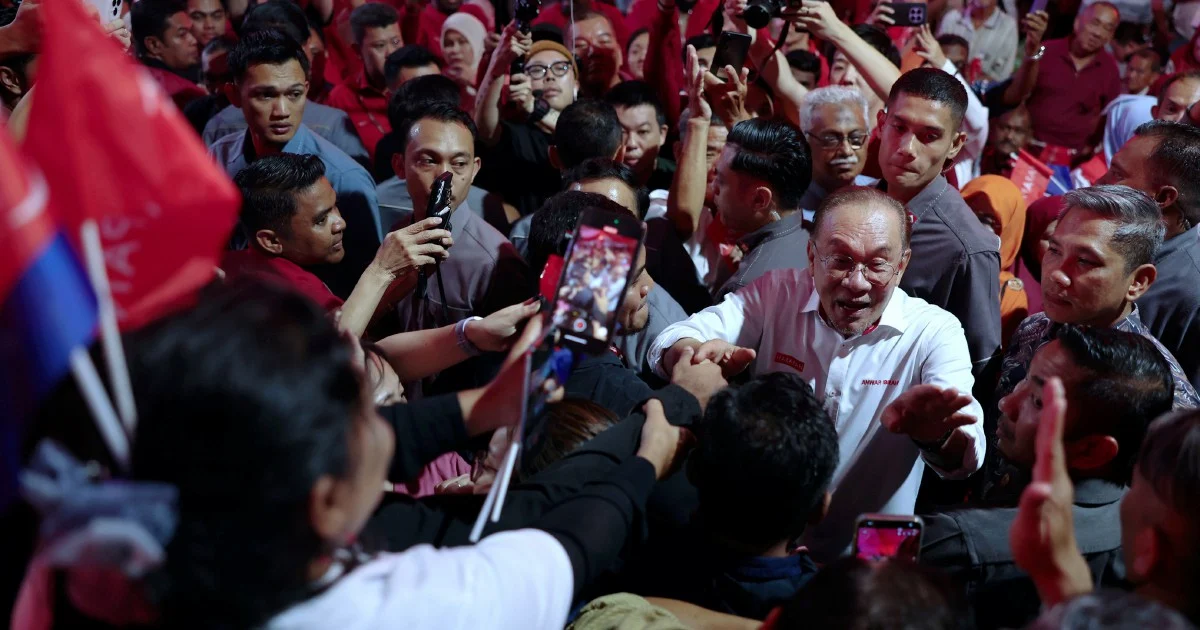
Pakatan Harapan formally presented its full complement of 56 candidates for the Johor state election slated for July 11, marking a decisive step in the coalition's strategy to wrestle back authority in a state that has long served as a political stronghold. The announcement, made by coalition chairman Datuk Seri Anwar Ibrahim in Tangkak, represents the culmination of months of internal negotiations and ground-level assessments aimed at fielding a competitive team across all state constituencies.
Johor represents considerably significant terrain in Malaysia's political landscape. The state's 56 assembly seats encompass urban centres, industrial zones, and rural constituencies, each presenting distinct electoral challenges and opportunities. For Pakatan Harapan, recovery in Johor would constitute a major symbolic and practical gain, reinforcing the coalition's viability as a governing force beyond its federal strongholds in the Klang Valley and Penang. The timing of this election also carries weight, arriving at a juncture when the coalition continues consolidating its position following the 2022 general election that brought it back to the national political stage.
The announcement underscores the coalition's commitment to contesting every available seat, a strategic posture that contrasts with earlier scenarios where parties might have fielded incomplete slates or concentrated resources selectively. By presenting a full candidate roster now, several weeks before polling day, Pakatan Harapan signals readiness and provides sufficient time for grassroots campaigning to gain traction. The comprehensive approach also reflects confidence in the coalition's organisational capacity to mobilise support across diverse demographic and geographic constituencies within the state.
Balancing competing interests within a multi-party coalition has historically challenged such efforts. Pakatan Harapan comprises the Democratic Action Party, the People's Justice Party, the Amanah Party, and increasingly the National Trust Party in various state configurations. The distribution of 56 candidacies among these constituent parties and their respective factions requires careful arithmetic to maintain cohesion whilst accommodating powerful grassroots leaders and securing geographical coverage. The fact that Anwar himself oversaw the unveiling suggests the exercise carried sufficient importance to warrant the coalition chairman's direct involvement, elevating its political weight.
Johor's electoral significance extends beyond the state boundary. Results here influence broader perceptions of which coalition commands momentum heading into potential future national polls. The state's economy, centred on manufacturing, petrochemicals, and agriculture, touches countless Malaysian lives through supply chains and employment. For voters evaluating competing visions of economic management, state-level contests provide vital testing grounds for policy platforms and leadership credibility. Pakatan Harapan's pitch to Johor residents likely emphasises transparency, economic diversification, and anti-corruption commitments that formed part of its 2022 federal campaign messaging.
The July 11 date positions this election within a specific electoral calendar that shapes political momentum. Coming after the Melaka state election in late 2023 and during a period of relative policy activity at the federal level, Johor becomes a barometer of voter sentiment regarding Pakatan Harapan's stewardship and its coalition partners' contributions to governance. Should the coalition perform strongly, it would validate the confidence expressed through fielding a full candidate slate and support narratives of PH resurgence. Conversely, an unexpectedly weak showing would prompt internal assessments regarding candidate selection and messaging effectiveness.
Geographically, Johor encompasses constituencies with vastly different voting patterns and demographic compositions. Johor Bahru and surrounding urban areas tend toward more volatile electoral behaviour, where younger voters and migrant populations shape outcomes differently than established rural communities in districts further north. Effective coalition campaigns must recognise these distinctions and tailor communication strategies accordingly. The quality and local standing of individual candidates therefore matter considerably, making the candidate selection process itself a revealing indicator of how thoroughly Pakatan Harapan analysed each constituency's particular needs and opportunities.
Opposition positioning in Johor deserves attention as well. Barisan Nasional maintains traditional support networks throughout the state, whilst Perikatan Nasional has cultivated following in specific regions. For Pakatan Harapan to make meaningful gains, it must penetrate established voter loyalty patterns or mobilise previously disengaged voters sufficiently to overcome incumbency advantages. The opposition's response to the coalition's candidate announcement would likely include counterarguments about governance records, development delivery, and local priorities where the ruling parties claim superior performance.
Anwar Ibrahim's personal involvement in the candidate unveiling carries additional implications. As Prime Minister, his credibility directly connects to Pakatan Harapan's electoral prospects. Johor voters evaluating the coalition partly assess whether federal government programmes and economic policies have tangibly improved their circumstances. The announcement therefore functions not merely as a procedural step but as an extension of the broader political narrative through which the Prime Minister and his coalition seek to rebuild trust and demonstrate effectiveness to the Malaysian electorate across diverse regions.

