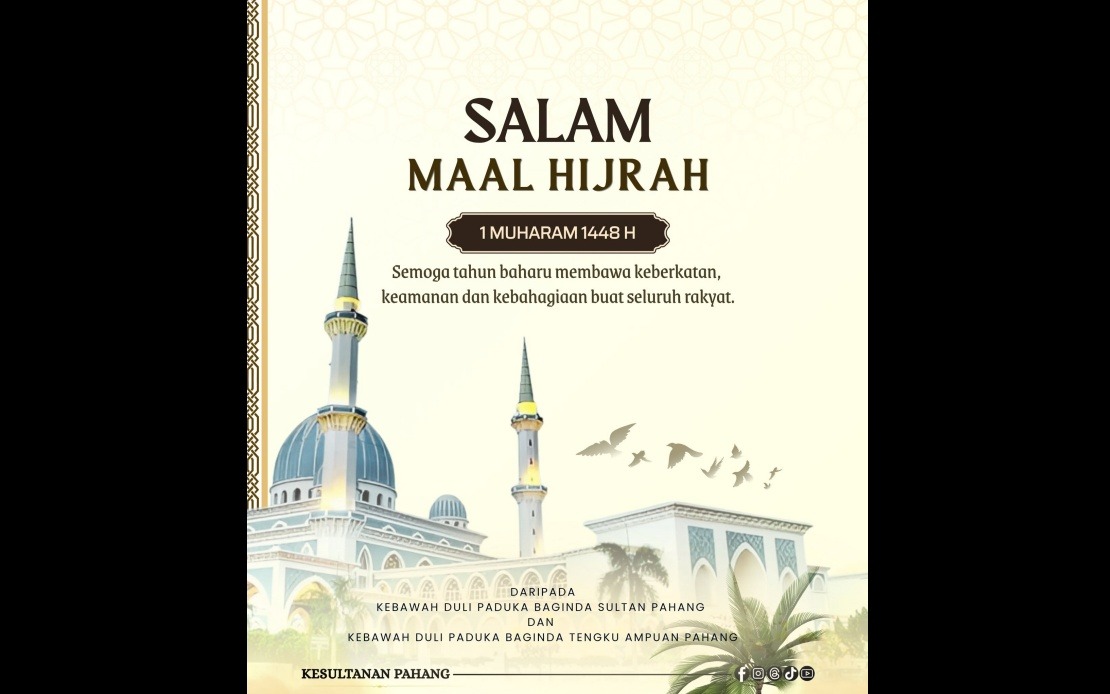
The Sultan of Pahang, Al-Sultan Abdullah Ri'ayatuddin Al-Mustafa Billah Shah, and the Tengku Ampuan of Pahang, Tunku Azizah Aminah Maimunah Iskandariah, have marked the Islamic New Year 1448H by conveying greetings and well-wishes to the Muslim community across the state. The message, shared through the Kesultanan Pahang's official social media channels, represents the royal household's continued engagement with significant religious observances that hold deep cultural and spiritual meaning for Malaysia's Muslim majority.
In their formal greeting, the royal couple expressed the hope that the advent of the new Islamic year would usher in a period characterised by blessings, tranquility, and contentment for all residents of Pahang, regardless of their background. This inclusive messaging reflects the constitutional role of the Pahang sultanate in promoting harmony and prosperity across the state. The gesture underscores how Malaysia's hereditary rulers continue to use public occasions to reinforce the values of compassion and collective well-being that form the foundation of the constitutional monarchy system.
Pahang Menteri Besar Datuk Seri Wan Rosdy Wan Ismail amplified the royal message by issuing his own statement on the Islamic New Year. His intervention adds a political and administrative dimension to the religious observance, linking the spiritual renewal associated with Maal Hijrah to concrete expectations about governance and public service. The Menteri Besar framed the new Islamic year as an opportune moment for Muslims to recalibrate their personal objectives, deepen their religious commitment, and expand their engagement in charitable and community-oriented activities.
Central to the Menteri Besar's message is the invocation of Prophet Muhammad's Hijrah—the historic migration from Mecca to Medina in 622 CE—as a template for positive transformation. By drawing this parallel, Wan Rosdy positioned the new Islamic year not merely as a calendar milestone but as a spiritual juncture prompting introspection and behavioural change. The reference to the Prophet's journey, which fundamentally altered the trajectory of Islamic history and established the foundations of the first Muslim community-state, carries symbolic weight that resonates across diverse Muslim populations.
The Menteri Besar's call for embracing the spirit of Hijrah by implementing constructive changes reflects a broader pattern in Malaysian political discourse where religious concepts are leveraged to mobilise social engagement and reinforce state narratives. By connecting the Islamic calendar transition to themes of unity strengthening, integrity promotion, and state development, Wan Rosdy articulated a vision where religious observance and administrative governance intersect. This framing suggests that spiritual renewal and material progress are complementary rather than competing objectives.
The emphasis on strengthening unity carries particular resonance in the Malaysian context, where maintaining inter-communal harmony remains an ongoing governmental priority. Pahang, like other Malaysian states, comprises diverse ethnic and religious populations, and official messaging that celebrates Islamic observances while maintaining inclusive language serves to reinforce the pluralistic constitutional framework. The Menteri Besar's reference to developing the state and improving public welfare positions religious observance as conducive to practical governance outcomes rather than as a matter of purely personal spirituality.
The articulation of integrity as a core value within the Menteri Besar's statement reflects contemporary concerns about accountability and ethical governance in Malaysian public administration. By invoking integrity alongside religious renewal, the official messaging suggests that Islamic principles and professional standards are mutually reinforcing. This rhetorical move serves to legitimise governance through an appeal to both religious authority and modern administrative norms, appealing to constituencies motivated by either or both frameworks.
For Malaysian Muslims observing the Maal Hijrah transition, official greetings from the state's highest political and ceremonial authorities provide public validation and encouragement for their religious observance. The prominence given to these messages through state media and social platforms underscores the significance accorded to Islamic occasions within Malaysia's constitutional and political structure. The timing and tone of such communications often set the tenor for broader public discussion around religious observances and their relationship to national identity and governance.
The reference in the Menteri Besar's statement to seeking divine mercy, blessings, and protection reflects the theological framework underpinning Islamic practice while simultaneously expressing collective aspirations for stability and progress. By concluding with a prayer for steadfastness in ongoing efforts and sacrifices, Wan Rosdy situated the new Islamic year within a longer trajectory of continuous endeavour and commitment. This language suggests that the spiritual renewal associated with Maal Hijrah is not an isolated moment of reflection but rather a stimulus for sustained engagement with the work of community and state building.
The multi-layered messaging from Pahang's royal household and executive government—combining ceremonial greetings, theological reflection, and policy-oriented language—illustrates how significant religious observances function within Malaysia's particular constitutional and political ecosystem. Rather than remaining confined to personal devotion or community-based religious institutions, major Islamic calendar events become occasions for state actors to articulate vision, reinforce values, and mobilise constituencies around shared objectives. This integration of religious observance into state discourse reflects both the constitutional recognition of Islam's special position in Malaysia and the pragmatic recognition that religious communities constitute essential constituencies within the political system.
The emphasis across both the royal and governmental messaging on transformation, renewal, and ethical commitment speaks to broader aspirations within Pahang and Malaysia more widely regarding developmental progress and social cohesion. By framing the Islamic New Year as a moment of collective recommitment to these ideals, state leaders sought to channel the spiritual momentum of Maal Hijrah toward practical outcomes in governance, community welfare, and institutional performance. Whether and how such messaging translates into tangible improvements in public service delivery, anti-corruption efforts, and development initiatives remains a matter for ongoing assessment by both Muslim communities and the broader Malaysian public.