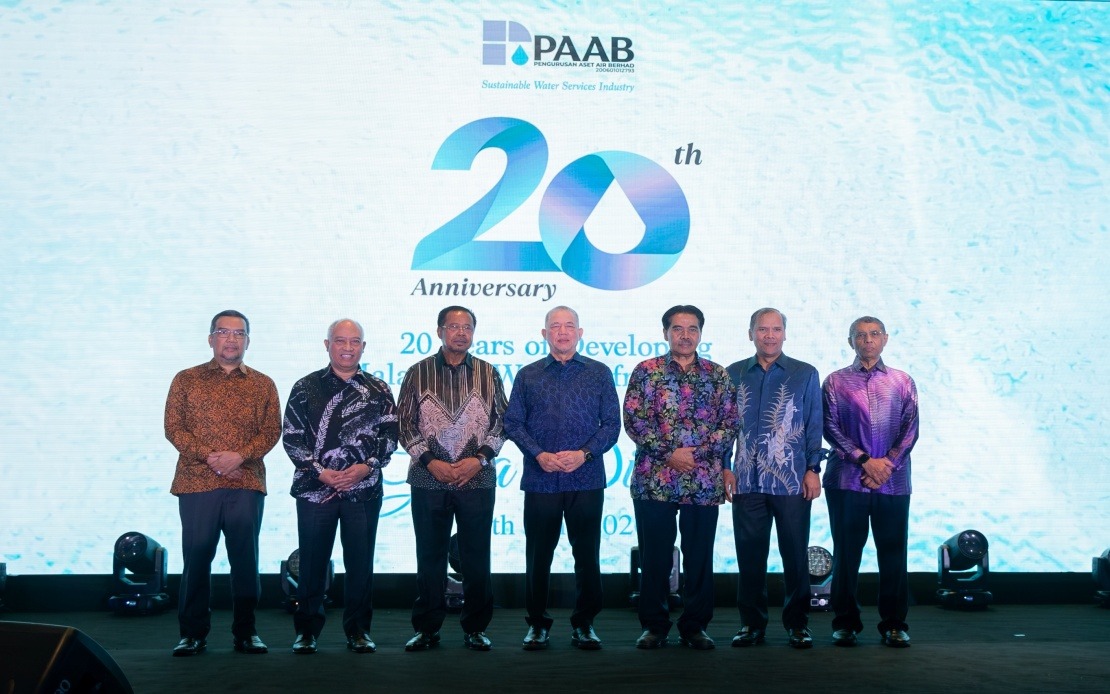
Pengurusan Aset Air Berhad (PAAB) has reached a significant milestone, celebrating two decades of directing strategic investments and orchestrating restructuring efforts across Malaysia's water services industry. The wholly owned company of the Minister of Finance Incorporated, established on May 5, 2006, has become instrumental in reshaping how the nation manages and delivers water to its population, while building the infrastructure foundation necessary to support economic growth and industrial development.
The organisation's financial footprint across two decades underscores its pivotal role in national infrastructure development. PAAB has financed the assumption of water industry loans worth RM23.04 billion whilst deploying RM23.84 billion into capital expenditure on water infrastructure projects. Combined, these contributions total RM46.88 billion—a figure that positions PAAB as one of Malaysia's most significant drivers of public utility infrastructure investment. This scale of commitment reflects the complexity and cost intensity of transforming a water sector that historically operated as fragmented regional monopolies into an integrated, professionally managed national system.
The tangible outcomes of PAAB's two-decade mandate are evident across the country's water supply network. As of December 2025, ten states have formally committed to the National Water Services Industry Restructuring Plan, culminating in a portfolio of completed and ongoing projects. These achievements include twenty-one operational water treatment plants with a combined processing capacity of 2,085 million litres per day, forty-two storage facilities holding 783 million litres, and 3,263 kilometres of upgraded and extended pipeline infrastructure spanning the nation. These physical assets represent the backbone of modern water delivery, designed to serve both residential consumers and increasingly water-intensive commercial operations.
The anniversary celebration, held at Menara Felda Platinum Park in Kuala Lumpur and officiated by Deputy Prime Minister Datuk Seri Fadillah Yusof, highlighted both achievements and urgency surrounding remaining challenges. Fadillah, who also holds the portfolio of Energy Transition and Water Transformation Minister, positioned water security as fundamental to Malaysia's ability to attract high-value foreign investment, particularly in emerging sectors such as data centres that demand reliable water and energy supply. This framing connects infrastructure investment directly to economic competitiveness, making water management a matter of national economic strategy rather than merely public utilities administration.
However, Fadillah's remarks underscored a critical vulnerability threatening Malaysia's progress. Non-revenue water—the proportion of treated water lost through leakage and system inefficiencies—remains at approximately forty per cent nationwide. This figure represents an enormous waste of both financial investment and natural resources. The Deputy Prime Minister argued that current timelines for addressing this systemic loss are inadequate, emphasising that Malaysia cannot afford to wait a decade longer for gradual improvement when foreign investors demand certainty regarding utility supply reliability today. The contrast between the magnitude of capital deployed and the persistence of water loss underscores structural challenges extending beyond financial investment alone.
The scale of non-revenue water loss carries profound implications for Malaysian consumers and businesses alike. When two out of every five litres of treated water disappears before reaching taps and industrial facilities, it reflects ageing infrastructure, poor maintenance practices, and sometimes theft. This inefficiency cascades through the entire system: water that must be treated at higher cost, energy expended in pumping lost supply, and inevitably, tariff pressures on paying consumers subsidising the system's leakage. For Southeast Asia's wealthier economy, such losses appear inconsistent with technical capacity and investment capability, suggesting that solutions require not merely financial commitment but comprehensive operational and governance reform.
PAOB's restructuring approach operates across four sequential phases extending to 2050, acknowledging that transforming a complex water sector cannot occur overnight. The migration phase (2008–2020) involved transferring systems and establishing new structures. The current stabilisation phase (2021–2030) focuses on strengthening operational capacity and achieving reliability improvements. Future consolidation (2031–2040) and full cost recovery (2041–2050) phases envision a sector where tariffs reflect true costs and systems operate at sustainable levels. This phased timeline reflects both realistic understanding of change management and implicit acknowledgment that Malaysia's water sector faces constraints of technical capacity, institutional coordination, and political will that cannot be bypassed through investment alone.
Of the RM23.84 billion capital expenditure deployed through December 2025, the breakdown reveals the various stages of project maturity. Completed projects handed to operating companies account for RM8.33 billion, representing infrastructure now delivering water to consumers. Projects under active construction involve RM1.84 billion, while RM13.67 billion remains allocated to design and planning stages. This distribution indicates that PAAB's capital pipeline remains robust, with the majority of committed spending still in development phases. The implication for Malaysian water users is one of extended transition: current supply challenges will persist as pipeline projects gradually mature and come online, suggesting that near-term relief from supply pressures depends more on operational improvements than capital completion.
The involvement of the National Water Services Commission (SPAN), led by Datuk Abdul Kadir Mohd Din with chief executive Datuk Ahmad Faizal Abdul Rahman, indicates coordination between PAAB's financing role and SPAN's regulatory oversight. This separation of functions—investment mobilisation distinct from operational regulation—mirrors international best practice in utility sector governance. However, such structural clarity requires corresponding clarity in accountability and performance metrics. PAAB itself measures impact not by investment volumes but by tangible improvements in water supply stability, quality, and accessibility for citizens. This user-centric framing appropriately emphasises that infrastructure investment succeeds only when it delivers superior service to the populations depending on water systems.
For Malaysian consumers and businesses, PAAB's twenty-year transformation programme represents an ongoing commitment to building water security, yet simultaneously underscores unfinished work. The presence of Deputy Prime Minister Fadillah and senior ministry officials at the anniversary event reflected the political significance now attached to water management, elevating it from technical utility administration to strategic national priority. Water scarcity and supply unreliability can derail economic development and compromise public health—realities that Malaysia has progressively confronted. The RM46.88 billion mobilised across two decades represents Malaysia's recognition that water security requires sustained, substantial investment.
Looking forward, PAAB's mandate to implement full cost recovery by 2050 raises questions about affordability, particularly for lower-income households, and about political will to sustain tariff increases reflecting true costs. Malaysia's transition to a water sector where users pay the genuine expense of supply—treatment, distribution, maintenance, and environmental protection—remains partially incomplete. The organisation's success will ultimately be measured by whether Malaysians experience fewer disruptions, enjoy cleaner water, and benefit from more resilient systems, rather than by the impressive investment volumes mobilised. The next phase of Malaysia's water transformation will test whether capital deployment and institutional restructuring translate into the user experience improvements that justify two decades of organisational effort and financial commitment.

