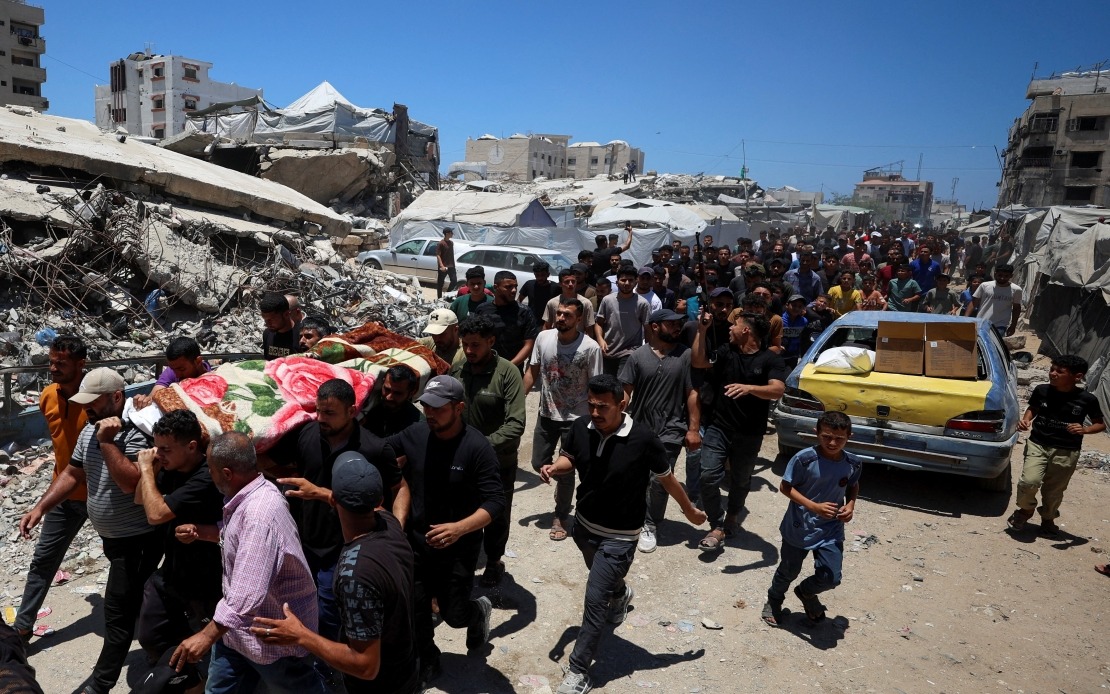
The Palestinian Prime Minister's Office has documented a grim milestone in the ongoing conflict, reporting that Israeli military operations have claimed 1,021 Palestinian lives since the implementation of the Gaza ceasefire, bringing the cumulative death toll in the enclave to 73,032 since fighting erupted in October 2023. The latest figures, released in a Situation Report on Tuesday, underscore the continued violence despite the ceasefire agreement and paint a stark picture of civilian suffering that extends far beyond casualty numbers.
The humanitarian environment across Gaza continues its rapid deterioration according to Palestinian government assessments. Israeli bombardments persist alongside restrictions that severely impede the flow of humanitarian assistance into the territory. One of the most acute challenges facing the population is a critical shortage of clean water, forcing the vast majority of residents to depend heavily on whatever supplies humanitarian organisations can deliver under existing constraints. This scarcity poses immediate health risks, particularly for vulnerable populations including children and the elderly who are susceptible to waterborne diseases.
The scale of physical destruction across Gaza has created a displacement crisis of unprecedented proportions. Nearly one million Palestinians are currently sheltering in tents after Israeli military operations destroyed or damaged 76.6 per cent of the enclave's housing stock. This figure reflects not merely the scale of destruction but the systematic nature of the damage that has rendered entire residential areas uninhabitable. The ongoing restrictions on reconstruction and building materials mean that many displaced families face no immediate prospect of returning to permanent accommodation, establishing what may become a prolonged humanitarian emergency.
Children have borne a particularly severe burden of the conflict's continuation. According to the United Nations Children's Fund, 265 Palestinian children have lost their lives and more than 400 others have sustained injuries in the period following the ceasefire announcement. These figures underscore how young lives remain at risk despite the agreement intended to halt large-scale hostilities. International humanitarian organisations including Oxfam have raised urgent concerns with the United Nations Security Council about how Israeli restrictions continue to obstruct the delivery of life-saving assistance, creating bottlenecks that prevent aid from reaching those most in need across the territory.
The violence and restrictions extend beyond the Gaza enclave into the occupied West Bank, where Palestinians face an intensifying campaign of displacement. The Office of the United Nations High Commissioner for Human Rights has documented a significant escalation in forced displacement across the West Bank, including East Jerusalem, driven by a combination of settler violence, home demolitions, movement restrictions, and forced evictions. This geographic expansion of the crisis suggests that the underlying tensions fuelling the broader conflict remain unresolved, with Palestinian communities facing pressure from multiple directions simultaneously.
Agriculture, a historically important sector of the Palestinian economy, has sustained devastating losses. The Palestinian Ministry of Agriculture has documented the destruction of 7,258 trees, including 1,270 olive trees, representing not only economic losses estimated at approximately US$5.17 million but also damage to cultural heritage and livelihoods dependent on agricultural production. In addition to tree destruction, arson attacks have targeted religious facilities, including two mosques in the villages of Jiljilya and Mazra' al-Nubani, suggesting that the violence encompasses attacks on cultural and religious sites significant to Palestinian communities.
Military operations in the West Bank refugee camps have compounded the displacement crisis. The camps of Jenin, Tulkarem, and Nour Shams have experienced intensive Israeli military operations since January 2025 that have displaced more than 33,000 Palestinians. These operations in densely populated civilian areas have contributed significantly to the overall humanitarian deterioration and represent a sustained military presence in civilian population centres. The situation in these camps reflects broader patterns of military operations that target areas where Palestinian populations have historically sought refuge.
Conditions in Israeli detention facilities have emerged as a separate but equally concerning humanitarian issue. Prisoners' institutions have raised alarms about deteriorating conditions, severe overcrowding, and the spread of infectious diseases within Israeli detention facilities holding Palestinian detainees. These concerns point to systemic issues in how detained Palestinians are being treated, with health and safety standards appearing to fall below international minimum standards.
Despite the encompassing crisis, Palestinian educational institutions have pressed forward with academic examinations. The Palestinian government has completed preparations for this year's General Secondary Education Examination involving approximately 91,000 students, with around 37,000 of those located in Gaza. For the third consecutive year, Gaza-based students are participating in the examination through electronic means, reflecting an improvised but determined effort to maintain educational continuity amid the conflict. This persistence in educational activity, while remarkable, also underscores the abnormality that has become the daily reality for Palestinian youth.
The situation reflects the complex regional dynamics that Malaysia and other Southeast Asian nations observe with concern. As a Muslim-majority nation with longstanding advocacy for Palestinian rights, Malaysia's diplomatic engagement with these developments carries particular significance in regional discourse. The humanitarian dimensions of the crisis extend beyond immediate casualty figures to encompass questions of displacement, resource scarcity, infrastructure destruction, and institutional collapse that define modern conflicts affecting civilian populations. For Southeast Asian observers and policymakers, the Gaza situation represents a case study in the humanitarian consequences of prolonged conflict and the inadequacy of ceasefire mechanisms that do not address underlying political grievances or establish genuine pathways toward sustainable peace and reconstruction.

