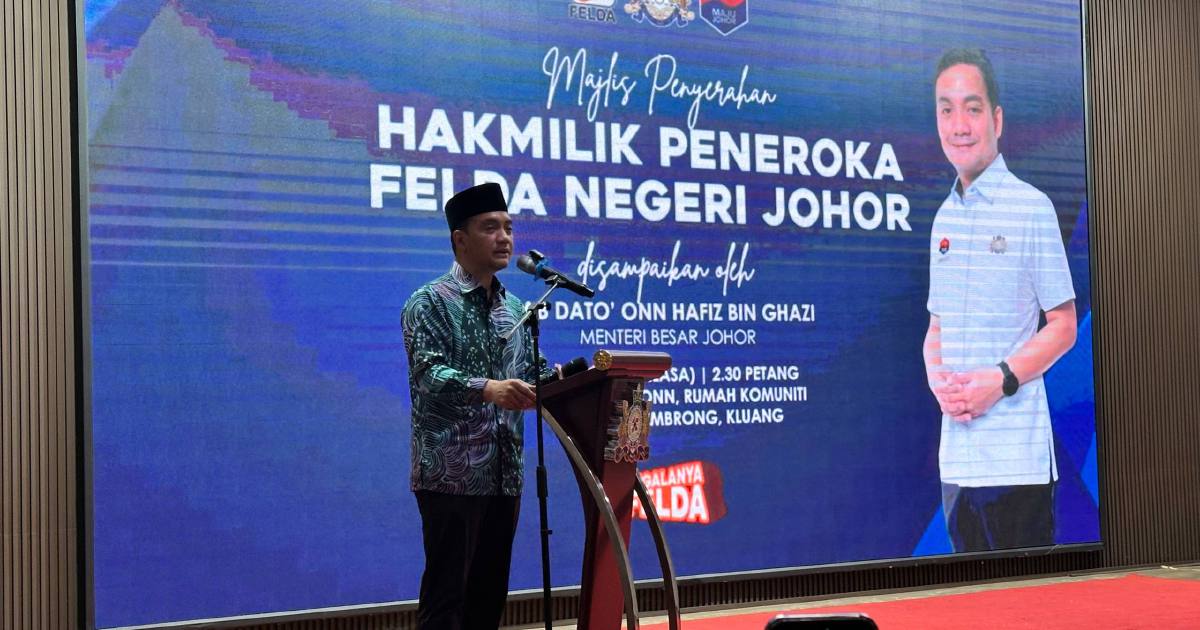
Caretaker Johor Menteri Besar Datuk Onn Hafiz Ghazi has alleged that he was prevented from accessing a Felda settlement in Kluang two days ago, thwarting his planned attendance at a ceremony to distribute land titles to residents. The incident marks a fresh flashpoint in Johor's volatile post-election period, underscoring the continued tensions that characterise the state's political landscape.
The obstruction of Onn Hafiz, who continues in a caretaker capacity pending the formation of a new state government following recent elections, raises serious questions about access and accountability during Malaysia's transitional political phases. When administrations are in caretaker mode, officials traditionally maintain a reduced public profile to respect the electoral process, yet they retain certain duties to constituents. The alleged blocking of a state leader's entry into a public settlement for an official function represents an unusual escalation and suggests deeper friction within state-level governance structures.
Felda settlements, which house thousands of smallholder farmers and their families across peninsular Malaysia, are typically managed through federal and state cooperation. These communities maintain particular political significance in Johor, given the state's agricultural heritage and the settlers' historically strong voting patterns. Any dispute involving senior state officials and Felda land distribution carries weighty implications, as land titles represent crucial assets for rural families dependent on palm oil cultivation and other agricultural pursuits. The timing of this incident—involving a ceremony to formalise land ownership—suggests the underlying conflict may relate to broader struggles over patronage and administrative authority during the transition period.
Onn Hafiz's status as caretaker Menteri Besar comes amid a complex post-election environment where no single coalition achieved a decisive mandate. This ambiguous mandate has created a governance vacuum that various political actors continue to navigate. The alleged obstruction from a Felda settlement—a constituency traditionally aligned with particular political factions—hints at attempts by other actors to constrain his movements or undermine his authority during this delicate period. Such actions would normally provoke swift responses from federal authorities overseeing caretaker conventions, yet the incident's details suggest it proceeded without immediate intervention.
The land title distribution ceremony itself deserves examination as a broader policy initiative. Formalising tenure for Felda settlers addresses long-standing demands from agricultural communities seeking clearer ownership documentation. For settlers, official land titles unlock numerous benefits including enhanced access to agricultural credit, smoother inheritance processes, and stronger collateral positions for agricultural investments. The inability to proceed with such a ceremony thus affects not merely political symbolism but practical livelihood outcomes for resident families. Any obstruction therefore carries consequences extending well beyond partisan maneuvering.
Johor's political architecture has grown increasingly fractionalised in recent years, with multiple factions competing for influence within the state apparatus. The alleged barring of Onn Hafiz from a public facility accessible to ordinary residents suggests that this internal competition has escalated to unprecedented levels of assertiveness. During normal governance circumstances, such an incident would attract immediate attention from federal authorities responsible for maintaining administrative standards. The caretaker convention, designed to ensure political neutrality during transitions, appears to have provided insufficient protection for a state official's basic access rights.
The incident also reflects broader patterns of administrative contestation occurring across Malaysian states as power dynamics shift following recent elections. Politicians in different coalitions have increasingly attempted to leverage their control over government machinery, resources, and even physical access to facilities, creating friction during transition periods. When such friction occurs in rural constituencies like Felda settlements, the consequences ripple through communities that depend upon smooth governmental service delivery for agricultural extension, infrastructure maintenance, and social welfare programs.
For ordinary Felda settlers, this episode demonstrates how state-level political instability directly affects their ability to engage with government institutions. If land title ceremonies cannot proceed smoothly due to administrative obstruction, it signals broader dysfunction in service delivery mechanisms. Settlers require assurance that governmental functions operate normally despite political transitions, particularly regarding crucial matters like land documentation that affect their economic security and generational wealth accumulation.
The allegation also raises questions about who exercised authority to prevent Onn Hafiz's entry and on what grounds. If Felda settlement management or local authorities acted to obstruct a state official, the decision likely reflected political calculations rather than legitimate administrative concerns. Conversely, if these bodies were instructed by other state-level figures to prevent the Menteri Besar's entry, it suggests a dramatic breakdown in institutional cooperation during a period when such cooperation remains essential.
Moving forward, this incident may prompt renewed scrutiny of caretaker governance protocols in Malaysia, particularly regarding how state-level political actors should navigate reduced authority while maintaining access to constituencies and facilities. The distribution of land titles—a fundamental governmental function benefiting rural communities—should not become a casualty of partisan competition. Resolving these tensions requires clarity about respective authorities during caretaker periods and firm commitment from all political actors to respect institutional norms, even during periods of heightened competition for power. For Johor's Felda settlers awaiting their land title distributions, the resolution of these administrative conflicts remains urgently necessary.

