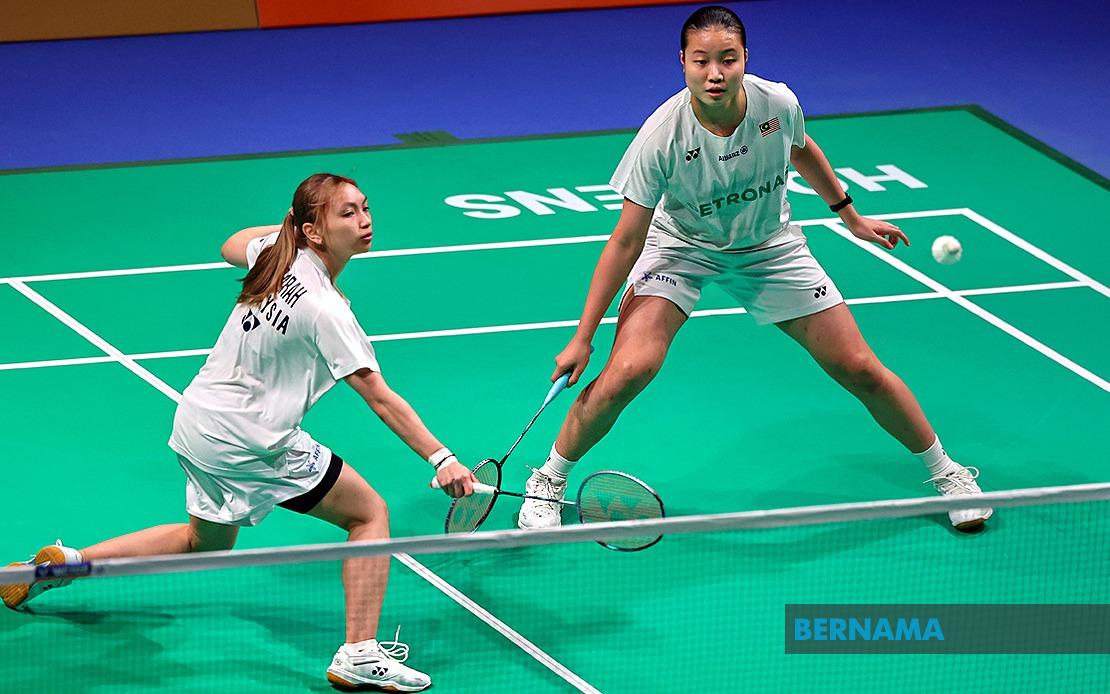
Noraqilah Maisarah Ramdan, the teenage badminton sensation who has captured national attention with her rapid development on the international circuit, has articulated a deliberately cautious strategy alongside partner Low Zi Yu rather than chasing lofty ambitions immediately. The 18-year-old shuttler believes that steady progression, measured through incremental ranking improvements, serves the partnership better than pursuing premature breakthroughs into elite competition. This philosophy reflects a maturity beyond her years and suggests the pair has benefited from seasoned guidance in structuring their career trajectory.
Currently positioned at 70th in the world standings, Noraqilah and Zi Yu have publicly declared that breaking into the top 50 represents their initial objective. This modest-sounding target actually carries substantial significance within the professional badminton landscape, as it establishes a realistic foundation upon which subsequent achievements may be built. The pair recognises that while the elite tier demands extraordinary talent and resources, the intermediate levels remain equally crucial for developing the mental resilience and tactical sophistication necessary for sustained performance at the highest levels.
The distinction Noraqilah draws between the top 50 threshold and the elite top 32 bracket reveals nuanced understanding of how world rankings affect tournament access and career progression. Breaking into the top 32 group opens doors to additional major tournaments and automatic qualification opportunities that remain closed to lower-ranked players. However, rather than fixating on this more prestigious marker, the Malaysian duo acknowledges that consolidating their position in the top 50 first creates a more sustainable pathway, reducing the risk of sudden ranking collapses that can devastate younger athletes' confidence and development momentum.
The partnership has demonstrated tangible improvement in recent months, most notably through their commanding performance against Taiwan's Hsieh Pei Shan-Hung En Tzu at the Australian Open, where they toppled the eighth-ranked pair in a significant upset victory. This achievement transcends mere statistics; it confirms that Noraqilah and Zi Yu possess the technical proficiency and competitive fortitude to compete against world-class opponents rather than simply participating in their matches. For Malaysian badminton observers, such victories carry symbolic weight, representing the national sport's continuing capacity to produce internationally competitive talent.
Noraqilah's reflection on the transformation in her partnership over approximately two months emphasises how recent progress extends beyond single matches to encompass systemic improvement in court positioning, tactical awareness, and ability to maintain competitive intensity against superior-ranked opposition. Previously, encounters against Taiwanese pairs resulted in the Malaysian team being overwhelmed by superior experience and conditioning. The reversal in their most recent meeting suggests that targeted training interventions and increased exposure to international competition have substantially closed the gap. This progression trajectory indicates that achieving the top 50 target may prove realistic within a reasonable timeframe rather than representing a distant aspiration.
For Malaysian badminton stakeholders, the emergence of promising mixed doubles pairs assumes particular importance given the sport's competitive landscape in Southeast Asia. While the country has traditionally dominated men's singles competition, doubles disciplines require different skill sets and offer pathways for younger players to contribute to national representation. Noraqilah and Zi Yu's methodical approach contrasts sharply with the pressure-driven expectations that sometimes burden young Malaysian athletes, suggesting a healthier developmental environment exists within at least segments of the national badminton establishment.
The realistic framing of objectives also addresses a psychological dimension often overlooked in sports analysis. Young athletes who pursue targets incrementally experience more frequent success milestones, which accumulates psychological capital and sustains motivation throughout extended careers. Noraqilah's explicit rejection of "rushing into pursuing big targets" reflects awareness that premature goal-setting misalignment can breed frustration and diminished confidence. This measured mentality may ultimately serve her partnership better than aggressive ranking chases that characterise some young competitors' approaches.
International badminton's competitive stratification means that progression from 70th to 50th place requires consistent tournament results over extended periods rather than isolated brilliant performances. The pair must navigate a calendar crowded with qualifying tournaments while facing opponents possessing similar ranking aspirations. This grinding reality underpins why Noraqilah and Zi Yu's stated approach emphasises gradual improvement rather than dramatic leaps. Their recent Australian Open victory demonstrated capability; now consistency becomes the key variable determining whether top 50 positioning materialises within twelve to eighteen months.
The broader implications for Malaysian badminton extend beyond this single partnership. The national programme's ability to develop multiple competitive pairs across different categories strengthens the country's international standing and provides greater depth when selecting Commonwealth Games and Olympic representatives. If Noraqilah and Zi Yu successfully establish themselves within the top 50, they would join an expanding cohort of Malaysian doubles specialists capable of winning tournaments and accumulating ranking points. This competitive depth ultimately strengthens the entire badminton ecosystem within Malaysia and across the Southeast Asian region.