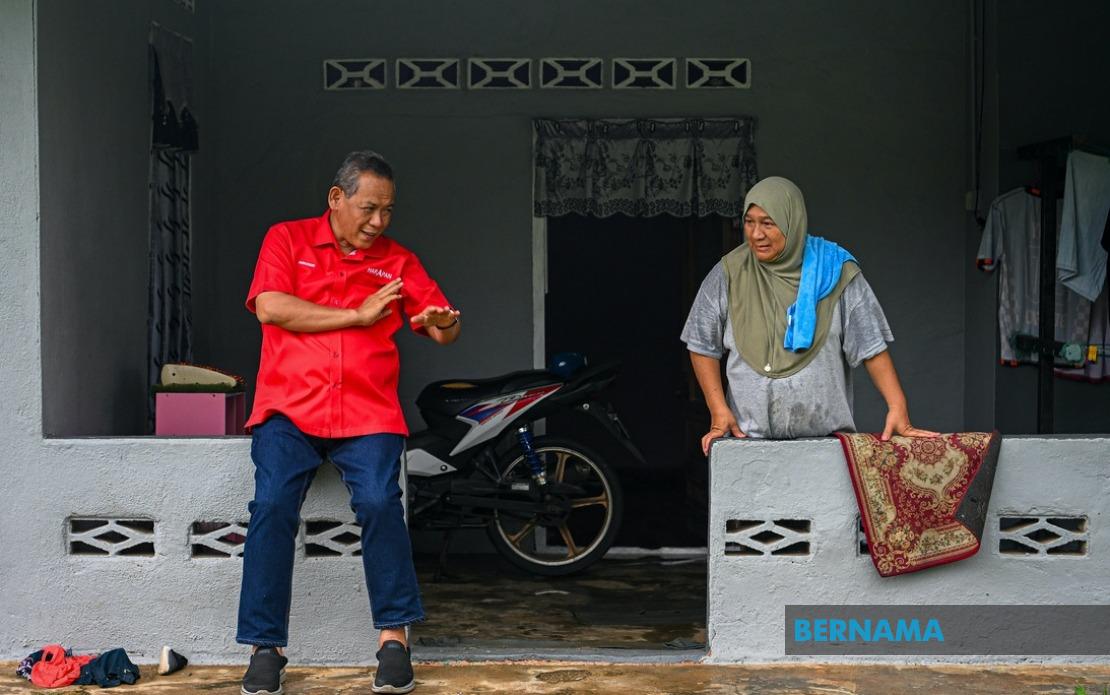
Pakatan Harapan is anchoring its campaign strategy for the Negeri Sembilan state election on the administrative integrity and service-focused governance of Menteri Besar Datuk Seri Aminuddin Harun, betting that his tenure will prove decisive in persuading voters to grant the coalition another five-year mandate. The coalition's emphasis on transparent, accountable administration has gained traction during early campaigning efforts, according to party officials who conducted ground mobilisation over the first week of the campaign period.
Election campaign director Datuk Seri Amirudin Shari, who doubles as Selangor Menteri Besar, characterised the initial voter reception as exceptionally encouraging, citing conversations with party volunteers and community leaders throughout the state. The PKR vice-president underscored that Aminuddin's stewardship spanning nearly two consecutive terms as menteri besar continues to resonate with constituents, offering voters reassurance regarding political continuity and the prospects for sustained economic development in the state.
In substantive terms, Amirudin highlighted that the Pakatan Harapan administration has operated without the encumbrance of major governance scandals, a claim designed to differentiate the coalition from competitors who faced corruption allegations in previous election cycles. The absence of high-profile administrative misconduct allegations or leadership controversies stands as a tangible asset in voter deliberations, particularly in a state where governance quality and institutional integrity factor prominently into electoral calculations. This positioning reflects a deliberate strategic pivot toward integrity-based messaging rather than policy differentiation alone.
Beyond Aminuddin's individual credibility, Amirudin pointed to Pakatan Harapan's organisational machinery at the grassroots level as a structural advantage in defending existing constituencies and potentially expanding the coalition's footprint. The party's capacity to mobilise volunteers, disseminate messaging, and coordinate voter engagement across Negeri Sembilan's 36 state assembly seats represents institutional infrastructure accumulated through years of electoral competition and organisational consolidation in the state.
Amirudin projected confidence that positive grassroots sentiment would materialise into electoral support, despite acknowledging that the response extends beyond the spectacle of public rallies and mass gatherings. Rather, he suggested that substantive feedback filtered through party networks and community interactions provided a more reliable indicator of voter disposition than attendance figures at campaign events. This distinction hints at a disciplined understanding of how sentiment translates to ballots, particularly in an era when traditional campaign metrics may diverge from actual voting intentions.
The coalition also anticipated that Prime Minister Datuk Seri Anwar Ibrahim's leadership and the federal government's policy achievements would amplify Pakatan Harapan's appeal in Negeri Sembilan. Drawing parallels to the party's triumphant performance in Johor's recent state election, Amirudin suggested that voter confidence in Anwar's premiership could provide substantial downstream benefits to state-level candidates running under the coalition banner. The federal-state connection thus constitutes a secondary messaging avenue, one that links Negeri Sembilan voters' state choices to their assessment of national governance.
Pakatan Harapan's campaign manifesto, to be unveiled during the campaign period, was characterised as integrating the coalition's existing policy initiatives with new proposals aimed at consolidating development outcomes and expanding economic opportunities for ordinary residents. Rather than presenting a wholesale policy reorientation, the manifesto appears positioned as an incremental advancement of the coalition's governing agenda, implying continuity in direction whilst promising tangible improvements in service delivery and livelihood conditions.
The electoral landscape in Negeri Sembilan reflects a competitive three-way contest among Pakatan Harapan, Barisan Nasional, and Perikatan Nasional. In the 2023 state election held just over a year ago, Pakatan Harapan secured 17 of 36 state assembly seats, while Barisan Nasional won 14 and Perikatan Nasional captured five seats. This distribution suggests that whilst Pakatan Harapan holds a working majority, the coalition's position remains vulnerable if significant numbers of voters shift allegiance, particularly to Barisan Nasional which governs adjacent Pahang and maintains substantial organisational capacity throughout the region.
The voter participation in this election encompasses 889,490 registered individuals, distributed across 867,151 ordinary voters, military personnel and their dependents designated for early voting, and police officers similarly classified as advance voters. These numbers underscore the state's diverse demographic composition and the administrative complexity of conducting elections that accommodate military and police voting schedules separately from the general population. Early voting was scheduled for July 28, with the main polling day set for August 1, providing a compressed campaign window in which to reach voters and consolidate support.
The Negeri Sembilan State Legislative Assembly was dissolved on June 5, initiating a prescribed campaign period that precedes the August 1 election. This timeline grants campaigns approximately four weeks to mobilise voters, which some observers regard as a moderately short window compared to previous election cycles. For Pakatan Harapan, the compressed period necessitates efficient resource allocation and reliance upon existing organisational networks rather than construction of new campaign infrastructure.
Geopolitically, Negeri Sembilan occupies a central position within Peninsular Malaysia, functioning as a bellwether that often reflects broader regional sentiment toward ruling coalitions. The state's electoral outcome carries implications beyond its immediate borders, potentially influencing assessments of Pakatan Harapan's viability in forthcoming state elections in other regions. A decisive victory would bolster the coalition's confidence heading into elections elsewhere, whilst a weakened performance could embolden opposition forces across the country and prompt questions about the sustainability of Pakatan Harapan's governing mandate nationally.

