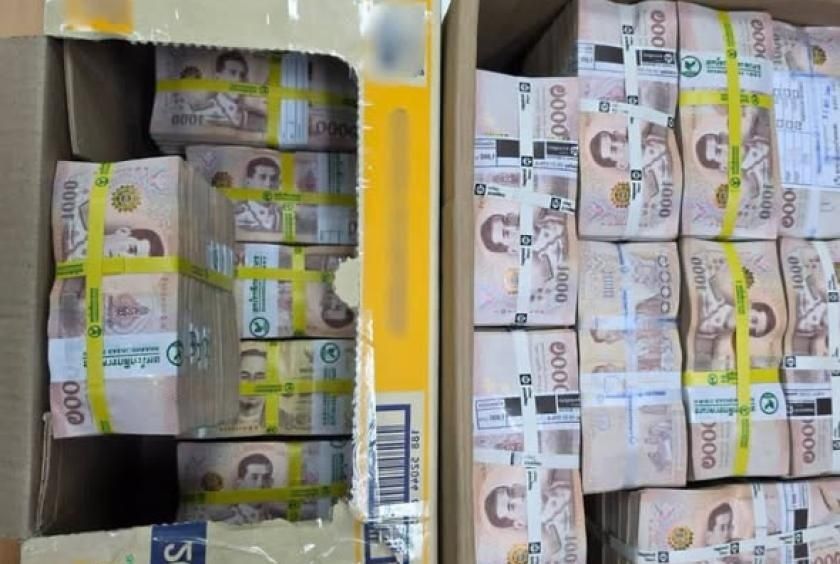
Thai customs officials have arrested a Myanmar national for allegedly attempting to illegally transport more than 23 million baht across the border at Mae Sai, marking another significant currency smuggling case at one of Southeast Asia's busiest cross-border checkpoints. The seizure underscores the persistent challenge of illicit financial flows through the Thailand-Myanmar border corridor, where criminal networks continue to exploit porous crossing points despite enhanced enforcement efforts.
Authorities stopped a vehicle bearing Myanmar licence plates as it entered Thai territory via the Friendship Bridge on the Mae Sai crossing. What began as a routine customs inspection quickly escalated when officers identified suspicious packaging within the vehicle's cargo. Upon closer examination, they discovered carefully concealed bundles of Thai currency hidden inside what appeared to be ordinary food products—specifically cartons labelled as dried fish and potatoes. The methodical placement of cash in plastic bags nestled within these innocent-looking provisions demonstrates the sophistication of smuggling techniques employed across this border region.
The haul totalled 23.023 million baht, equivalent to approximately US$689,077. Officers recovered approximately 17 million baht from the first carton and an additional 6.023 million baht from a second container. All seized currency comprised 1,000-baht banknotes, suggesting a high-value operation rather than opportunistic smuggling. The denomination and packaging method point to organised activity, though authorities have not yet revealed whether the 31-year-old driver was acting as a courier for larger criminal enterprises or operating independently.
The arrested Myanmar driver now faces allegations of currency smuggling under Thailand's Customs Act and foreign exchange control regulations. These offences carry serious penalties in Thailand, where authorities maintain strict oversight of cross-border currency movements. The regulatory framework exists to prevent money laundering, terrorist financing, and other illicit financial activities that destabilise regional economies. By enforcing these controls, Thai authorities aim to maintain transparency in international transactions and prevent the underground economy from functioning unchecked across borders.
The Mae Sai checkpoint sits at a critical juncture in mainland Southeast Asia's trade infrastructure, with legitimate commerce flowing continuously between Thailand and Myanmar. This high volume of traffic creates an environment where contraband can potentially slip through if inspection procedures are inadequate. However, the success of this interception suggests that Thai customs has maintained vigilance despite the enormous logistical challenge of screening thousands of vehicles daily. The discovery illustrates that even sophisticated concealment methods remain vulnerable to thorough inspection protocols.
Currency smuggling along the Thai-Myanmar border reflects deeper economic and financial dynamics within the region. Myanmar's ongoing political instability and economic uncertainty have created conditions where Thai baht holds particular value as a store of wealth across the border. Networks engaged in illegal activities—including drug trafficking and human smuggling—also generate significant cash proceeds that require movement across international lines. By restricting the physical transport of cash, governments attempt to force transactions into formal banking channels where they can be monitored and traced.
The case raises questions about the scope of organised smuggling networks operating in this region. Investigators at Mae Sai Police Station are reportedly examining whether the driver was part of a larger operation with connections to other individuals or organisations. These investigations often reveal intricate supply chains, with drivers serving as low-level operatives within hierarchical criminal structures. Understanding the full network behind this particular smuggling attempt could reveal patterns of cross-border financial crime affecting multiple jurisdictions throughout mainland Southeast Asia.
For Malaysia and other ASEAN nations, this incident carries important implications. Currency smuggling and illicit financial flows represent a genuine transnational threat that affects the entire region's financial integrity and security. Malaysia's own border enforcement agencies face similar challenges with the country's extensive maritime and land borders. Coordinating intelligence and enforcement strategies across ASEAN has become increasingly crucial as criminals adapt their methods and exploit gaps in inter-country cooperation.
The Thai authorities' success in this case demonstrates the value of maintaining robust customs inspection capabilities at major border crossings. However, enforcement experts acknowledge that seizing 23 million baht represents only a fraction of illicit currency movement occurring across the region daily. Many smuggling attempts likely succeed without detection, suggesting the true scale of the problem far exceeds official seizure figures. This gap between detected and undetected contraband highlights why regional cooperation and intelligence sharing have become essential components of border security strategy.
The incident also reflects broader concerns about financial crime in Southeast Asia, where remote border regions and inadequate institutional capacity create vulnerabilities. International organisations including the Financial Action Task Force have long flagged the region as requiring enhanced anti-money laundering efforts. Cases such as this smuggling attempt provide concrete evidence supporting those concerns and justify continued investment in customs training, technology, and inter-agency coordination across the region.

