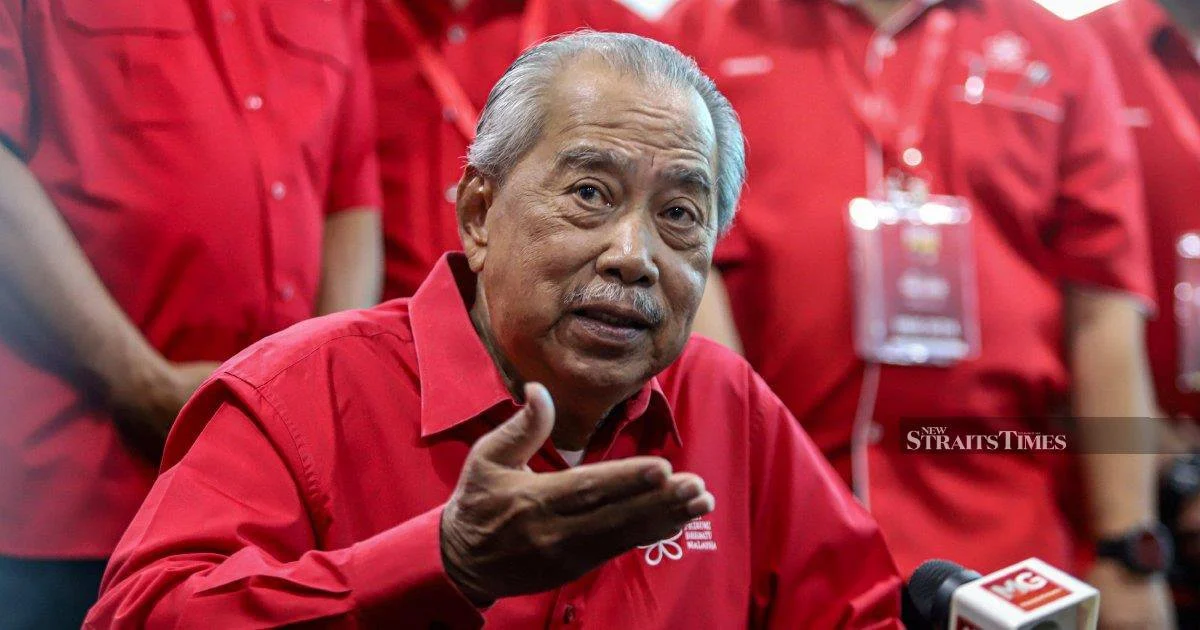
Tan Sri Muhyiddin Yassin has moved to quell persistent rumours about Perikatan Nasional's internal stability by issuing an unequivocal declaration of Bersatu's loyalty to the coalition. Speaking in Kuala Lumpur, the Bersatu party president stated that the party would remain anchored within PN indefinitely, brushing aside conjecture that has periodically surfaced regarding the bloc's cohesion and long-term viability.
The reaffirmation carries weight within Malaysia's fractious opposition landscape, where coalition arrangements frequently face pressure from competing political ambitions and shifting electoral calculations. Bersatu, as one of PN's anchoring members alongside Perikatan parties and other smaller formations, plays a stabilising role in what has become an increasingly important counterweight to the ruling coalition at federal and state levels. Muhyiddin's public commitment seeks to project unity and resolve at a moment when such declarations have become routinely necessary to maintain coalition discipline.
Such pronouncements from PN leadership arrive regularly as the coalition navigates the complex terrain between maintaining internal cohesion and adapting to the demands of federal and state politics. Each time one component party or another signals flexibility regarding its alignment, questions emerge about whether the broader partnership can withstand the centrifugal forces that have historically pulled apart Malaysian opposition fronts. Muhyiddin's statement appears calibrated to address these doubts head-on rather than allowing them to fester.
The Perikatan Nasional formation emerged from the political turbulence of 2020 and has since positioned itself as a significant organised force opposing the federal government. Its capacity to remain intact affects not only the opposition's electoral prospects but also the stability of state governments where its members hold power. Any fracturing would reverberate across Malaysia's political architecture, potentially opening pathways for either the ruling coalition to expand influence or for new regroupings to emerge among opposition parties.
Bersatu itself occupies a particular position within this constellation. The party brings a substantial bloc of parliamentarians and considerable machinery in several states, particularly in East Malaysia, where it controls or influences multiple state administrations. The party's trajectory since its formation reflects the volatility of Malaysian politics, having moved between governing coalitions before settling into its present opposition role. Muhyiddin's longevity as party president and his previous experience as prime minister grant his statements particular resonance within party structures and among party cadres.
The timing of such declarations often proves revealing about underlying anxieties. Speculation about coalition stability typically intensifies when either electoral contests approach, when state politics produces unexpected outcomes, or when senior figures make moves that others interpret as positioning for alternative arrangements. By pre-emptively anchoring expectations, Muhyiddin appears to be establishing parameters for how party members and external observers should interpret future developments or positioning moves.
Within the Malaysian context, opposition coalitions have historically struggled to maintain discipline across multiple election cycles. The experience of Pakatan Harapan, which governed between 2018 and 2020 before fragmenting, demonstrates how quickly structural arrangements can unravel when electoral fortunes shift or personal calculations change. Perikatan Nasional's relative youth as a formal coalition structure means it lacks the institutional sediment that might help weather successive crises. Repeated reassurances of loyalty and commitment therefore serve as important reinforcement mechanisms.
For Malaysian voters and observers assessing the political landscape, such declarations provide signals about coalition stability that influence perceptions of viability. Investors, state governments, and federal institutions alike benefit from clearer expectations about which parties will work together across planning horizons. The opposition's capacity to present itself as a credible alternative requires not merely policy platforms but demonstrated organisational cohesion.
Bersatu's particular circumstances add dimension to the significance of Muhyiddin's statement. The party has pursued ambitious expansion efforts, particularly through recruitment from other formations and through efforts to broaden its organisational footprint. Maintaining its PN anchor provides a framework within which such expansion occurs, distinguishing Bersatu's growth from moves toward independent dominance. The party leadership's emphasis on permanent commitment thus serves to clarify for party members that expansion occurs as part of a larger coalition project rather than as positioning for departure.
The repetition of such commitments across Malaysian politics reflects deeper structural realities about how opposition coalitions must function. Without periodic restatement and reinforcement, the assumption that parties will remain aligned cannot be maintained. Each fresh declaration serves as a checkpoint, allowing the coalition to recalibrate expectations and reaffirm priorities. Muhyiddin's insistence on permanence, while presented as a simple statement of fact, functions as part of the ongoing work required to hold multiparty alliances together in Malaysia's competitive political environment.

