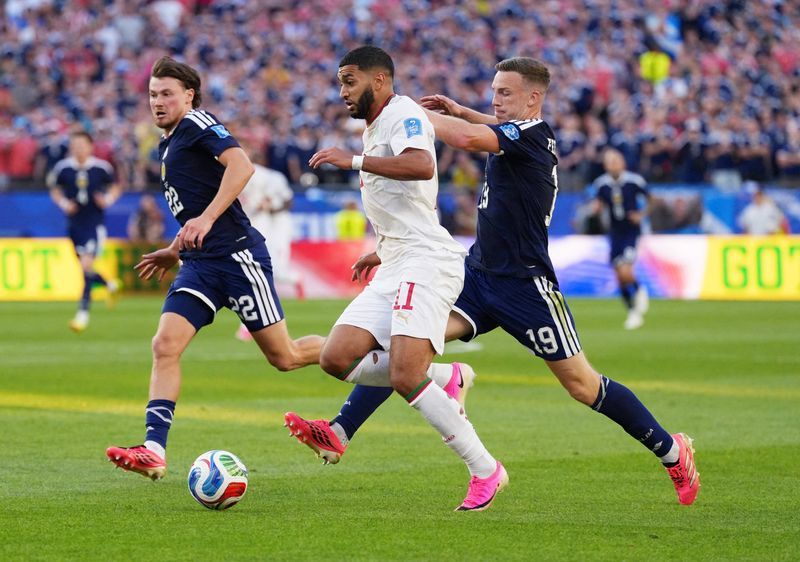
Morocco produced a masterclass in controlled aggression at Foxborough, Massachusetts, on Friday, dismantling Scotland with a 1-0 victory that underscored their credentials as genuine contenders in this World Cup. The decisive moment arrived with remarkable speed—Ismael Saibari pounced on a Brahim Diaz cross just 71 seconds into the match, capitalising on a premature advance by Scottish central defender Grant Hanley to fire past the defence. The early breakthrough would prove decisive, affording Morocco the luxury of controlling the tempo and rhythm throughout an encounter where they held commanding territorial and tactical superiority.
With this victory, Morocco ascended to the summit of Group C with four points from two matches, positioning themselves favourably ahead of their final group assignment against Haiti on Wednesday. The result reinforces the narrative surrounding the North African side, who reached the semi-finals in Qatar four years ago and appear determined to exceed that achievement. Scotland, despite collecting three points from their opening two games—including a historic 1-0 triumph over Haiti that marked their first World Cup victory in 36 years—now find themselves in a precarious position. They must face five-time champions Brazil in their concluding group match, where a failure to secure points could see them eliminated depending on how other results unfold. Brazil and Haiti were scheduled to contest their own fixture later on Friday, adding further complexity to Group C's final standings.
Saibari's moment of brilliance carried additional significance beyond the immediate tactical context. The midfielder, already credited with a goal in Morocco's 1-1 draw against Brazil the previous week, became only the second African player to score in his opening two World Cup appearances, joining Egypt's Mohamed Salah in this exclusive club. Furthermore, Saibari has reportedly undergone a medical examination in relation to a potential transfer to German champions Bayern Munich, suggesting his stock continues to rise among Europe's elite clubs. His composed finish demonstrated the composure and technical quality that has attracted such high-profile attention.
From the outset, Morocco's gameplan centred on domination rather than defensive caution. They suffocated Scotland's attacking ambitions through relentless pressing and possession management, leaving the Scottish side chasing shadows for substantial periods. The Scots struggled to generate any meaningful attacking threat, recording zero shots on target or off target until deep into the first-half stoppage time—a damning statistic that illustrated their complete subjugation in the opening 45 minutes. Morocco's superiority manifested through a series of incisive moves and dangerous situations that repeatedly tested Scotland's defensive resolve.
The Moroccan press continued unabated throughout the second period, with Saibari striking the post following a deflection in a move that could easily have extended their advantage. Bilal El Khannouss posed consistent problems down the flanks and through the middle, forcing goalkeeper Angus Gunn into a sharp save following a glancing header shortly after the interval. Meanwhile, El Khannouss had also fired over the bar during the first half after orchestrating another flowing move that exemplified Morocco's fluid attacking approach. Scotland's defensive backline found themselves constantly retreating, reorganising, and attempting to contain waves of Moroccan pressure without ever appearing to threaten a genuine counterattack of their own.
Scotland's pre-match confidence, bolstered by their unexpected victory against Haiti, evaporated within the opening moments. Ounahi, the Moroccan midfielder who had audaciously declared his team's ambitions to reach the final just 24 hours earlier, demonstrated through concrete performances that such aspirations were not merely fanciful rhetoric. The Scots' inability to construct anything approaching Morocco's rhythm proved costly. One particular opportunity arrived when Ounahi charged down the left flank, cut the ball back into the penalty area, but two Moroccan colleagues inexplicably failed to connect in front of goal—a rare moment of sloppiness from the otherwise clinical North Africans.
The match took place against the backdrop of considerable controversy surrounding Morocco's captain Achraf Hakimi, who faced audible booing from Scottish spectators. Hakimi remains entangled in a rape trial, a serious legal matter that casts a shadow over his participation in the tournament. Such external factors, however, appeared not to distract Morocco's collective focus or intensity during the match itself.
As the encounter progressed toward its conclusion, Scotland belatedly attempted to generate offensive pressure and search for an equalising goal. However, their late push lacked the sustained intensity and organisation necessary to breach Morocco's increasingly well-organised defensive structure. Morocco's management of the closing stages, combined with their energy and discipline throughout, ensured Scotland departed empty-handed—a stark contrast to the optimism that had preceded kickoff following their surprise opening victory.
Morocco's performance suggested they possess the defensive organisation, attacking fluency, and mentality to navigate successfully through a World Cup tournament. Their capacity to dominate possession, control midfield, and capitalise on defensive lapses bodes well for their remaining fixtures. Conversely, Scotland faces the daunting prospect of confronting Brazil, a team with far greater experience and arguably superior individual talent. The Mathematics of Group C will ultimately depend on outcomes elsewhere, but Scotland's failure to extract anything from this encounter has substantially complicated their qualification arithmetic, potentially leaving them dependent on unlikely results in Wednesday's fixtures.

