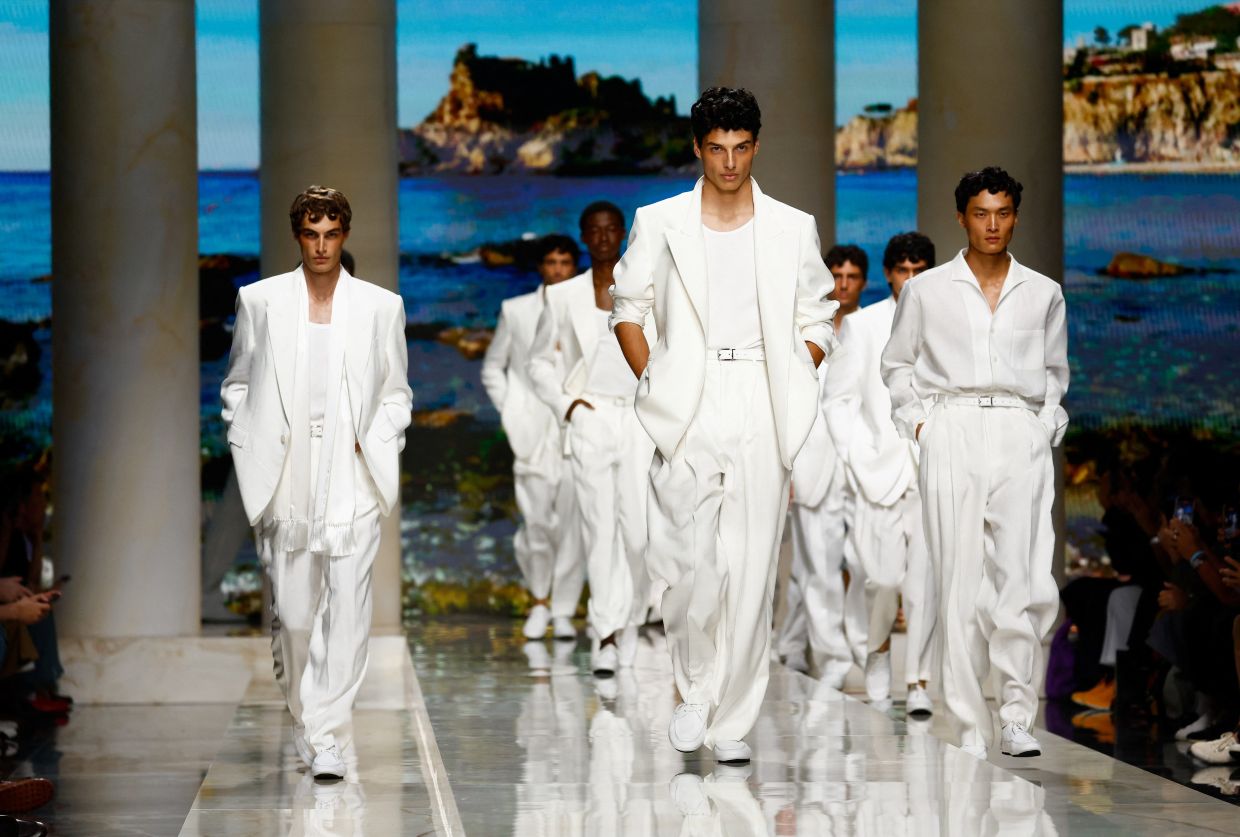
The menswear collections unveiled at Milan Fashion Week revealed a fashion industry grappling with contemporary anxieties through the language of restraint. As economic headwinds and geopolitical volatility swirl across global markets, the designers who command the industry's attention chose to respond not with escapism or theatrical excess, but with a deliberate paring-down of silhouettes and a return to foundational dressing principles. The shift reflects a broader cultural moment where complexity is yielding to clarity, even as the physical challenge of dressing well in warming climates demands creative solutions.
Prada's vision, articulated through the collaborative lens of co-creative directors Miuccia Prada and Raf Simons, set the intellectual tone for the week. Their argument centred on elevating the ordinary through disciplined proportioning and thoughtful material choices rather than radical reinvention. This philosophy of making the familiar feel fresh through subtle manipulation of proportion and fabrication proved influential, resonating with audiences weary of constant novelty and seeking instead a sense of timeless reliability. The approach suggested that luxury in uncertain times manifests not as conspicuous consumption but as intelligent curation and restrained elegance.
Yet the path toward lighter, simpler dressing proved far more complicated than the final aesthetic might suggest. Milan's runways presented a paradoxical collection of Spring/Summer 2027 looks dominated by leather jackets, heavy knits, and substantial layering—materials and constructions that belong more naturally to autumn wardrobes than summer ones. This tension between the designers' conceptual embrace of minimalism and the physical reality of heavy fabrics highlighted a fundamental contradiction in contemporary fashion. The collections appeared designed for men who either inhabit aggressively air-conditioned environments, retreat to mountain resorts during peak heat, or live at higher latitudes where summer temperatures remain manageable. For Malaysian and Southeast Asian readers accustomed to tropical humidity year-round, such collections raise practical questions about adaptation and wearability in genuinely hot climates.
The most unexpected trend emerged from an unlikely source: leather experienced a remarkable persistence throughout the collections, challenging assumptions about what constitutes seasonal dressing. Rather than abandoning the material, designers developed ingenious approaches to make leather breathable and summer-appropriate. Prada's leather combinations drew inspiration from the democratic universality of denim, translating five-pocket jean proportions into cropped jackets that functioned simultaneously as structured shirts paired with slim leather trousers. Other houses experimented with woven and perforated leather techniques, engineering airflow into material traditionally associated with opacity and weight. This approach exemplified how the industry responds to constraints—not by wholesale rejection but through technical innovation and material engineering.
After years during which oversized, deliberately shapeless silhouettes dominated menswear discourse, Milan signalled a decisive return to garments that acknowledge and celebrate the male form. The collective agreement among designers that a well-dressed man still wears a suit proved more significant than it might initially appear, representing a reaffirmation of tailoring's centrality to masculine fashion even as the industry grapples with gender fluidity and changing notions of masculinity. The challenge became not whether to abandon tailoring but how to make formal dressing viable in climates where traditional construction feels oppressive.
The industry's solution emphasised ventilation as a design principle rather than an afterthought. Dress shirts were left unbuttoned, their hems untucked, creating silhouettes that maintained formal pretension while allowing air circulation. Some shirts were rendered transparent through technical innovation, transforming vulnerability into a design statement. In more radical moments, shirts disappeared entirely, forcing a reconsideration of what constitutes formal dressing. Long trousers remained the dominant silhouette across most collections, signalling that menswear's conservative underpinnings remain deeply entrenched, yet the fit shifted markedly toward the body rather than away from it. This represents a subtle but significant recalibration: the suit persists, but it becomes a second skin rather than armor.
Dolce & Gabbana pushed this philosophy to its most confrontational extreme, introducing microshorts that exposed muscular legs and challenging decades of menswear convention that reserves such exposure primarily for beachwear or athletic contexts. Simultaneously, other designers experimented with bare-chested silhouettes and open construction, using negative space and strategic transparency as formal devices. These choices acknowledged that in sweltering conditions, the question becomes not how much to conceal but how to conceal strategically while maintaining sartorial credibility. The underlying argument suggested that formality derives not from fabric coverage but from precision, proportion, and material quality.
Milan's tailoring evolved into lighter, more conversational forms that retained authority without density. Construction was deliberately softened, necklines opened to encourage airflow, and fabrication choices emphasised breathability without sacrificing luxury. Thom Browne, the American designer now operating under Zegna's ownership, made his return to Milan after a sixteen-year absence with layered suiting that drew liberally from seersucker and pleated skirts—materials and silhouettes traditionally coded as summery and accessible rather than formal and exclusive. This signalled how the industry's most respected practitioners were willing to question the hierarchy of menswear fabrics and challenge assumptions about what constitutes luxury dressing in hot weather.
Yet Milan's embrace of restraint proved incomplete and contested. Philipp Plein presented crystal-encrusted denim ensembles representing days of meticulous handwork, while Dolce & Gabbana incorporated elaborate beading that evoked marine imagery and recalled coral formations. These maximalist responses offered a deliberate counterpoint to Prada's reductive philosophy, suggesting that within the industry, fundamentally different visions of luxury coexist. Where one faction saw restraint as the appropriate response to global uncertainty, another insisted that glamour, embellishment, and conspicuous craft represent valid and necessary expressions of fashionable excess. This ideological split may ultimately prove more significant than any single trend or proportion.
The lighter Milan calendar—reflecting both evolving industry economics and practical scheduling pressures—created unexpected opportunities for emerging talent to gain meaningful visibility. Martin Quad made his Milan debut with unorthodox tailoring techniques that had previously attracted attention in Copenhagen, while Domenico Orefice presented richly woven textiles and leather explorations within a co-ed collection framework that acknowledged changing consumer expectations about gender differentiation in fashion. Japanese designer Shinya Kozuka's label made its Milan bow with notably poetic and genuinely summery sensibilities, epitomised by bare-chested models draped in billowing sheer coats rendered in teal, paired with relaxed white trousers. Such collections suggested that emerging voices may offer more practical and culturally responsive solutions to dressing well in genuinely warm climates than the industry's established giants.
For Malaysian readers and Southeast Asian consumers, Milan's Spring/Summer 2027 menswear collections present both inspiration and cautionary lessons. The emphasis on proportion, material quality, and intelligent tailoring offers frameworks applicable to tropical contexts, yet the persistent reliance on leather, structured knits, and heavy layering suggests a fashion system still fundamentally oriented toward temperate climates. The most valuable innovation may be the elevation of ventilation as a conscious design principle and the renewed acceptance that formality need not depend on opacity or weight. As global fashion continues to evolve, the opportunity exists for Southeast Asian designers to develop contextually appropriate interpretations of these principles, creating menswear that addresses the region's specific climatic realities while maintaining the sophistication and luxury messaging that drives contemporary fashion discourse.

