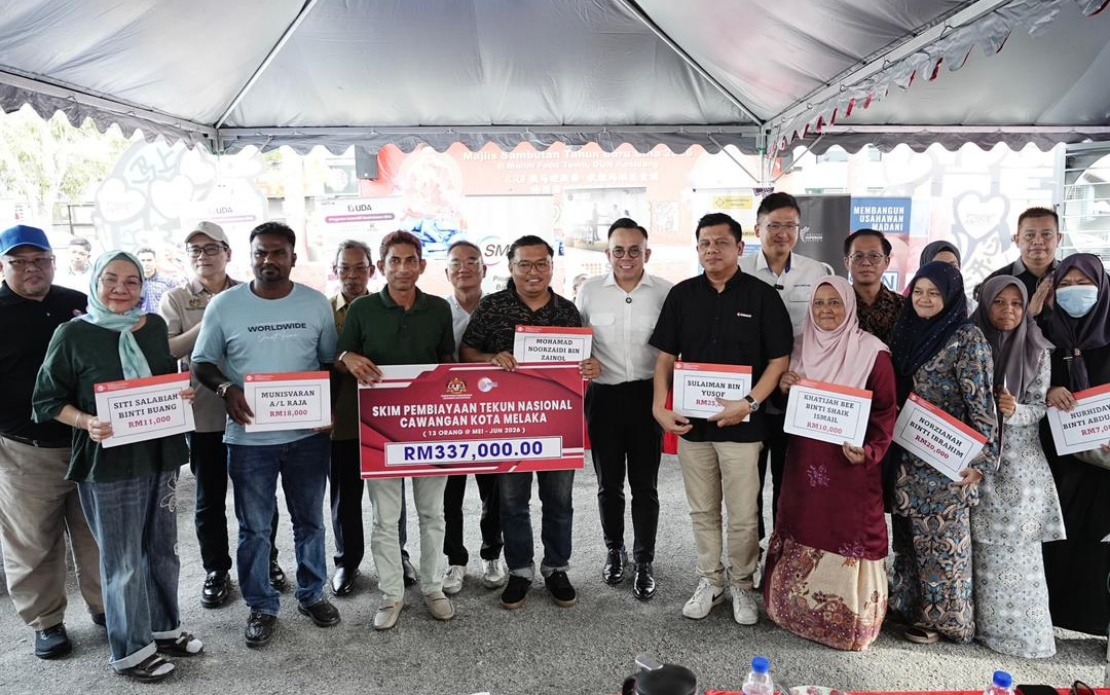
The Ministry of Entrepreneur Development and Cooperatives (KUSKOP) has extended financing support worth nearly RM100 million to over 4,300 entrepreneurs across Melaka as of the end of May, marking significant progress in the ministry's drive to strengthen the small and medium enterprise ecosystem in the state. This substantial capital injection underscores the government's strategic focus on nurturing homegrown businesses at the grassroots level, where MSMEs form the backbone of local economic activity and employment generation.
Minister Steven Sim has framed this financing initiative as more than merely distributing capital; rather, it represents a comprehensive economic strategy designed to create multiplier effects throughout the Malaysian economy. According to Sim, when entrepreneurs receive funding to expand operations, the resulting growth cascades across entire supply chains and communities. Employees hired by growing businesses spend wages locally, suppliers benefit from increased orders, and property owners see greater foot traffic and commercial activity. This systemic perspective aligns with global development thinking that emphasises how targeted small business financing can unlock broader economic transformation, particularly in states like Melaka where tourism and retail sectors intertwine with manufacturing and services.
The capital allocation announced reflects the government's confidence in Melaka's entrepreneurial base and its potential to absorb and productively deploy additional investment. The state has emerged as a significant hub for food and beverage ventures, retail operations, and service-oriented businesses, all sectors represented among recent TEKUN beneficiaries. By concentrating resources in Melaka, KUSKOP is responding to demonstrated demand from local business communities whilst building on existing cluster development in areas such as Malim Food Town, where informal and formal enterprises coexist.
At the national level, the scale of KUSKOP's intervention becomes clearer when contextualised within broader targets. The ministry approved RM5 billion in financing across Malaysia during the first five months of the year, supporting approximately 180,000 entrepreneurs countrywide. This translates to an average disbursement of roughly RM27,800 per entrepreneur, suggesting a focus on early-stage and micro-level enterprises rather than large-scale manufacturing or infrastructure projects. The PowerUp10K initiative aims to channel RM15 billion to MSMEs nationwide throughout 2024, indicating the ministry's commitment to scaling up access to affordable capital that remains a persistent challenge for entrepreneurs outside major urban centres.
Minister Sim's three-day working visit to Melaka, conducted in conjunction with the Hebatkan Perniagaan Malaysia Carnival (KHPM), served dual purposes: demonstrating political commitment to entrepreneurial development while gathering on-ground intelligence about implementation challenges. The mega meet and greet session at Malim Food Town, which engaged approximately 50 local entrepreneurs, provided an opportunity for direct dialogue between government and business communities. Such forums prove valuable for identifying bottlenecks in financing accessibility, understanding sectoral challenges, and building political constituencies supportive of continued MSME funding.
During his Melaka engagement, Sim personally facilitated the distribution of nearly RM1 million in financing to 18 entrepreneurs through TEKUN Nasional and SME Corp Malaysia, demonstrating institutional coordination between agencies. The diversity of sectors represented among these recipients—spanning food and beverages, wholesale trade, professional services, construction contracting, retail, e-commerce, automotive maintenance, and miscellaneous services—reflects both the breadth of entrepreneurial activity in Melaka and the government's sector-agnostic approach to financing. This diversification across industries reduces concentration risk and ensures that financing reaches entrepreneurs aligned with genuine market demand rather than predetermined sectoral preferences.
The emphasis on walkabouts and direct engagement at Malim Food Town signals a policy approach grounded in observable reality rather than abstract planning. By observing traders' operations, examining customer behaviour, and conversing with business operators, Sim gathered contextual understanding that informs policy refinement. Such grassroots exposure often reveals implementation gaps—instances where formal policies falter in practice—and generates feedback loops that improve programme design. For Malaysian policymakers increasingly attentive to MSME concerns, this ground-truth gathering complements statistical reporting and formal evaluations.
Sim's comments regarding Malaysia's demographic diversity and cultural pluralism as economic assets merit particular attention for Southeast Asian readers. He articulated a thesis that multicultural societies possess competitive advantages in global business environments by combining diverse talent pools, enabling companies to serve varied domestic markets more effectively, and making the nation attractive to multinational investors seeking cultural sophistication and market access. This framing addresses concerns among some Malaysian stakeholders about competitive positioning relative to regional peers like Singapore, Thailand, and Vietnam by reframing cultural diversity as an economic strength rather than a governance liability. For investors evaluating regional locations, such messaging attempts to position Malaysia as uniquely positioned for inclusive growth models that expand rather than concentrate economic opportunities.
The financing reaching Melaka entrepreneurs must be examined within historical context of regional development disparities. Melaka has experienced less rapid urbanisation and industrialisation than Selangor, Kuala Lumpur, or Penang, and consequently contains substantial untapped entrepreneurial potential. By directing near-RM100 million specifically to this state, KUSKOP acknowledges regional economic inequities and attempts corrective targeting. Whether this represents sufficient resource allocation relative to Melaka's population and entrepreneurial density compared with other states remains a question for further analysis, but the targeted engagement suggests policy sophistication in recognising that one-size-fits-all financing approaches risk deepening regional disparities.
The sustainability of this financing expansion depends critically on borrower success rates and repayment performance. Government-backed financing programmes sometimes face challenges with loan defaults if underlying business models prove unviable or if entrepreneurs lack sufficient business acumen to deploy capital effectively. Complementary non-financial support—training in financial management, business planning, market research, and digital skills—often determines whether financing access translates into lasting enterprise growth. KUSKOP's effectiveness ultimately hinges on whether its financing reaches entrepreneurs capable of generating sufficient returns to repay loans while expanding employment and output, or whether it becomes a subsidy programme masquerading as development finance.
For Malaysian entrepreneurs and business communities, the expansion of KUSKOP financing represents tangible opportunity, particularly for those previously unable to secure conventional bank credit due to collateral insufficiency, informal accounting systems, or perceived risk profiles. Access to government-backed financing at reasonable interest rates removes critical barriers to business expansion, equipment purchase, and working capital accumulation. Melaka entrepreneurs' demonstrated ability to absorb nearly RM100 million suggests healthy demand for capital, and the variety of sectors benefiting indicates that financing reaches across the economic spectrum rather than concentrating in politically favoured industries.

