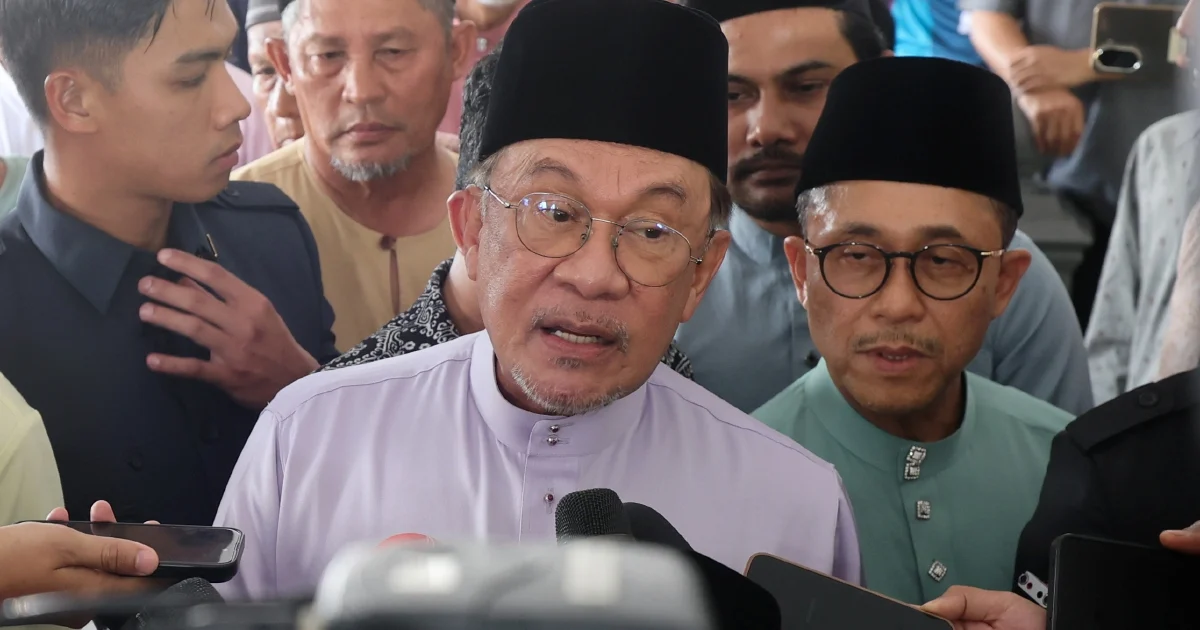
Prime Minister Datuk Seri Anwar Ibrahim moved to quell concerns among non-Muslim communities in Malaysia on Wednesday, asserting that the government's intention to bolster the institutional framework of Syariah courts will operate independently of protections afforded to religious minorities. Speaking at a cabinet session in Putrajaya, the Prime Minister emphasised the dual legal structure underpinning Malaysian governance, wherein Islamic and civil law systems function as parallel mechanisms tailored to their respective constituencies.
Anwar's statement arrives amid ongoing discourse regarding the constitutional position and jurisdictional scope of religious courts in the federation. Malaysia's plural legal architecture has long been a defining feature of its multiconfessional society, with the federal constitution explicitly demarcating the boundaries between Islamic jurisprudence and secular law. The Syariah courts, which operate in all 13 states and federal territories, maintain exclusive jurisdiction over matrimonial disputes, inheritance, and personal matters affecting Muslims, whilst civil courts retain authority over non-Muslims and secular criminal and commercial matters.
The Prime Minister's clarification underscores a critical juncture in Malaysia's ongoing dialogue about constitutional interpretation and the proper balance between religious autonomy and secular governance. His reassurance reflects broader sensitivities within Malaysian society, where any perceived expansion of Islamic institutional power can generate apprehension among the non-Muslim majority, despite constitutional safeguards. This anxiety is not merely abstract; it reflects historical episodes where incremental jurisdictional shifts have prompted organised advocacy and parliamentary scrutiny.
Malaysia's constitutional framework, entrenched since independence in 1957, has invested authority over Islam in individual state sultans and the Dewan Rakyat for federal territories. This fragmented arrangement, combined with disparities in how different states administer Syariah law, has created perennial tensions between uniformity and pluralism. Some states have periodically pursued amendments to expand Syariah courts' purview or impose greater penalties, prompting counter-mobilisation among civil society organisations concerned with constitutional democracy and individual liberty.
The government's commitment to institutional enhancement of Syariah courts likely encompasses infrastructure development, judicial capacity-building, and administrative efficiency rather than substantive jurisdictional expansion. Such modernisation efforts reflect legitimate governance objectives and international standards for independent judiciaries. Nevertheless, distinguishing reform from retrenchment of minority rights requires transparency regarding legislative intent and implementation parameters.
For non-Muslim citizens—comprising roughly 40 percent of Malaysia's population—the constitutional guarantee of religious freedom, enshrined in Article 11 of the Federal Constitution, remains paramount. This provision permits individuals to profess, practise, and propagate religion within customary legal boundaries, though subject to public order and morality provisos. Anwar's reassurance implicitly reaffirms this constitutional commitment, signalling that government initiatives shall not circumvent judicial precedent or fundamental rights protections.
The regional context amplifies significance of Malaysia's approach to religious pluralism. Neighbouring nations have witnessed erosion of minority protections through gradualist constitutional amendments and institutional capture, transforming previously mixed legal systems into predominantly Islamic frameworks. Malaysia's maintenance of dual jurisdictional equilibrium stands as a notable exception within Muslim-majority Southeast Asia, though continuous vigilance remains necessary.
Civil society organisations representing Christian, Buddhist, Hindu, and non-religious Malaysians have historically maintained coordinated advocacy on constitutional matters. Their engagement reflects not hostility toward Islam or Islamic institutions, but rather defence of constitutional provisions securing their own communities' welfare and autonomy. Constructive dialogue between government and these constituencies strengthens democratic accountability and social cohesion.
Implementation mechanisms will ultimately determine whether Anwar's assurance translates into sustained practice. Departmental circulars, judicial training protocols, and parliamentary oversight mechanisms must embed protections for non-Muslims into operational procedures. Moreover, accountability mechanisms should permit redress when institutional boundaries are transgressed, reinforcing rule of law principles applicable across both legal systems.
Moving forward, the government would benefit from establishing permanent institutional forums for interfaith consultation regarding court system reforms, particularly those potentially affecting jurisdictional demarcations. Such mechanisms would enhance transparency, facilitate early identification of concerns, and demonstrate government commitment to inclusive governance beyond rhetorical assurances. Regular public reporting on Syariah court operations, resource allocation, and caseload statistics would further substantiate claims that reforms serve administrative improvement rather than jurisdictional expansion.
Anwar's statement represents necessary political communication in a religiously plural democracy. However, constitutional protection of minorities ultimately rests upon institutional design, judicial independence, and sustained political will across multiple administrations. Malaysia's experience demonstrates that formal rights require continuous defence through vigilant engagement with constitutional principles and democratic processes.

