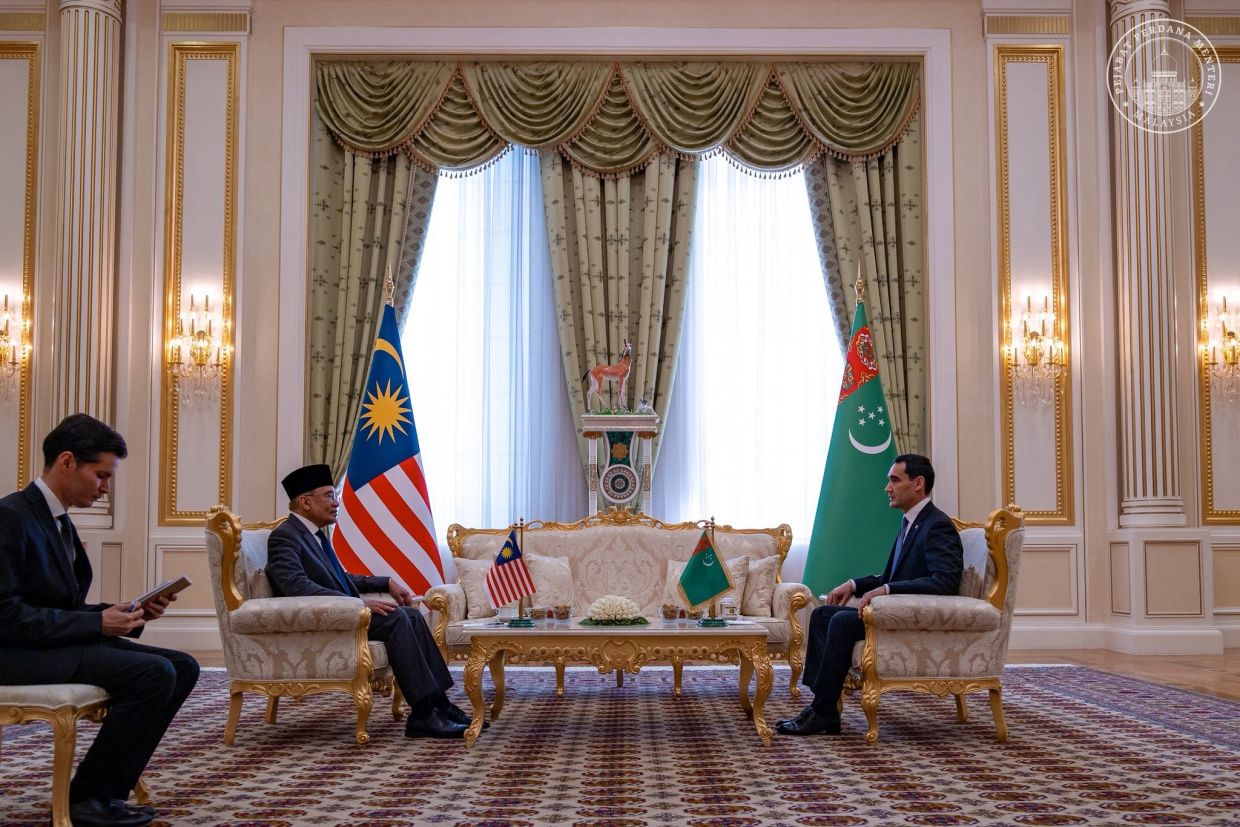
Prime Minister Datuk Seri Anwar Ibrahim stood alongside Turkmenistan President Serdar Berdimuhamedov in Ashgabat today to witness the formal signing of a strategic partnership between Malaysia's national oil and gas company Petronas and Turkmenistan's energy authorities. The agreement represents a watershed moment in bilateral relations, building on three decades of sustained cooperation in the energy sector that has anchored Malaysia-Turkmenistan ties since the mid-1990s.
According to a statement from the Prime Minister's Office, the partnership extends well beyond conventional business arrangements, framing the engagement as a comprehensive framework for economic growth and technological advancement benefiting both nations. The agreement underscores Malaysia's commitment to deepening involvement across Turkmenistan's energy infrastructure, particularly in capitalising on the country's vast natural gas reserves, which rank among the world's largest and represent largely untapped development potential.
Turkmenistan's energy sector has long attracted international investment, but the formalisation of this partnership with Petronas signals confidence in Malaysian expertise and operational capabilities at the global level. The Malaysian government emphasised that the arrangement reflects international recognition of the country's technical prowess and competitive advantages in upstream energy exploration and development, attributes that position Malaysia as a credible partner for nations with substantial hydrocarbon resources.
The strategic value of this engagement extends beyond immediate commercial benefits. For Malaysia, the partnership demonstrates the viability of exporting energy sector knowledge and technology to Central Asia, a region increasingly important to global energy security. This positions Malaysian companies as viable alternatives to traditional Western operators and other Asian competitors in the region, potentially opening pathways for additional ventures across Central Asia's resource-rich economies.
Trade data reveals the growing economic relationship between the two countries. In 2025, Turkmenistan ranked as Malaysia's fourth-largest trading partner among Central Asian nations, with bilateral trade reaching RM75.80 million. Malaysian exports dominated the exchange, valued at RM75.50 million and representing a robust 9.0 per cent year-on-year increase. These figures, while modest in absolute terms, reflect the steady expansion of commercial ties and Malaysia's capacity to supply specialised goods and services to the Central Asian market.
Petronas's historical commitment to Turkmenistan provides essential context for understanding the significance of this new partnership. The company has maintained substantial operations in the country since 1996, with cumulative investments totalling RM52.73 billion. This three-decade presence demonstrates Petronas's confidence in the market and its ability to navigate the operational complexities of energy development in Turkmenistan, positioning the company uniquely among Malaysian enterprises to lead expansion efforts.
The timing of this partnership aligns with broader Malaysian foreign policy objectives under the MADANI government framework, which emphasises strategic economic cooperation and investment diversification. By formalising the Petronas-Turkmenistan arrangement during a high-level visit, the government signals its commitment to expanding Malaysia's footprint in high-value sectors across emerging markets. This approach complements Malaysia's existing engagements in the Middle East and Africa while establishing deeper roots in Central Asia.
For Southeast Asian observers, the partnership offers insights into how regional energy champions can leverage technological and operational expertise to compete globally. Malaysia's experience managing complex upstream operations in geologically challenging environments positions it as a knowledge-provider for countries seeking to optimise hydrocarbon development. This consultancy dimension of the relationship may prove as valuable as direct investment, generating sustained income streams through technical services and capacity-building initiatives.
The agreement's emphasis on knowledge transfer and talent development reflects contemporary expectations in energy partnerships. Rather than extractive arrangements benefiting only foreign investors, the partnership incorporates provisions for developing Turkmenistan's human capital in energy sector roles. This approach aligns with international best practices and potentially enhances Malaysia's reputation as a responsible investor, qualities increasingly valued in Central Asia where geopolitical sensitivities run high.
Turkmenistan's vast natural gas reserves, among the world's largest but historically constrained by limited export infrastructure and geopolitical isolation, represent long-term development opportunities for partners like Petronas. The strategic partnership may facilitate discussions on pipeline development, liquefied natural gas facilities, or other infrastructure that could unlock greater gas export capacity. Such projects would benefit Malaysian companies through both primary construction contracts and long-term operational roles.
Regionally, this partnership reinforces Malaysia's positioning as a bridge between Southeast Asia and Central Asia. While many Southeast Asian nations maintain limited presence in Central Asian energy markets, Malaysia's Petronas operations provide a template for successful long-term engagement. Other regional companies may reference this arrangement when evaluating Central Asian opportunities, potentially increasing Malaysia's influence as a development model.
The bilateral economic relationship shows potential for expansion beyond energy. Malaysia's demonstrated capacity to conduct complex business in Turkmenistan could extend to finance, manufacturing, and technology sectors. The partnership's success will likely influence official attitudes toward Malaysian investors seeking entry into other Turkmenistan economic zones, multiplying the agreement's strategic value beyond immediate energy sector gains.
Looking forward, the agreement positions both nations to benefit from anticipated shifts in global energy markets. As energy security concerns intensify worldwide and traditional suppliers face geopolitical constraints, Turkmenistan's reserves become increasingly strategically valuable. Petronas's partnership ensures Malaysia maintains privileged access to these resources while cementing its status as a trusted energy sector operator capable of functioning effectively in diverse geopolitical environments.

