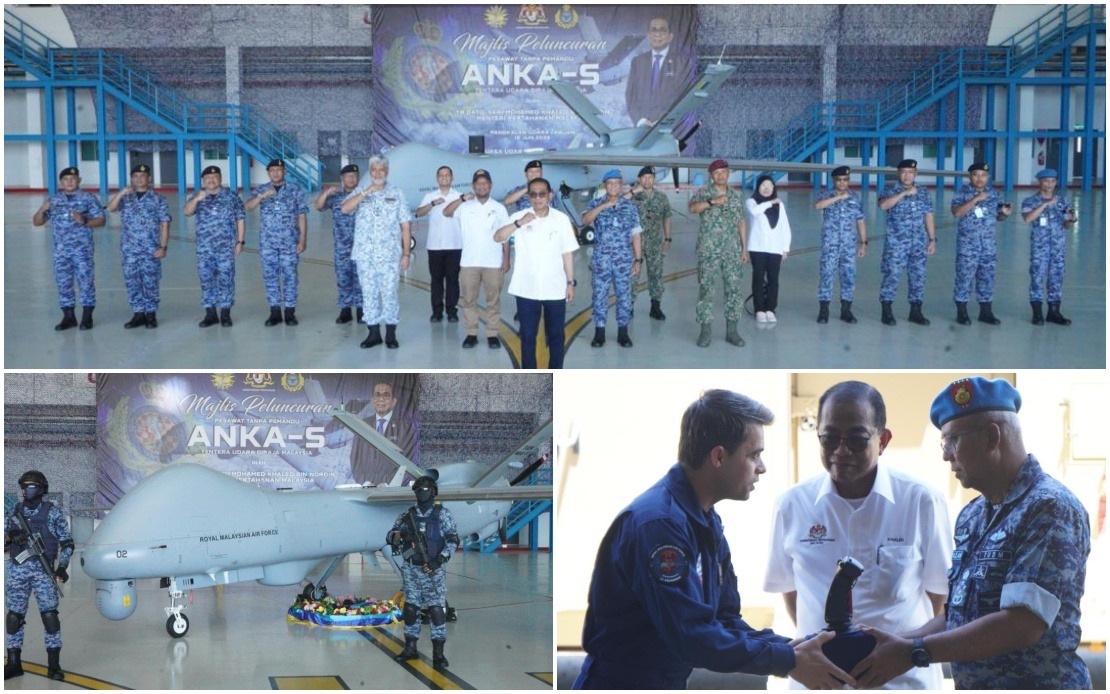
Malaysia has taken a decisive step forward in modernising its defence infrastructure with the operational deployment of the Royal Malaysian Air Force's ANKA-S Unmanned Aircraft System, which Defence Minister Datuk Seri Mohamed Khaled Nordin unveiled at RMAF Labuan Air Base on June 16. The launch represents a watershed moment for the country's ability to monitor and protect its maritime interests, particularly across the strategically vital South China Sea where competing territorial claims and increased maritime activity have long posed surveillance challenges.
The acquisition of three ANKA-S Medium Altitude Long Endurance aircraft, procured at a cost of RM423.8 million including ground control stations and two years of specialist personnel training, addresses a longstanding capability gap in Malaysia's maritime security architecture. These drones are engineered to operate continuously for periods exceeding 24 hours at altitudes reaching 30,000 feet, enabling the RMAF to maintain persistent surveillance over vast ocean expanses that would otherwise require costly and resource-intensive patrols using manned aircraft or naval vessels. The deployment at Labuan positions this capability strategically near Malaysia's primary maritime zones of concern.
For Malaysian defence officials, the ANKA-S system unlocks operational advantages that were previously unavailable. The aircraft's capacity to accurately identify and track vessel movements allows the RMAF to allocate resources far more strategically, directing assets specifically toward detected intrusions rather than conducting broad, unfocused patrols that consume fuel and personnel without productive results. This intelligence-driven approach to maritime security represents a shift toward more cost-effective and efficient operational planning. The ability to conduct surveillance under varying weather conditions and maintain positions difficult to detect adds another tactical dimension to Malaysia's maritime oversight.
The economic efficiency argument underlies much of the government's rationale for the investment. Maintaining constant maritime surveillance through conventional means—whether fighter aircraft or large patrol vessels—incurs substantially higher operational expenses. By deploying unmanned platforms for intelligence, surveillance and reconnaissance missions, Malaysia can drastically reduce the burden on its fleet while maintaining the vigilance necessary to protect national waters and economic interests. This cost-benefit calculation has become increasingly relevant as Southeast Asian nations grapple with expanding defence budgets and fiscal constraints.
Mohamed Khaled's explicit emphasis on the ANKA-S remaining unarmed carries considerable diplomatic significance. By deliberately choosing not to equip these aircraft with weapons systems despite their technical capability to carry ordnance, Malaysia projects a carefully calibrated message to regional powers and international observers. This decision signals that the country's defence modernisation is fundamentally protective rather than provocative in character, a positioning that matters considerably in a region already characterised by territorial sensitivities and great power competition. The stance reflects Malaysia's longstanding preference for defensive security strategies and its effort to avoid escalating regional tensions even as it strengthens its monitoring capabilities.
The South China Sea context makes this surveillance capability particularly significant for Malaysian interests. As a coastal nation bordering this heavily trafficked waterway where multiple countries assert overlapping claims, Malaysia faces constant pressure to demonstrate effective sovereignty over its maritime zones. The ANKA-S system provides concrete technological backing to those assertions, offering the means to detect, track and document activities in Malaysian waters with precision previously unattainable. For a country seeking to balance its regional relationships while protecting its interests, such surveillance capacity provides crucial leverage in maritime negotiations and disputes.
The government's indication that it is considering acquiring three additional ANKA-S aircraft under a second procurement phase suggests confidence in the initial deployment's effectiveness and a commitment to expanding this capability. Should such an expansion proceed through Malaysia's national development planning framework, the country would operate a fleet of six medium-altitude long-endurance drones—a substantial aerial surveillance infrastructure by Southeast Asian standards. This expansion would enable more comprehensive coverage across multiple maritime zones simultaneously, reducing response times to detected activities and enhancing overall maritime domain awareness.
The high-level attendance at the Labuan launch, including the Chief of Navy, Chief of Air Force, and Joint Forces Commander, reflected the significance this capability holds across Malaysia's defence establishment. These military leaders recognise that modern maritime security increasingly depends on technological sophistication and persistent surveillance rather than on traditional ship-and-aircraft patrols alone. The ANKA-S represents the kind of modern, networked capability that contemporary defence strategies increasingly demand, particularly for nations protecting vast maritime zones with relatively limited resources.
For broader Southeast Asian security dynamics, Malaysia's move to operationalise advanced surveillance drones carries implications beyond national borders. The region has witnessed gradual technological advancement across defence forces, with multiple nations acquiring unmanned systems and advanced monitoring capabilities. Malaysia's step-by-step approach—beginning with three aircraft, demonstrating capability, and planning expansion—provides a model that emphasises measured military modernisation without appearing destabilising. This incremental approach may prove reassuring to neighbours concerned about regional arms races while still allowing Malaysia to close critical surveillance gaps.
The operational deployment also reflects Malaysia's integration into broader defence modernisation trends across Asia-Pacific. Nations throughout the region increasingly recognise that unmanned aerial systems offer cost-effective solutions to maritime surveillance challenges, enabling persistent monitoring without the operational burden and expense of continuous manned patrols. By joining this trend, Malaysia positions itself within contemporary defence thinking while remaining focused on its specific geographical and strategic requirements. The emphasis on training personnel for two years alongside the aircraft acquisition demonstrates Malaysia's commitment to building genuine operational expertise rather than simply acquiring technology.
The Data Exploitation Centre that Mohamed Khaled visited represents another crucial component of the ANKA-S system's value. Raw surveillance data becomes operationally useful only when properly analysed and interpreted, requiring skilled intelligence professionals and sophisticated analysis facilities. Malaysia's development of this analytical infrastructure alongside the unmanned aircraft reflects understanding that modern maritime surveillance is fundamentally an intelligence operation requiring both collection and interpretation capabilities. This integrated approach to capability development distinguishes professional modernisation from mere equipment acquisition.
Looking forward, the ANKA-S system's operationalisation establishes a foundation for Malaysia's maritime security posture that will likely evolve over coming years. As the system accumulates operational experience and proves its worth in monitoring Malaysia's contested waters, it will almost certainly inform future procurement decisions and strategic planning. The technology also opens possibilities for regional cooperation, should Malaysia eventually coordinate surveillance efforts with other Southeast Asian nations facing similar maritime challenges. For now, however, the primary significance lies in Malaysia's demonstrable commitment to using modern technology to protect its interests in one of the world's most strategically important maritime zones.