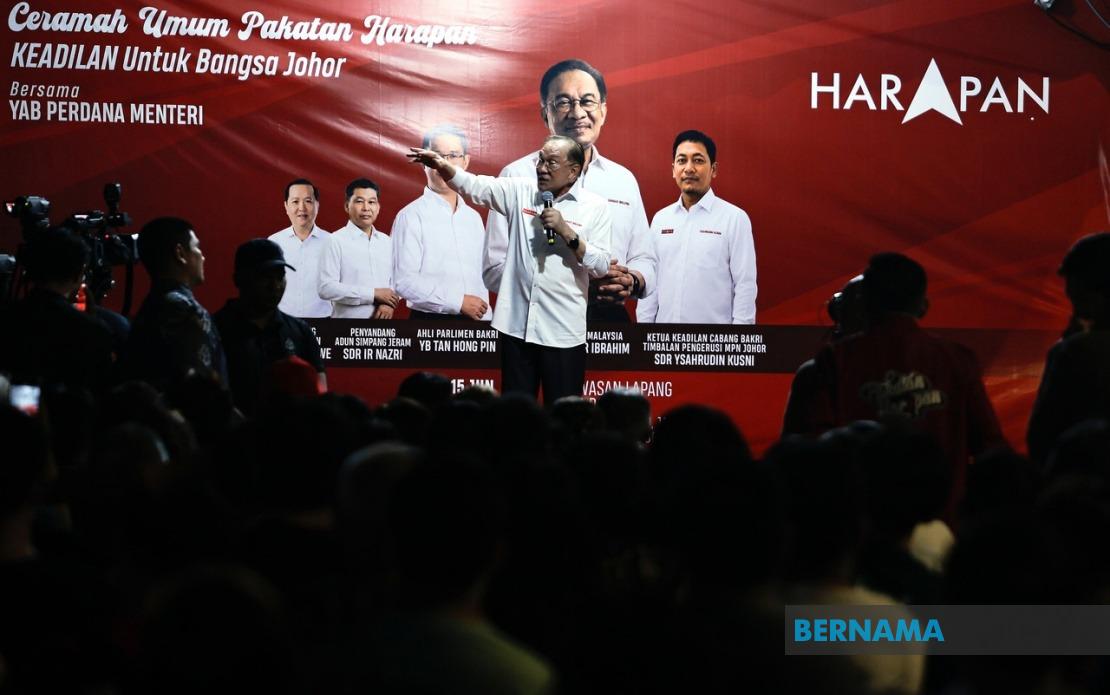
Prime Minister Datuk Seri Anwar Ibrahim has issued a pointed call for Malaysian political leaders and society to redirect their energies toward positioning the country as a technological powerhouse, rather than becoming mired in perpetual political conflict and communal tensions. Speaking at a Pakatan Harapan rally in Muar on June 15, the Prime Minister articulated a vision centred on leveraging artificial intelligence, data centre infrastructure, and quantum computing as the cornerstones of Malaysia's future economic strategy, drawing on insights from his recent visit to Japan where such technologies were explored.
Anwar's remarks underscore a growing frustration within government circles about what he characterises as counterproductive political behaviour that detracts from urgent developmental priorities. The Prime Minister framed the choice starkly: continued domestic bickering over cultural and religious issues serves no constructive purpose when the nation faces intensifying global competition in emerging technologies. His invocation of generational responsibility—emphasising that Malaysia's children will inherit a world shaped by AI and quantum advancement—positions technological investment as a moral imperative rather than merely an economic preference.
The government's existing initiatives to attract foreign direct investment in AI and data centres represent a concrete manifestation of this strategic pivot. These infrastructure projects carry significant implications for Malaysia's positioning within the regional digital economy, potentially establishing the country as a Southeast Asian hub for technology development and attracting multinational corporations seeking regional headquarters or research facilities. Such investments would create high-value employment opportunities and technology transfer pathways that could elevate Malaysian expertise in cutting-edge fields currently dominated by Singapore, South Korea, and Japan.
Anwar's appeal for cross-communal cooperation assumes particular relevance in Malaysia's complex political landscape, where appeals to communal interests remain potent electoral tools. His explicit rejection of what he terms endless bickering over ethnicity and religion represents a departure from conventional Malaysian political messaging, which often leverages such divisions to mobilise voter blocs. By framing technological advancement as a unifying national project transcending such divisions, the Prime Minister seeks to reorient political discourse toward outcomes-based governance focused on economic performance and quality of life improvements.
The presence of PKR Vice-President Datuk Seri Dr. Zaliha Mustafa and Johor Pakatan Harapan Chairman Aminolhuda Hassan at the Muar rally signals organisational alignment behind this message, though implementation across the coalition's diverse membership may prove challenging. Political parties within the Pakatan Harapan coalition maintain distinct electoral constituencies and sometimes divergent policy priorities, making unified messaging on deprioritising communal rhetoric susceptible to fracture during competitive electoral periods.
Anwar's observation that international investors are increasingly viewing Malaysia as an attractive destination without extensive government promotion campaigns carries implications for how the administration markets itself to foreign audiences. The statement suggests confidence in Malaysia's inherent competitive advantages, yet simultaneously highlights the paradox that domestic political instability and divisive rhetoric could undermine investor confidence. Foreign investment decisions, particularly in technology sectors requiring long-term commitment and intellectual property protection, depend partly on perceptions of political stability and predictable governance environments.
The Prime Minister's exhortation to political leaders to exercise restraint in exploiting sentiments of hatred represents a normative call that acknowledges the prevalence of such practices within Malaysian politics. This tacit admission that manipulation of communal sentiments remains widespread suggests that reversing such patterns requires sustained leadership intervention rather than organic shifts in political culture. The challenge lies in translating rhetorical appeals into systemic changes within political party structures and campaign strategies.
Quantum computing specifically represents a frontier technology with profound implications for global competitiveness across multiple sectors—from pharmaceuticals and materials science to financial modelling and cybersecurity. Malaysia's exploration of this field during high-level diplomatic visits indicates awareness of its transformative potential, though translating interest into meaningful research capabilities and commercial applications requires sustained investment in human capital development, research institutions, and industry partnerships. Southeast Asian countries generally lag behind global leaders in quantum research, creating both catch-up challenges and opportunities for leapfrogging through strategic partnerships.
The Muar rally itself represents a political event designed to mobilise Johor support for the Pakatan Harapan coalition ahead of future electoral contests. Against this backdrop, Anwar's emphasis on unity and forward-looking governance can be understood both as genuine strategic conviction and as a political narrative designed to appeal to voters fatigued by divisive rhetoric. The effectiveness of this messaging depends significantly on whether government policies and resource allocation demonstrably prioritise technological development and whether political actors across the coalition consistently reinforce rather than contradict this messaging.
For Malaysia's technology ambitions to materialise successfully, alignment must extend beyond political rhetoric to encompassing educational curriculum reform, research institution funding, regulatory frameworks facilitating innovation, and sustained attraction of international talent. Singapore's success as a regional technology hub reflects decades of coordinated policy effort across multiple domains, not merely aspirational speeches. Malaysia possesses demographic advantages, geographic positioning, and growing digital infrastructure that could support comparable development trajectories, provided political divisions do not prevent the concentrated focus required.
The international context adds urgency to Anwar's message. Competition for technology sector dominance intensifies globally, with established players in North America, Europe, and East Asia already commanding substantial resources and expertise advantages. Emerging technologies create windows of opportunity for nations to establish competitive positions before technological standards crystallise and market leaders consolidate power. Malaysia's participation in this competition requires exactly the kind of unified national commitment that Anwar articulates, suggesting that his rhetoric, while politically motivated, reflects legitimate strategic imperatives for national development.
%22%2F%3E%3C%2Fpattern%3E%3C%2Fdefs%3E%3Crect%20width%3D%22100%25%22%20height%3D%22100%25%22%20fill%3D%22url(%23ph5xlmyg)%22%2F%3E%3Crect%20width%3D%22100%25%22%20height%3D%22100%25%22%20fill%3D%22url(%23ph5xlmyp)%22%2F%3E%3Ctext%20x%3D%2250%25%22%20y%3D%2250%25%22%20text-anchor%3D%22middle%22%20dominant-baseline%3D%22central%22%20fill%3D%22rgba(255%2C255%2C255%2C0.95)%22%20font-family%3D%22Georgia%2C%20'Times%20New%20Roman'%2C%20serif%22%20font-weight%3D%22700%22%20font-size%3D%22272%22%20letter-spacing%3D%22-0.02em%22%3EAnwar%3C%2Ftext%3E%3C%2Fsvg%3E)
%22%2F%3E%3C%2Fpattern%3E%3C%2Fdefs%3E%3Crect%20width%3D%22100%25%22%20height%3D%22100%25%22%20fill%3D%22url(%23phoa7ug)%22%2F%3E%3Crect%20width%3D%22100%25%22%20height%3D%22100%25%22%20fill%3D%22url(%23phoa7up)%22%2F%3E%3Ctext%20x%3D%2250%25%22%20y%3D%2250%25%22%20text-anchor%3D%22middle%22%20dominant-baseline%3D%22central%22%20fill%3D%22rgba(255%2C255%2C255%2C0.95)%22%20font-family%3D%22Georgia%2C%20'Times%20New%20Roman'%2C%20serif%22%20font-weight%3D%22700%22%20font-size%3D%22272%22%20letter-spacing%3D%22-0.02em%22%3EKuala%3C%2Ftext%3E%3C%2Fsvg%3E)