The Prime Minister's Department (Religious Affairs) has unveiled an ambitious new programme designed to bring the intellectual contributions of respected Islamic scholars into mainstream public discourse across Malaysia. The Maal Hijrah Lecture Series, formally inaugurated in Putrajaya on June 18, represents a strategic pivot toward democratising access to Islamic thought by featuring both nationally and internationally recognised figures whose expertise has previously remained largely confined to university campuses and specialised forums.
Dr Zulkifli Hasan, Minister in the Prime Minister's Department (Religious Affairs), framed the initiative as a deliberate effort to prevent important Islamic perspectives from remaining siloed within academic institutions or restricted audience groups. His remarks underscore a broader governmental concern that valuable intellectual resources and moral guidance from prominent Islamic thinkers risk limited reach when confined to professional networks or scholarly gatherings. By contrast, the new lecture series aims to position these insights as resources available to Malaysians across all demographic segments and educational backgrounds.
The minister's language around the project emphasises accessibility and public participation. Rather than treating Islamic scholarship as an exclusive domain, the government seeks to position these lectures as civic engagements that benefit society writ large. Zulkifli articulated a vision wherein the thinking of Maal Hijrah figures becomes embedded in public consciousness through intentional dissemination strategies, suggesting this represents not merely an educational exercise but a social integration project.
Collaborative partnerships with Malaysia's premier Islamic universities form the backbone of the initiative's implementation framework. Both Universiti Sains Islam Malaysia (USIM) and International Islamic University Malaysia (IIUM) have already provided positive feedback regarding participation, and the Religious Affairs Ministry intends to expand these relationships to encompass additional higher education institutions. This multi-institutional approach reflects recognition that universities possess existing infrastructure, audiences, and credibility necessary for successful programme rollout.
The lecture series carries particular significance within the Malaysian context, where Islam occupies a constitutional position as the federation's official religion whilst the nation simultaneously maintains a plural, multicultural demographic reality. By framing these lectures as potentially valuable not only to Muslim audiences but also to non-Muslim citizens, government officials signal intent to position Islamic scholarship as contributing to broader national conversation rather than serving exclusively religious constituencies. This framing carries both practical and symbolic weight in a society where religious harmony and interfaith understanding remain ongoing priorities.
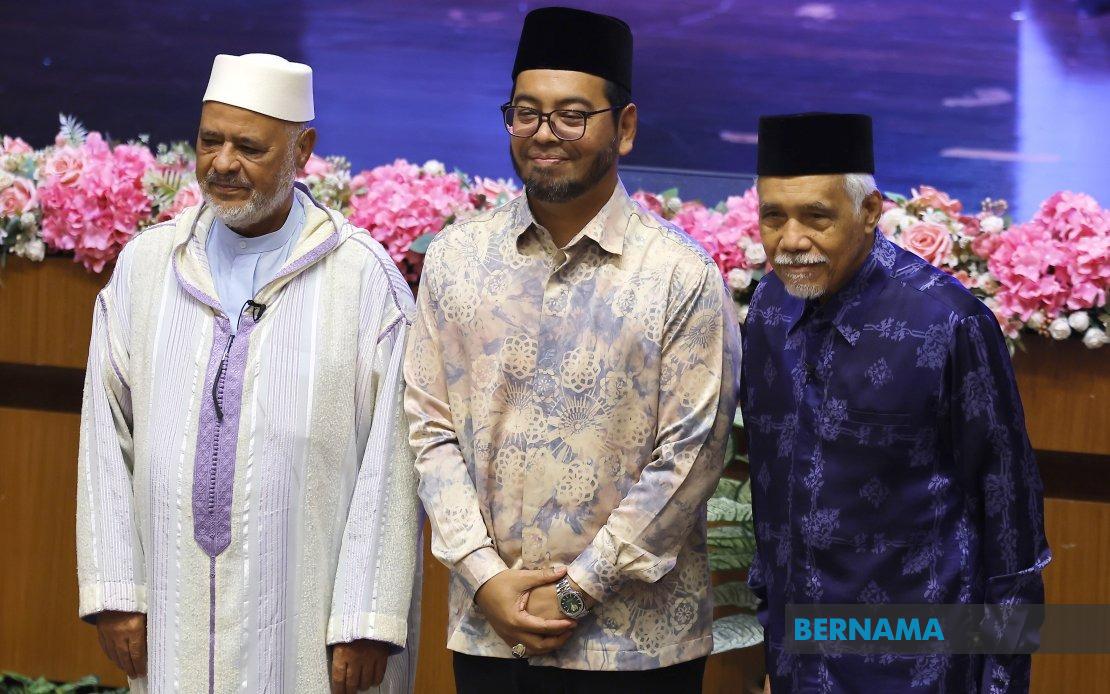
Two distinguished academics received formal recognition at the inaugural event, with Emeritus Professor Osman Bakar of IIUM honoured as the national Maal Hijrah figure, whilst Professor Sheikh Dr Ahmad Al-Raysuni of Morocco received designation as the international Maal Hijrah figure. Osman Bakar brings extensive credentials spanning Islamic philosophy and comparative civilisational studies, whilst Al-Raysuni represents leading expertise in Islamic jurisprudence from the broader Arab and Muslim world. Their selection reflects intentional curation aimed at representing diverse intellectual traditions within Islamic scholarship.
The ceremonial recognition of these scholars occurred at the national-level Maal Hijrah 1448H/2026 celebration held at Masjid Putra, where the Sultan of Perak, Sultan Nazrin Shah, presented awards, accompanying cash prizes, trophies, and certificates of appreciation. The involvement of the Sultan underscores the constitutional and symbolic significance attached to honouring Islamic intellectuals within Malaysia's governance framework, situating these scholars within formal state recognition protocols.
For regional observers, Malaysia's initiative reflects broader Southeast Asian efforts to articulate Islamic intellectual traditions as compatible with modern governance, educational advancement, and multicultural citizenship. The lecture series implicitly rejects narratives suggesting Islam operates separately from or antagonistically toward secular institutional frameworks. Instead, it positions Islamic scholars as contributors to public discourse within established governmental and educational structures, suggesting a model wherein religious and civic spheres interact constructively.
The expansion strategy articulated by the Religious Affairs Ministry indicates anticipation of sustained demand and broad receptivity to these lectures. By deliberately planning to involve more universities and institutions, officials demonstrate confidence that audiences across Malaysia will engage substantively with scholarly presentations on Islamic thought. This optimism reflects assumptions about public appetite for intellectually rigorous engagement with religious subject matter, departing from stereotypes that position religious learning narrowly.
Implementation of the Maal Hijrah Lecture Series also carries implications for how Malaysia positions itself internationally within Islamic intellectual networks. By featuring international scholars like Al-Raysuni and creating platforms for their engagement with Malaysian audiences, the government signals openness to global Islamic thought whilst maintaining national institutional control over dissemination mechanisms. This approach allows Malaysia to benefit from international scholarly resources whilst ensuring alignment with domestic policy priorities and constitutional arrangements.
The initiative ultimately reflects governmental recognition that intellectual leadership matters for social cohesion and religious community formation. Rather than leaving Islamic thought leadership to spontaneous emergence or informal networks, the Religious Affairs Ministry assumes proactive responsibility for identifying exemplary scholars and creating systematic channels for their influence. Whether this top-down approach effectively reaches intended audiences and generates genuine public engagement remains to be assessed as the lecture series develops throughout the Maal Hijrah 1448H/2026 period and beyond.