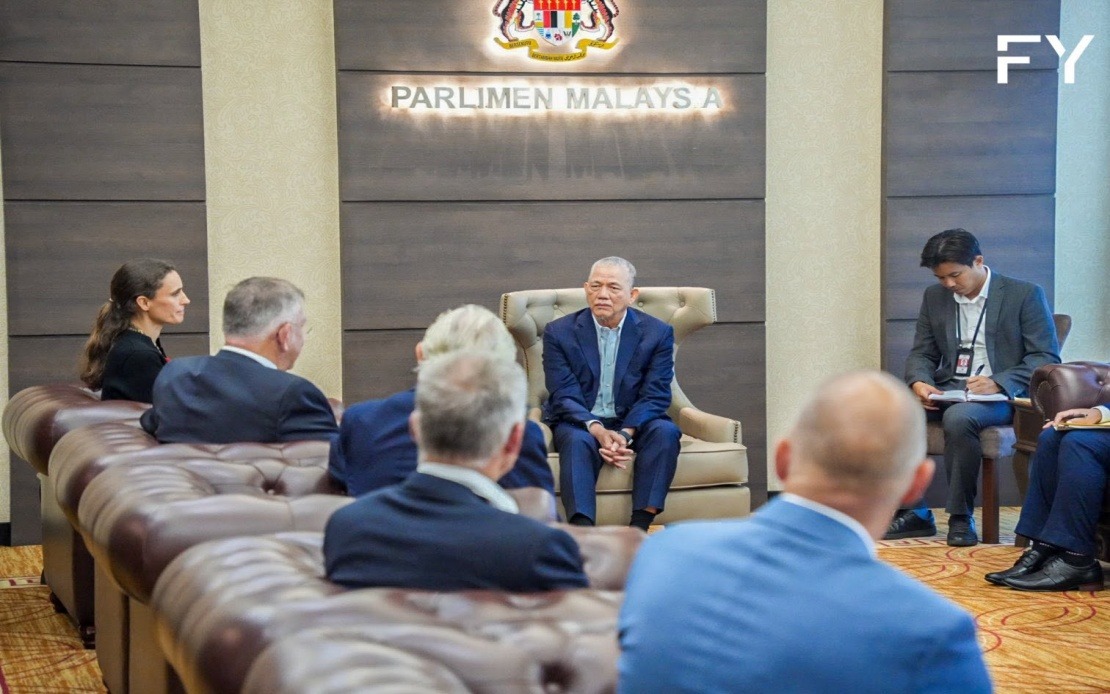
Malaysia is positioning itself as an attractive destination for German small and medium-sized enterprises seeking to expand into Southeast Asia, particularly in sustainability-focused sectors. The message came from Deputy Prime Minister Datuk Seri Fadillah Yusof during a meeting with German Ambassador to Malaysia Silke Riecken-Daerr and representatives from the German SME Business Association at Parliament House. The encounter underscores Malaysia's determination to deepen economic ties with Europe's largest economy while advancing its own environmental and developmental objectives.
Fadillah's invitation specifically targeted three interconnected areas: green technology, renewable energy, and water management and treatment systems. These sectors align squarely with Malaysia's articulated sustainability agenda, which has become increasingly central to the nation's economic planning. As Malaysia grapples with rapid industrialisation and urbanisation, the need for sophisticated solutions in resource efficiency and environmental stewardship has become more pressing. German expertise in these domains—built on decades of engineering excellence and regulatory stringency—represents precisely the type of knowledge transfer that could accelerate Malaysia's transition toward cleaner, more resilient economic activity.
The economic relationship between Malaysia and Germany is already substantial and multifaceted. Over 800 German companies currently operate across Malaysian territory, spanning diverse industries and operating scales. This existing presence demonstrates that German business confidence in the Malaysian market is well-established, even as the deputy prime minister seeks to expand and redirect investment flows toward emerging green sectors. The mechanical engineering and manufacturing technology spheres have historically dominated bilateral commercial ties, but the push now is to branch into areas where Malaysia itself is still building institutional and technical capacity.
Germany's reputation as a knowledge economy and manufacturing powerhouse stems partly from its distinctive approach to workforce development. The nation's Technical and Vocational Education and Training (TVET) system has become a global benchmark, consistently producing workers whose skills command premium salaries and whose adaptability allows them to thrive amid technological disruption. Fadillah explicitly identified this dimension as an opportunity for bilateral cooperation, recognising that Malaysia's long-term competitiveness hinges not merely on attracting capital but on developing human talent capable of managing complex technologies and business processes.
The potential collaboration in TVET reflects a deeper strategic calculation within Malaysian policymaking circles. As automation and artificial intelligence reshape labour markets globally, countries that can bridge the gap between theoretical knowledge and practical application gain a decisive advantage. Germany's dual education system—which integrates classroom instruction with on-the-job apprenticeship—has proven particularly effective at this integration. Malaysian institutions and employers, by adopting or adapting such models, could build a workforce better equipped to navigate the green economy's technical demands while reducing youth unemployment and skills mismatches that currently burden the labour market.
The timing of this diplomatic engagement is significant. Global momentum around climate commitments and the energy transition is intensifying, with multinational corporations and government agencies increasingly demanding sustainable products and processes from their supply chains. German SMEs, many of them world-class specialists in niche areas of green technology, face both opportunities and pressures to relocate or expand production outside Europe to serve Asian markets more efficiently. Malaysia's combination of geographic proximity to major Southeast Asian consumption centers, established infrastructure, relative political stability, and stated commitment to sustainability makes it a logical choice for such operations.
Fadillah's confidence in strengthened bilateral relations reflects a pragmatic assessment of mutual benefit. For Malaysia, German investment brings advanced technology, management expertise, and access to global supply networks. For Germany, Malaysia offers manufacturing cost advantages, access to regional markets, and a platform for serving the growing green energy transition across Southeast Asia. This complementarity creates conditions for sustained partnership rather than transactional one-off deals.
However, attracting such investment requires more than diplomatic overtures. German businesses typically demand predictable regulatory environments, efficient bureaucratic processes, and credible long-term policy frameworks. Malaysia's commitment to its green agenda must extend beyond rhetoric into concrete policy instruments: tax incentives for green manufacturing, streamlined approval processes for environmental technology projects, guaranteed access to skilled workers, and stability in energy pricing and supply. The existence of over 800 German firms already suggests these conditions are being met to a reasonable degree, but further improvement would strengthen the proposition.
The sectoral focus on water management carries particular regional resonance. Southeast Asia faces mounting water stress from population growth, industrial demand, and climate variability. Countries across the region, including Malaysia itself, increasingly struggle with water quality, distribution efficiency, and treatment capacity. German firms specialising in advanced water technologies—filtration, recycling, smart metering systems—could find substantial markets not only in Malaysia but throughout the region, using Malaysia as a springboard for expansion.
The invitation to German SMEs also implicitly acknowledges that innovation in green sectors often originates from smaller, nimbler firms rather than lumbering multinational corporations. SMEs can adapt quickly to local conditions, establish close relationships with supply chain partners, and take calculated risks on emerging technologies. Malaysia's openness to such enterprises suggests a pragmatic understanding that sustainable development requires diverse sources of capital and expertise, not merely flagship investments from global giants.
This bilateral initiative fits within Malaysia's broader regional positioning. As ASEAN nations compete to attract foreign investment amid the digital age and energy transition, offering tailored opportunities to investor groups from developed economies becomes strategically important. Malaysia's explicit targeting of German SMEs in green sectors positions the country as not merely open for business but thoughtfully aligned with global economic trajectories. It signals that Malaysia understands where value is being created in twenty-first-century capitalism and has institutions and policies designed to capture that value while serving environmental imperatives.
The pathway forward will depend on follow-through. Diplomatic interest must translate into simplified investment procedures, workforce development initiatives, and perhaps targeted tax or financing mechanisms. If Malaysia executes effectively, the meeting with Ambassador Riecken-Daerr and the German SME delegation could prove a pivotal moment in the country's evolution toward a more sophisticated, sustainable, and innovation-driven economy. The scale of opportunity in green technology remains vast, and German expertise could help Malaysia convert aspiration into competitive advantage.

