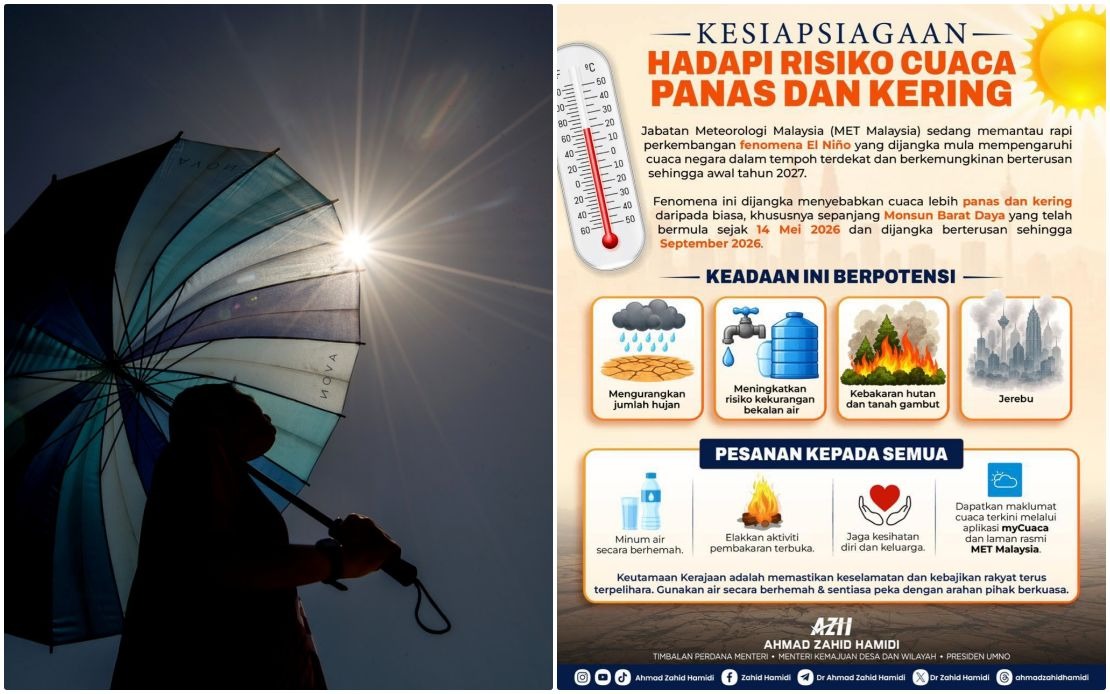
Malaysia faces an extended period of above-average heat and reduced rainfall as the El Niño weather phenomenon is anticipated to take hold of the region in coming months and persist until early 2027, according to a warning issued by Deputy Prime Minister Datuk Seri Dr Ahmad Zahid Hamidi. Speaking in his capacity as chairman of the Central Disaster Management Committee, Ahmad Zahid flagged the anticipated climatic shift as a matter requiring immediate public awareness and proactive household planning across the nation.
The El Niño effect is poised to intensify conditions during Malaysia's Southwest Monsoon season, which commenced on May 14 and will extend through September this year. During this period, the phenomenon will suppress cloud formation and precipitation across much of the country, leading to drier than normal atmospheric conditions. The combination of high temperatures and moisture deficit creates a cascade of secondary hazards that extend beyond simple weather inconvenience, touching upon critical infrastructure, public health, and environmental stability.
Ahmad Zahid specifically highlighted the compounding risks that emerge from prolonged drought conditions. Water scarcity threatens both urban supply networks and agricultural operations that depend on seasonal rainfall and groundwater reserves. Beyond immediate consumption needs, reduced water availability constrains industrial activities and hydroelectric power generation, sectors that remain central to Malaysia's economic functioning. The phenomenon also heightens vulnerability to uncontrolled fires in forest and peatland ecosystems, which during dry seasons become tinderboxes susceptible to ignition from human activities or natural causes.
The smoke and particulates generated by forest and peatland fires constitute a transboundary air quality crisis affecting not only Malaysia but neighbouring countries throughout Southeast Asia. Historical El Niño events have triggered severe haze episodes that disrupted regional air quality indices, forced school closures, and triggered respiratory health emergencies. The visibility degradation and atmospheric pollution carry economic consequences through tourism disruption, flight delays, and broader productivity losses across affected economies.
Public health considerations feature prominently in the government's messaging. Prolonged exposure to elevated temperatures increases heat stress and dehydration risks, particularly among elderly populations, young children, outdoor workers, and individuals with pre-existing cardiovascular or respiratory conditions. The combination of heat and poor air quality from potential fires creates a dual environmental stressor that amplifies morbidity and mortality risks across vulnerable demographic groups. Healthcare systems may face surges in heat-related ailments and air pollution-related presentations during peak impact periods.
To mitigate these anticipated challenges, Ahmad Zahid issued a comprehensive advisory framework emphasising behavioural adjustments at the household and community levels. Water conservation practices must become habitual rather than occasional, encompassing irrigation efficiency, reduced discretionary outdoor water use, and awareness of supply constraints. The directive against open burning activities carries particular weight given the historical tendency for agricultural clearing and land preparation activities to coincide with dry seasons, inadvertently triggering larger uncontrolled fires.
The Malaysian Meteorological Department, under director-general Dr Mohd Hisham Mohd Anip, confirmed the scientific basis for these warnings, emphasising that the Southwest Monsoon period overlaps with the anticipated peak intensity of El Niño effects. MetMalaysia has positioned itself as the authoritative source for real-time weather intelligence, directing the public toward the myCuaca mobile application and official departmental channels for continuously updated forecasts and alert systems. This technological infrastructure enables granular, location-specific weather information that facilitates more targeted preparedness measures than broad national advisories.
The government's framing emphasises that managing an El Niño event represents a collective responsibility transcending traditional government-citizen divisions. Early institutional preparation encompasses pre-positioning drought response mechanisms, activating water rationing protocols before acute shortages materialise, and coordinating with regional fire management agencies on prevention strategies. Private sector participation proves essential, particularly within agriculture, manufacturing, and utilities sectors where operational modifications can substantially reduce water demand and fire risk.
From a regional perspective, Malaysia's experience with El Niño positioning cascades across Southeast Asia, where Indonesia, Thailand, and Singapore face similar meteorological trajectories. The transboundary nature of haze and air quality impacts incentivises regional coordination mechanisms. ASEAN-level dialogue on drought adaptation and fire suppression strategies becomes increasingly relevant when individual nation-states confront synchronised climatic pressures. Lessons learned through Malaysia's response framework may inform broader regional resilience-building efforts.
The temporal extent of this forecast—spanning potentially two-and-a-half years until early 2027—suggests that adaptation strategies must move beyond emergency response toward structural adjustments. Water security investments, including aquifer management, alternative supply development, and demand-side efficiency improvements, warrant acceleration. Peatland and forest management protocols should incorporate El Niño risk scenarios into strategic planning, with enhanced surveillance and suppression capacity activated during vulnerable periods.
Historically, El Niño events have exposed infrastructure vulnerabilities and resource constraints previously masked during normal precipitation cycles. The forthcoming event presents both challenge and opportunity—the former in terms of immediate hardship and service disruption risks, the latter through demonstrating genuine conservation needs and catalysing lasting efficiency improvements. Households and institutions that implement water conservation measures now may discover that operational adjustments remain beneficial even after normal precipitation patterns resume, embedding sustainability gains into long-term practice.