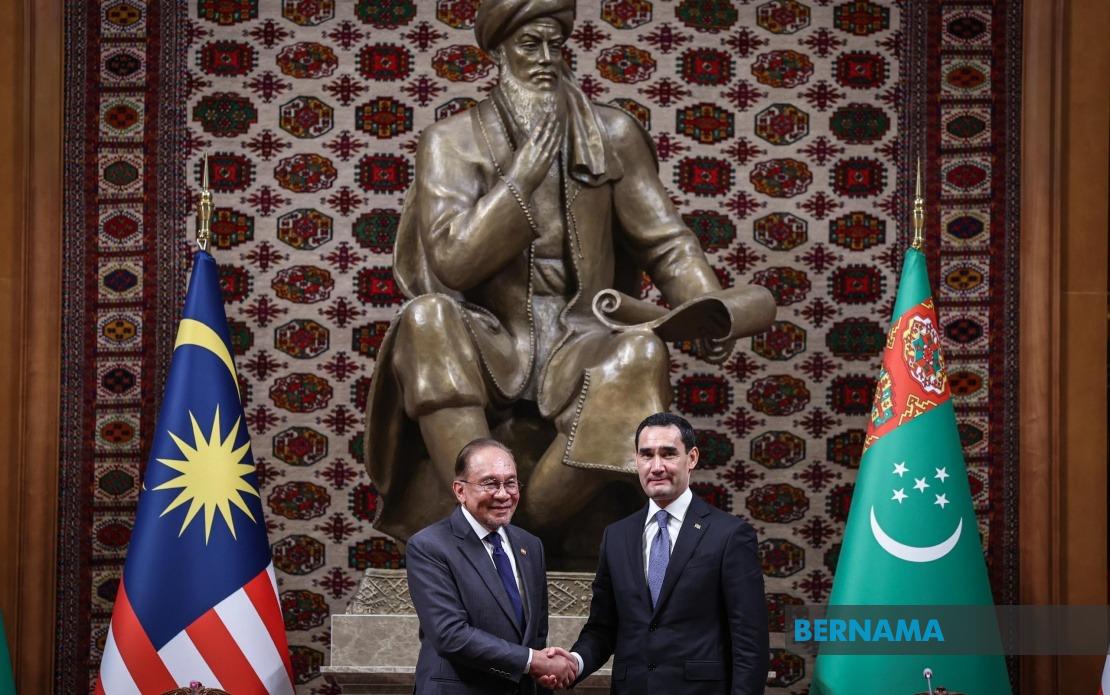
Prime Minister Datuk Seri Anwar Ibrahim and Turkmenistan President Serdar Berdimuhamedov have committed to building a more structured and forward-looking partnership between Malaysia and Turkmenistan, rooted in mutual strategic interests and long-term benefits for both nations. The undertaking emerged from their bilateral meeting at the Presidential Palace in Ashgabat on Friday, where the two leaders and their delegations engaged in substantive discussions across multiple sectors of mutual concern.
The partnership framework is anchored by several formal instruments that the two governments exchanged during the visit, setting concrete benchmarks for cooperation. Both sides have underscored their determination to ensure that each area of agreed cooperation progresses with rigorous discipline, full transparency, and operational effectiveness—a pledge that reflects recognition of the need for accountability in bilateral initiatives. Anwar characterised the arrangement as grounded in deep trust and mutual respect, sentiments that he expressed in the hope that the friendship would continue to flourish between the two nations.
The scope of potential collaboration between Malaysia and Turkmenistan spans domains critical to both countries' development priorities. Energy cooperation features prominently given Turkmenistan's substantial natural gas reserves and Malaysia's position as an energy consumer and producer in Southeast Asia. Trade and investment pathways have been identified as areas where both economies can benefit from increased commercial interaction, particularly as Malaysian businesses explore opportunities in Central Asia and Turkmen enterprises look to expand their regional footprint. The halal industry represents a significant niche, reflecting Malaysia's global leadership in halal certification and Turkmenistan's Muslim-majority population, which provides natural synergies for market development and standards harmonisation.
Islamic banking and financial services constitute another pillar of the emerging partnership. Malaysia's sophisticated Islamic finance ecosystem, anchored by Kuala Lumpur's position as a major global Islamic banking hub, offers valuable expertise and institutional models that Turkmenistan may seek to adopt or adapt. Educational exchanges and research collaboration are positioned to deepen human capital development and foster intellectual connections between institutions in both countries, enhancing long-term people-to-people bonds. Science and technology initiatives could enable both nations to benefit from knowledge transfer and joint innovation projects, particularly in sectors aligned with their respective economic strategies.
Tourism and air connectivity were explicitly highlighted as priority areas during the bilateral talks. Improved air links between Malaysia and Turkmenistan would facilitate increased visitor flows and business travel, supporting the tourism sectors of both countries. The Air Services Agreement signed during the visit represents a concrete step toward this objective, potentially enabling airlines from both nations to establish or expand flight operations and enhance accessibility for travellers and cargo shipments. Such connectivity improvements are particularly significant for Malaysia's regional positioning and for broadening Southeast Asia's links with Central Asian markets.
The formal documents exchanged during the visit constitute the operational infrastructure for this expanded partnership. The Air Services Agreement provides the regulatory foundation for expanded aviation cooperation. Parallel agreements between Malaysia's Institute of Diplomacy and Foreign Relations and Turkmenistan's Institute of International Relations establish channels for diplomatic engagement and policy dialogue at the institutional level, fostering sustained high-level communication beyond periodic governmental summits. Separately, the Ministry of Transport agreement with Turkmenistan's State Service creates a framework for collaboration on transport policy and infrastructure development.
The involvement of the Academy of Sciences Malaysia and Turkmenistan's Academy of Sciences signals the integration of research institutions into the bilateral relationship, enabling scientists and scholars from both countries to collaborate on projects of mutual academic interest. This institutional linkage often generates spillover benefits across multiple sectors, as research partnerships frequently inform policy decisions and commercial applications. The emphasis on scientific cooperation also reflects both governments' recognition that technological advancement and innovation are essential drivers of competitiveness in an increasingly complex global economy.
Anwar's visit, which began on June 18 and extends across two days, marks his first official journey to Turkmenistan since assuming the office of Prime Minister in November 2022. The visit took place at President Berdimuhamedov's invitation, underscoring Turkmenistan's interest in forging stronger ties with Malaysia. Anwar travelled with a substantial delegation that included Minister of Investment, Trade and Industry Datuk Seri Johari Abdul Ghani and Minister of Economy Akmal Nasrullah Mohd Nasir, demonstrating the cross-sectoral focus of the engagement and Malaysia's intention to pursue concrete commercial and developmental outcomes.
The timing of this visit reflects broader shifts in Malaysia's foreign policy positioning under Anwar's leadership. Malaysia has emphasised strengthened engagement beyond its traditional Southeast Asian neighbourhood, seeking to expand strategic partnerships with nations across diverse regions. Central Asia, as an energy-rich zone with growing economic dynamism and cultural ties to the Islamic world, represents a natural sphere for Malaysian engagement. Turkmenistan, with its substantial hydrocarbon resources and strategic location along ancient trade corridors, holds particular relevance for Malaysian businesses and policymakers.
For Southeast Asia more broadly, Malaysia's deepening engagement with Central Asia carries implications for regional connectivity and multilateral frameworks. Enhanced Malaysia-Turkmenistan ties could serve as a foundation for broader Southeast Asian engagement with Central Asia, potentially fostering greater inter-regional trade and people-to-people exchanges. Malaysia's experience in navigating diverse partnerships and bridging different regional contexts positions it to facilitate such broader linkages, contributing to a more interconnected geopolitical landscape.
The emphasis placed on transparency, discipline, and effectiveness in implementation distinguishes this partnership framework from more aspirational statements of intent. Both governments have signalled their commitment to moving beyond ceremonial declarations toward concrete deliverables with measurable outcomes. This operational orientation reflects lessons learned from previous bilateral and multilateral initiatives and suggests a determination to ensure that the agreements translate into tangible benefits for businesses, researchers, and citizens of both nations.
The partnership also reflects shared values regarding Islamic finance, the halal economy, and scientific collaboration that create natural bridges between Malaysian and Turkmen institutions and stakeholders. These thematic areas align with each country's development priorities while offering scope for genuine mutual benefit rather than zero-sum competition. As the agreements are progressively implemented over the coming months and years, the success of this partnership will depend on both governments' willingness to allocate resources, facilitate bureaucratic coordination, and maintain the political momentum generated by Anwar's visit.

