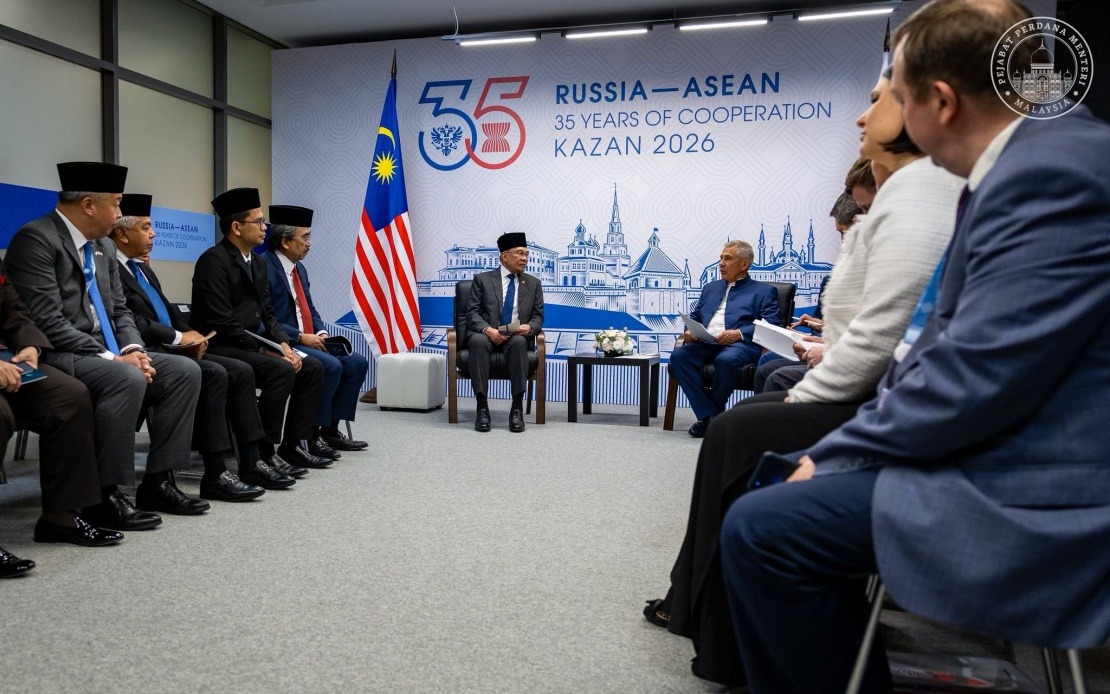
Prime Minister Datuk Seri Anwar Ibrahim has identified substantial avenues for Malaysia to expand collaboration with Russia's Republic of Tatarstan, spanning sectors from hydrocarbon development to digital innovation and the halal economy. The announcement came during his bilateral meeting with Tatarstan's leader Rustam Minnikhanov in Kazan this week, as Anwar attended the ASEAN-Russia Commemorative Summit—a two-day gathering that underscores the strategic importance of the association's relationship with Moscow.
The energy sector emerged as a cornerstone of their discussions, reflecting Tatarstan's status as one of Russia's most prolific oil-producing jurisdictions. Anwar emphasised that Malaysia and Tatarstan could develop mutually beneficial arrangements across the entire petroleum value chain, extending beyond raw material supply to encompass refining operations, petrochemicals manufacturing, and downstream industrial activities. For Malaysia, which remains heavily dependent on energy imports and maintains significant petrochemical capabilities, such linkages could strengthen supply chain resilience while creating new avenues for industrial collaboration.
Beyond energy, the bilateral agenda encompassed education, tourism, talent mobility, technology development, and the halal sector—domains where Malaysia has cultivated considerable expertise and competitive positioning. The halal industry reference carries particular significance, as Malaysia has long positioned itself as a global halal standards-setter and certification authority. Tatarstan, with its substantial Muslim population and growing recognition as an Islamic cultural hub, represents both a market opportunity and a potential production partner for halal-certified goods destined for Islamic economies across the Middle East, Central Asia, and Southeast Asia.
Anwar and Minnikhanov also explored the role of the Kazan Forum in strengthening commercial networks and catalysing fresh partnerships in emerging domains such as artificial intelligence, fintech, and green technology. The Kazan Forum functions as an important platform for business exchange and investment promotion across Eurasian markets, and Malaysia's inclusion in these conversations reflects its evolving position within Russia's strategic outreach beyond traditional ASEAN dialogue structures.
A notable development was Anwar's acknowledgement of Kazan's designation as the Islamic World Cultural Capital 2026 by the Islamic World Educational, Scientific and Cultural Organisation—a recognition that positions the city as a confluence of Islamic scholarship, contemporary innovation, and cultural preservation. The Prime Minister also commended President Vladimir Putin's establishment of the Strategic Vision Group, characterising it as a bridge facilitating constructive dialogue and substantive collaboration between Russia and Islamic-majority nations. This framing reflects Malaysia's interest in positioning itself as a mediator and partner within broader Russia-Islamic world engagement frameworks.
Anwar arrived in Kazan following a journey that underscored Malaysia's diplomatic reach. He travelled with a high-level delegation comprising Investment, Trade and Industry Minister Datuk Seri Johari Abdul Ghani and Economy Minister Akmal Nasrullah Mohd Nasir, alongside senior officials from the Prime Minister's Office and the Foreign Ministry. The composition of this delegation signalled that the visit carried substantive commercial and investment objectives, not merely ceremonial significance.
The ASEAN-Russia Commemorative Summit represents a juncture in a partnership architecture that has matured considerably over three decades. Dialogue relations were established in 1991, Russia achieved full ASEAN Dialogue Partner status in 1996, and the relationship was formally elevated to a Strategic Partnership in 2018. This progression reflects mutual recognition that engagement across political, security, economic, and cultural dimensions serves both parties' long-term interests. For Malaysia particularly, deeper Russia ties offer strategic diversification in great-power relationships and alternative sources of investment and technology partnerships, especially as the region navigates evolving geopolitical alignments.
Kazan itself embodies the geographical and cultural significance that Malaysia seeks to tap. Situated approximately 800 kilometres east of Moscow at the confluence of the Volga and Kazanka rivers, the city of 1.3 million people represents Russia's historical and contemporary bridge to Islamic civilisation. Its millennium-spanning heritage as a centre of Islamic learning and culture, combined with its contemporary role as an industrial and innovation hub, makes it an attractive focal point for Malaysian commercial and diplomatic engagement.
The summit's timing reflects broader strategic recalibrations within the region. ASEAN's commitment to balancing relations across multiple powers while maintaining strategic autonomy remains a defining principle of its foreign policy doctrine. Malaysia's active participation in ASEAN-Russia forums, coupled with bilateral initiatives like the Anwar-Minnikhanov meeting, demonstrates how Southeast Asian nations are simultaneously deepening ties with various international partners to serve their own development and security interests. For Malaysian businesses, particularly those in petrochemicals, manufacturing, and technology sectors, the expanded diplomatic space opens practical opportunities for market access, joint ventures, and technology transfer arrangements that could enhance competitiveness and profitability.
The potential gains extend beyond conventional commercial metrics. Educational exchanges could enable Malaysian students and professionals to access Russian expertise in energy technologies, artificial intelligence, and aerospace sectors. Tourism partnerships might introduce Russian visitors to Malaysia's Islamic heritage sites and contemporary development models. Investment protocols could facilitate capital flows in both directions, with Malaysian sovereign funds and private entities exploring opportunities in Tatarstan's manufacturing and technology sectors, while Russian investors gain exposure to Malaysian market dynamics and ASEAN-wide opportunities.
Moving forward, translating these expressed intentions into concrete agreements will require sustained diplomatic engagement and the establishment of practical mechanisms for cooperation. The Kazan Forum and bilateral channels must evolve from discussion platforms into functional frameworks that facilitate business matchmaking, regulatory harmonisation, and dispute resolution. Malaysia's experience in multilateral economic integration—through CPTPP, RCEP, and bilateral free trade agreements—positions it well to structure arrangements that balance openness with appropriate safeguards.
Ultimately, the Malaysia-Tatarstan engagement narrative reflects a broader pattern whereby middle-power Southeast Asian nations are methodically deepening diverse international partnerships to advance development objectives and enhance strategic flexibility. As Anwar's visit demonstrates, such engagement is neither anti-Western nor exclusively aligned with any single bloc; rather, it represents pragmatic statecraft aimed at leveraging opportunities wherever they emerge. The success of this approach will depend on whether general statements of cooperation translate into institutional arrangements, investment commitments, and sustained policy follow-through from both governments and their respective private sectors.