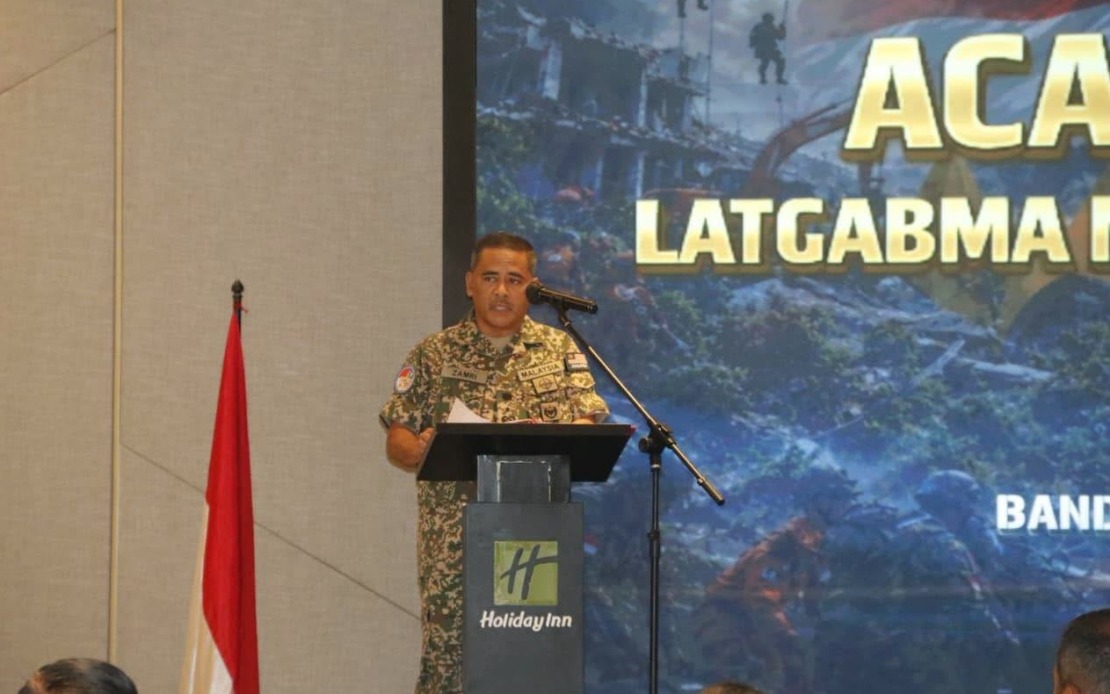
Malaysia and Indonesia have moved to strengthen their defence partnership through a major joint military exercise currently underway in Sumatra. The LATGABMA MALINDO DARSASA 12AB/2026 operation, a 13-day initiative hosted in Lampung, reflects the deepening strategic relationship between the Malaysian Armed Forces (MAF) and the Indonesian National Armed Forces (TNI). With 719 participants representing various military and civilian agencies from both nations, the exercise represents a significant commitment to coordinated regional security and represents far more than a routine training activity.
The exercise, overseen by the Joint Forces Headquarters at Al-Sultan Abdullah Camp in Kuala Lumpur, has been structured to test integrated operational approaches across land, maritime, and air domains. According to Brigadier General Datuk Zamri Othman, Commander of the 1st Infantry Brigade and Chief of the MAF Exercise Planning Group, the initiative demonstrates the fraternal relationship and mutual confidence that underpins Malaysia-Indonesia defence ties. Beyond testing joint operational concepts, the exercise provides valuable opportunities for military personnel from both countries to develop shared understanding of procedures and establish personal connections that strengthen institutional relationships between the armed forces.
The selection of Lampung Province as the primary training location reflects a deliberate strategic choice rooted in both geographical and operational considerations. The region sits at the convergence of three active tectonic plate systems, making it particularly susceptible to significant seismic events and tsunamis. This geographical reality transforms the exercise venue into a realistic training environment where participants can rehearse responses to natural disasters based on actual experiences that have affected Indonesia's southern Sumatra region. By grounding the exercise in authentic disaster scenarios, planners ensure that skills developed during training directly translate to practical capability for future emergency response.
The contemporary security landscape facing Malaysia and Indonesia extends well beyond traditional military threats. Non-traditional challenges including maritime piracy and smuggling across the shared waters, terrorism networks operating across borders, sophisticated cyber attacks targeting critical infrastructure, and unpredictable natural disasters demand coordinated responses that transcend national boundaries. Both countries recognise that strengthening defence cooperation provides essential mechanisms for addressing these multifaceted threats. The exercise framework allows military planners and operational personnel to develop joint protocols and build confidence in coordinated action when facing these challenges in real-world scenarios.
This exercise continues a tradition of bilateral military cooperation that stretches back more than four decades. LATGABMA MALINDO DARSASA has been conducted triennially since 1984 under the auspices of the General Border Committee and the Malaysia-Indonesia Joint Training Committee, rotating between host nations on a three-year cycle. The previous iteration, held in Pekan, Pahang in 2023, focused on counter-terrorism operations. The current exercise's emphasis on humanitarian assistance and disaster relief reflects evolving regional priorities and the recognition that non-military crises increasingly demand armed forces participation in rescue, recovery, and stabilisation operations.
The academic component of the exercise operates through structured staff sessions examining ten critical scenarios that military and civilian personnel might encounter during major disasters. These scenarios progress logically from immediate response to initial incidents through mass casualty management, infrastructure damage assessment, international coordination, information security, population evacuation, and eventual stabilisation and transition phases. This comprehensive framework ensures participants develop understanding not merely of tactical procedures but of the broader operational sequence required to manage complex emergencies. The scenario development has drawn on historical experiences from Indonesia's own encounters with major earthquakes and tsunamis, grounding the training in authentic challenges.
Field training components bring theoretical understanding into practical application through force integration training involving Malaysian and Indonesian military personnel working alongside civilian agencies. Indonesian participants include the National Search and Rescue Agency, volunteer disaster preparedness cadets, the Indonesian Red Cross, and regional disaster management authorities. Joint activities encompassing rope rescue techniques, rappelling operations, emergency medical procedures, and field hospital establishment provide hands-on experience in coordinated operations. This integration of military and civilian agencies reflects modern understanding that major disasters require seamless coordination across organisational boundaries and that peacetime exercises provide essential opportunities to develop these working relationships before crisis situations demand them.
The exercise incorporates substantial community engagement through engineering and medical civic action programmes. Teams will undertake repairs to uninhabitable housing structures in two villages and construct concrete road infrastructure, directly improving local living conditions while providing valuable operational experience for participants. Medical components include general health screenings, eyeglass provision, and blood donation activities conducted at community health facilities. These civic action elements serve dual purposes: they deliver tangible benefits to Indonesian communities while providing medical personnel realistic experience in delivering health services in resource-constrained settings, skills directly applicable to disaster response scenarios.
Cyber operations constitute an increasingly critical dimension of modern military and national security challenges, and the exercise incorporates dedicated cyber training components. Participants will gain practical experience with technical reconnaissance, credential access attempts, man-in-the-middle interception techniques, spoofing tactics, and data manipulation scenarios. This cyber exercise segment acknowledges that contemporary disasters and security threats increasingly intersect with digital infrastructure vulnerabilities. From disrupted communication networks during natural disasters to coordinated cyber attacks targeting critical systems, military and government personnel must understand both offensive cyber techniques and defensive countermeasures to protect operational effectiveness during crises.
The force composition reflects Malaysia's commitment to meaningful participation in the exercise. While Indonesian forces contribute 463 military personnel representing the TNI, Malaysian participation includes 150 armed forces members. The broader exercise incorporates 25 members of the Indonesian National Police, 79 participants from various Indonesian civilian agencies, and two representatives from Malaysia's National Disaster Management Agency. This multinational and multiagency composition mirrors real-world disaster response operations where success depends on effective collaboration across organisational and national boundaries. The relatively smaller Malaysian contingent reflects the host nation hosting arrangement, though the exercise provides Malaysian personnel with direct exposure to Indonesian operational procedures, equipment, and institutional approaches.
The timing and scope of this exercise carry significance for broader Southeast Asian security dynamics. As the region faces intensifying competition among external powers seeking influence, Malaysia and Indonesia's emphasis on deepening bilateral defence cooperation sends important signals about regional cohesion. The exercise demonstrates that ASEAN's two largest and most strategically important Muslim-majority nations maintain strong military-to-military relationships focused on practical capability development. For Malaysia specifically, the exercise provides opportunities to access Indonesian experience in managing disaster response across vast archipelagic territories and to strengthen relationships with a neighbour sharing extensive maritime borders and complex security challenges.
Looking forward, the exercise framework established through LATGABMA MALINDO DARSASA provides foundation for expanding defence cooperation. The triennial cycle ensures institutional continuity while allowing exercises to evolve in response to emerging threat environments and technological developments. Future iterations may incorporate additional dimensions such as expanded cyber operations, maritime security operations across shared waters, or counter-terrorism scenarios reflecting evolving regional threats. The personal relationships developed between Malaysian and Indonesian military personnel through joint exercises generate institutional trust that translates into more effective bilateral coordination during actual emergencies or security crises. In an increasingly uncertain regional environment, such investments in defence partnerships represent prudent risk management and commitment to stable development.

