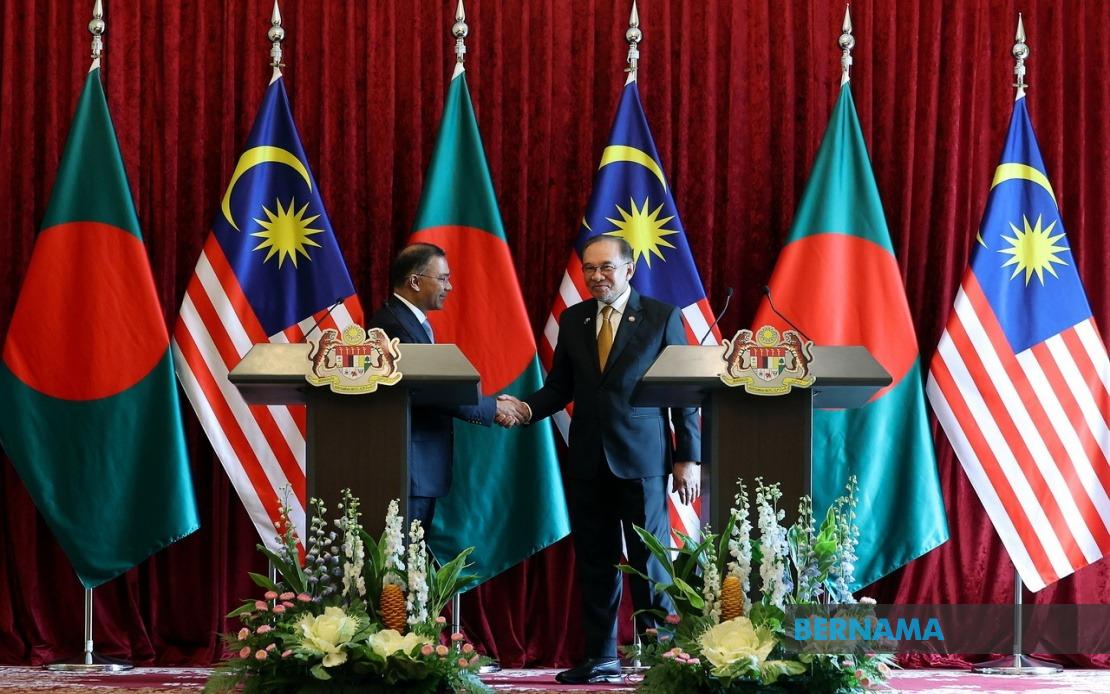
Malaysia and Bangladesh have resolved to take a firmer stance against the abuse and mistreatment of migrant workers, marking a significant moment for labour standards in the region. Prime Minister Datuk Seri Anwar Ibrahim and visiting Bangladesh Prime Minister Tarique Rahman issued the joint commitment at a press conference in Putrajaya on June 22, underscoring their governments' determination to address systematic failures that have long plagued the recruitment and employment of foreign workers across Southeast Asia.
Anwar's remarks highlighted a critical tension that has defined Malaysia's relationship with its substantial migrant workforce for decades. While acknowledging that foreign workers have been essential to sustaining Malaysia's economic expansion and competitiveness across manufacturing, construction, agriculture, and domestic services, the prime minister recognised that this dependence has simultaneously created conditions ripe for exploitation. The admission represents a rare public acknowledgement of the scale of the problem and signals political will at the highest level to implement systemic change.
Central to the bilateral agreement is Malaysia's commitment to establishing a more transparent and equitable recruitment framework. The current system has long been criticised by human rights organisations, worker advocates, and international bodies for enabling unscrupulous agents and employers to impose hidden fees, falsify contracts, and trap workers in conditions of debt bondage and forced labour. Anwar's emphasis on transparency and mutual compliance with both nations' standards suggests recognition that recruitment abuse typically begins not in Malaysia but at source countries, where desperate workers are promised positions that differ dramatically from the realities they encounter upon arrival.
The protection of workers' families emerged as another key dimension of the commitment. Many Bangladeshi and other migrant workers support extended families back home through remittances, making them vulnerable to exploitation if employers or agents threaten their employment or withhold wages. By explicitly pledging to safeguard families, Malaysia and Bangladesh signalled an intention to address the psychological and financial coercion mechanisms that perpetuate modern slavery dynamics within otherwise legal employment relationships. This reflects growing international understanding that worker protection cannot be confined to workplace conditions alone.
Bangladesh Prime Minister Tarique Rahman used the occasion to advance his nation's own interests, requesting that Malaysia expand its recruitment of Bangladeshi workers and reopen labour market access as soon as possible. This appeal underscores the economic importance of Malaysian employment for Bangladesh, where tens of thousands of citizens depend on remittances from overseas jobs. The dual message—stronger protections paired with expanded access—reflects the delicate balance labour-sending nations must strike between shielding workers from abuse and maintaining the economic flows that sustain millions of households.
For Malaysian readers and policymakers, the agreement carries several implications. First, it suggests that concrete reforms to recruitment practices are forthcoming, though details remain sparse. These might include stricter vetting of labour agencies, mandatory transparent contracts in workers' native languages, capped recruitment fees, and enhanced pre-departure orientation for Malaysian employers. Second, any labour market reopening will likely be conditional on Bangladesh meeting new standards, creating incentives for both countries to develop enforceable mechanisms rather than rhetorical commitments.
The timing of this statement also reflects broader regional pressure. Southeast Asia has faced mounting international scrutiny over migrant worker conditions, with United Nations bodies, the International Labour Organization, and foreign governments increasingly questioning practices in Malaysia, Singapore, and Thailand. Malaysian companies have faced boycotts and sanctions over labour concerns, and the government's image has suffered accordingly. Anwar's public stance appears designed to reposition Malaysia as taking labour issues seriously, potentially ahead of international reviews and to protect the country's reputation for responsible governance.
Historically, Malaysia's approach to migrant labour has been reactive rather than proactive. Scandals—whether involving trafficking networks, wage theft, or extreme workplace abuses—have typically prompted temporary crackdowns rather than systemic reform. The voluntary departure programme for irregular workers, periodic regularisation schemes, and enforcement raids have provided short-term pressure valves but have not addressed root causes. The Bangladesh agreement suggests a shift toward longer-term institutional change, though sceptics note that previous bilateral labour agreements have yielded mixed results.
One critical question is whether Malaysia will establish independent enforcement mechanisms or rely on voluntary compliance by employers and recruiters. Past experience indicates that without robust inspections, penalties, and worker complaint mechanisms, even well-intentioned frameworks often fail. Workers themselves must be able to report abuses without fear of deportation or retaliation, and there must be accessible remedies for wage theft, contract violations, and discrimination. The agreement's silence on these enforcement details leaves significant room for implementation gaps.
For Bangladesh, the commitment represents leverage. As Malaysia's largest source of migrant workers and a nation facing significant emigration pressures, Bangladesh possesses genuine negotiating power. Tarique's request for expanded recruitment access signals that Bangladesh is willing to use this leverage to secure both worker protections and economic opportunity. Future labour agreements between the two nations will likely build on this bilateral statement, potentially establishing model frameworks that other Southeast Asian nations might adopt.
The broader regional context matters as well. Singapore, Thailand, and Indonesia are watching how Malaysia-Bangladesh cooperation develops. If this agreement translates into genuine improvements in worker safety, transparent recruitment, and accessible complaint mechanisms, it could establish standards that reshape labour practices across Southeast Asia. Conversely, if the statement proves purely symbolic, it will reinforce worker advocates' cynicism about government pledges.
Implementation will determine whether this agreement represents meaningful progress or merely a diplomatic gesture. Malaysian employers, particularly labour-intensive sectors, will face pressure to adapt their practices. The costs of compliance—whether through higher recruitment fees, improved working conditions, or wage increases—will ultimately affect Malaysia's competitiveness and labour market dynamics. Balancing worker protection with economic efficiency remains the central challenge, and the true test of this commitment will come not from diplomatic statements but from measurable improvements in the lived experiences of Bangladesh's workers in Malaysia.

