Malaysia's commemoration of Maal Hijrah 1448H on June 17 brought together thousands of citizens across the country in a collective reflection on spiritual renewal and national progress. The nationwide celebrations, anchored by a major ceremony in Kuala Lumpur, centred on the transformative power of hijrah—the concept of migration and positive change—as a foundational principle for building a more cohesive society. Deputy Prime Minister Datuk Seri Fadillah Yusof and Minister in the Prime Minister's Department (Religious Affairs) Dr Zulkifli Hasan led proceedings alongside approximately 5,000 attendees, underscoring the government's commitment to fostering interfaith understanding and ethical leadership in the pursuit of national development.
The event, organised under the theme "MADANI Dihayati, Ummah Diberkati" (MADANI Lived, Ummah Blessed), deliberately wove together spiritual substance with practical governance messaging. A structured programme of Quranic recitations, scholarly religious discourse, and formal award presentations created space for both inner reflection and public recognition of exemplary citizenship. This dual focus reflects a deliberate effort by organisers to position Maal Hijrah not merely as a religious observance disconnected from civic life, but as a moment for society to recalibrate its commitment to values—integrity, justice, compassion—that underpin both Islamic teaching and functional democracies.
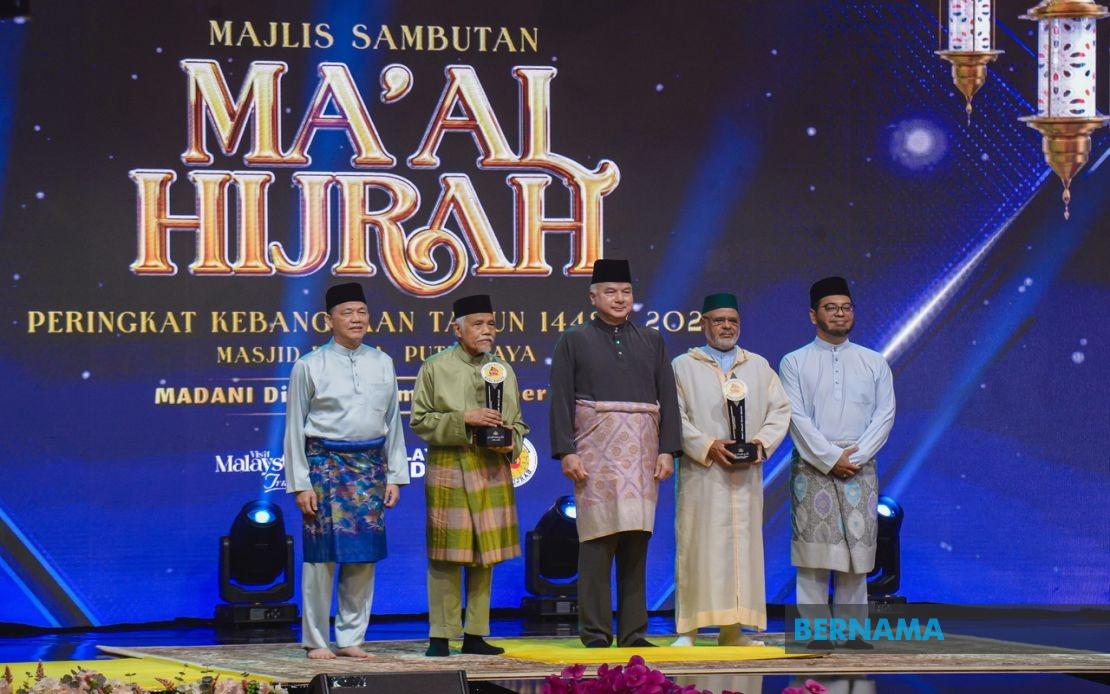
The centrepiece of the ceremony involved the presentation of prestigious national and international recognition awards. Sultan Nazrin Shah, who also holds the title of Sultan of Perak, conferred the National Tokoh Maal Hijrah Award upon Prof Emeritus Datuk Dr Osman Bakar, the rector of International Islamic University Malaysia. This honour acknowledged Bakar's decades of intellectual leadership in bridging Islamic scholarship with contemporary academic rigour, a contribution of particular significance in a region where the relationship between religious study and secular knowledge remains contested terrain. The parallel conferment of the International Tokoh Maal Hijrah Award on Dr Ahmad Al-Raysuni, a distinguished Islamic jurisprudence scholar from Morocco, signalled Malaysia's positioning as a node within a broader global Islamic intellectual network.
Recognition extended throughout the federation and across demographic categories. In Sabah, Chief Minister Datuk Seri Hajiji Noor presided over concurrent celebrations where community activist Datuk Ag Sharin Alimin—himself a former director of Sabah's Islamic Religious Affairs Department—received the male category award, while former Sabah deputy state secretary Datuk Masnah Matsalleh was honoured in the female category. These selections reflected a deliberate effort to celebrate both established institutional figures and individuals whose contributions might otherwise remain in the shadows of formal bureaucracy. The inclusion of women in formal recognition ceremonies carries particular symbolic weight in Malaysian public life, signalling institutional acknowledgment that spiritual and civic advancement requires the full participation of all citizens.
One of the most poignant moments came in recognition of extraordinary longevity in religious service. The 95-year-old Quranic teacher Jusoh @ Muda Ismail received the Tokoh Maal Hijrah Award in ceremonies attended by approximately 1,000 people. His distinction as the adopted student and successor of the late Tuan Guru Haji Mat Lintar—a legendary figure in Islamic education across the Malay Archipelago—connects contemporary Malaysia to pedagogical traditions stretching back generations. This intergenerational acknowledgment carries weight beyond sentiment; it validates oral transmission and mentorship as legitimate forms of Islamic knowledge transfer, a recognition that proves especially important in an age where credentialing increasingly privileges formal institutional pathways.
The recurring thematic emphasis on quality leadership proved particularly noteworthy given Malaysia's contemporary governance challenges. In public discourse dominated by concerns about corruption, institutional capture, and the erosion of trust in bureaucratic structures, the deliberate positioning of Maal Hijrah as a moment for reflecting on ethical leadership standards served a clarifying function. By tying spiritual renewal to questions of governance capacity and moral character, organisers implicitly acknowledged that religious observance divorced from practical accountability rings hollow. The notion that hijrah—as both historical event and ongoing metaphor—demands positive transformation in behaviour, decision-making, and institutional practice reshaped the conversation beyond ritual compliance.
For Malaysian readers and policymakers, the emphasis on ummah unity carries particular contemporary relevance. In a nation where religious identity intersects with ethnicity, political affiliation, and regional identity in complex ways, celebrations that foreground shared Islamic values while simultaneously honouring individual conscience and conscience represent a delicate balancing act. The breadth of participation—spanning federal and state governments, religious authorities, academic institutions, and grassroots community figures—demonstrated that at least in ceremonial moments, consensus exists around the proposition that religious observance and national development need not operate in opposition.
The geographic dispersion of celebrations, from Kuala Lumpur's formal state ceremony to Sabah's regional observances, also illustrated how Maal Hijrah traditions have localised and adapted across Malaysia's diverse landscape. Each regional celebration maintained thematic coherence with the national framework while allowing space for local expression and acknowledgment of figures whose influence extends primarily within their communities. This decentralisation of recognition reflects a mature understanding that nation-building occurs simultaneously at multiple scales—federal policy, state governance, and community mobilisation all contribute to the broader project of ummah unity.
Looking outward, Malaysia's explicit invitation of international Islamic scholars to participate in and receive recognition at Maal Hijrah celebrations signals the nation's aspiration to remain intellectually plugged into the wider Muslim world while maintaining distinctive local characteristics. Dr Ahmad Al-Raysuni's presence and honour represents not merely diplomatic courtesy but a statement that Malaysian Islamic thought does not develop in isolation. The exchange of ideas, scholarly rigor, and ethical frameworks with figures of stature in global Islamic jurisprudence enriches domestic intellectual life and protects against insularity or parochialism.
The underlying message threading through all these elements—from ceremonial grandeur to intimate recognition of elderly teachers—holds particular urgency for Southeast Asian societies navigating rapid modernisation. Maal Hijrah celebrations offer an annual touchstone for communities to ask foundational questions: What does positive change actually mean in our specific context? How do we cultivate leadership that serves collective wellbeing rather than factional interest? What responsibilities do we bear toward one another in an increasingly atomised world? By framing these questions within religious tradition while insisting on their practical implications for governance and social cohesion, Malaysian Maal Hijrah observances model a mode of religious engagement that proves both spiritually substantive and civically functional.