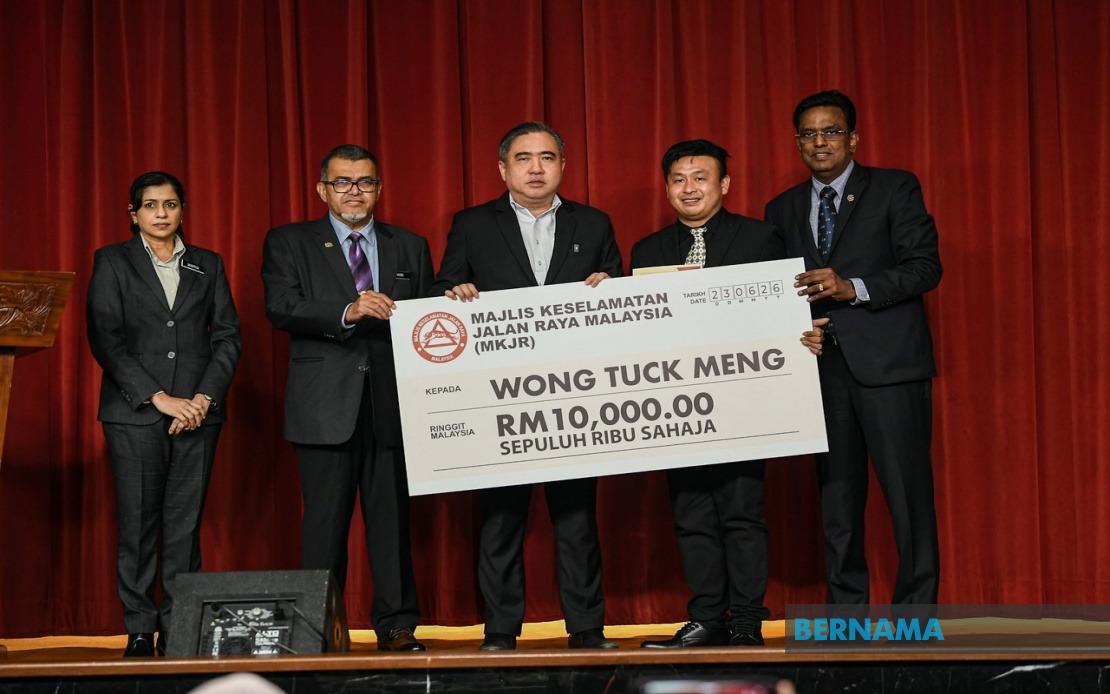
Wong Tak Ming, a lorry driver from Perak, was formally recognised today by Transport Minister Anthony Loke at a special ceremony held at Parliament for his extraordinary actions during a critical incident on June 15. The award, which comprises a Special Certificate of Appreciation and RM10,000 in cash, was funded by the Malaysian Road Safety Council (MKJR) in acknowledgement of Wong's bravery in helping to avert what could have been a catastrophic accident that claimed up to 21 lives.
The incident that prompted this recognition occurred when an express bus operating the Kedah-to-Kuala Lumpur route experienced a sudden mechanical failure whilst navigating a downhill section approaching the Menora Tunnel. The loss of brake functionality or other critical systems caused the vehicle to veer dangerously out of control, creating an immediately life-threatening situation for all passengers on board. Wong, whose alertness and presence of mind proved decisive in the critical seconds that followed, acted with extraordinary presence of mind to prevent the unfolding catastrophe.
According to the account provided at today's ceremony, Wong manoeuvred his lorry strategically to make contact with the rear of the stricken bus, using his heavier vehicle as a stabilising force to gradually reduce the runaway bus's dangerous velocity. Rather than allowing panic to dictate his response, he then carefully steered both vehicles towards the guardrail, ensuring that the collision and subsequent braking sequence unfolded in a controlled manner that ultimately brought both vehicles to a halt without triggering a multi-vehicle pile-up or other secondary accidents.
Transport Minister Anthony Loke characterised Wong's intervention as nothing short of heroic, emphasising the extraordinary personal risk that Wong accepted in choosing to act rather than remain a bystander. "His swift action prevented what could have been a tragic accident and saved many lives," Loke said during the appreciation ceremony, underscoring the life-or-death stakes that framed Wong's decision-making in those crucial moments. The minister highlighted that Wong's conduct represented precisely the kind of citizen engagement and social responsibility that Malaysia's road safety framework depends upon.
When asked about his motivations during the ceremony, Wong downplayed any sense of having performed an extraordinary feat, instead attributing his actions to simple human instinct and concern for the welfare of those in danger. He explained that his immediate priority was preventing fatalities and creating enough time for vehicles ahead of the runaway bus to clear the danger zone. "At that moment, I was only thinking about preventing any loss of life. There was still some distance between the bus and my lorry, so I had time to sound the horn to alert vehicles ahead," Wong reflected, demonstrating that his actions unfolded through a series of calculated decisions rather than blind impulse.
Parliament itself joined in honouring Wong's contributions to public safety, with Deputy Speaker Datuk Dr Ramli Mohd Nor conveying formal recognition from the Dewan Rakyat during today's proceedings. This parliamentary acknowledgement came during Transport Minister Loke's tabling of the Road Transport (Amendment) Bill 2025 for its second reading, linking Wong's individual heroism to broader legislative efforts aimed at enhancing road safety across Malaysia's growing highway network.
The incident gained significant traction across Malaysia's social media platforms, where video footage of the event circulated widely and generated substantial public engagement. This viral moment appears to have reflected broader societal appreciation for Wong's quick thinking and willingness to place himself in harm's way for the benefit of strangers. The widespread digital circulation of the incident likely amplified public awareness of the specific dangers that downhill stretches and tunnel approaches present, particularly for larger commercial vehicles operating under challenging conditions.
For Malaysia's road safety landscape, Wong's actions and subsequent recognition carry important implications. The incident underscores the critical importance of proper vehicle maintenance protocols for commercial operators, particularly for express buses that regularly transport dozens of passengers on routes that include challenging topography. The mechanical failure that precipitated this emergency highlights how preventive maintenance failures can cascade into life-threatening situations within seconds, leaving little margin for error or recovery.
Wong's recognition also reflects Malaysia's growing commitment to acknowledging and rewarding citizen heroism in traffic-related emergencies. As Malaysia's highway network expands and traffic volumes continue rising, the role of attentive and quick-thinking motorists in preventing secondary accidents becomes increasingly vital. The RM10,000 financial award and formal certification represent relatively modest investments in incentivising the kind of public-spirited behaviour that ultimately protects entire communities.
The incident also raises questions about whether current road safety standards for express bus operations adequately address the risks posed by mechanical failures on downhill stretches and in tunnel approaches where emergency response times may be constrained. Industry stakeholders and regulators will likely review whether additional redundancy systems or enhanced maintenance protocols should become mandatory for operators running long-distance passenger services on routes featuring challenging terrain.
Wong's actions serve as a compelling reminder that road safety extends beyond regulatory frameworks and mechanical safeguards to encompass the human element of situational awareness and willingness to intervene. In Southeast Asia, where road fatality rates remain stubbornly elevated across multiple countries, examples of citizen heroism like Wong's demonstrate how individual courage and quick thinking can sometimes succeed where systems and infrastructure fail. His recognition by the government appropriately underscores that such interventions merit public acknowledgement and material appreciation.

