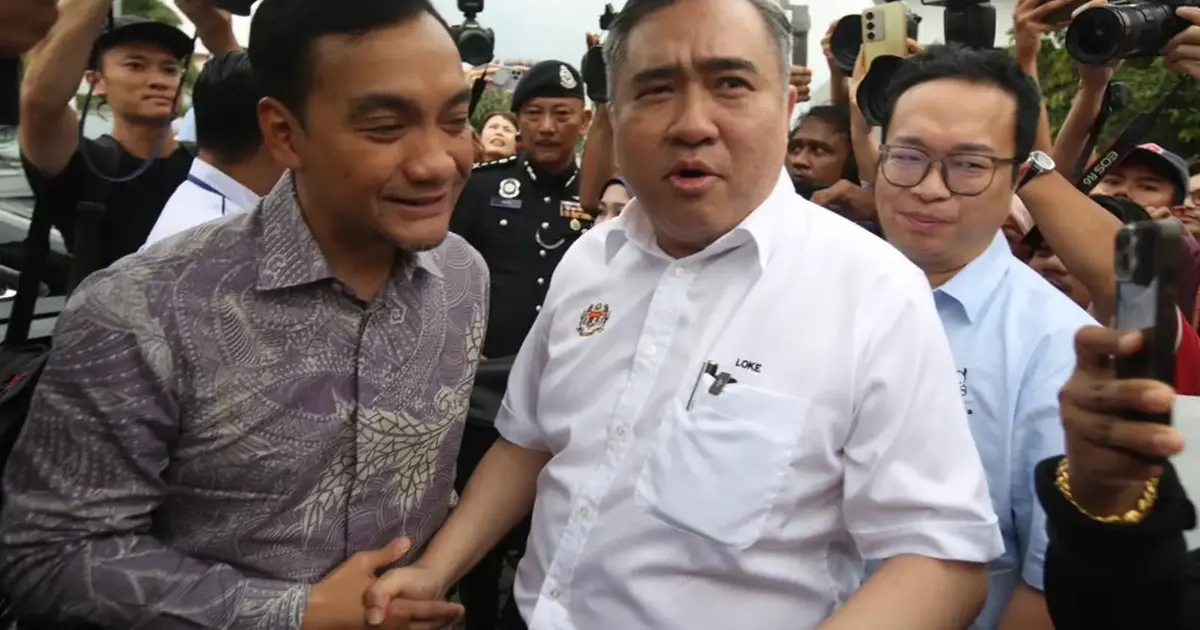
The Transport Minister Anthony Loke and Johor Menteri Besar Onn Hafiz managed to maintain diplomatic composure during their first encounter following a recent online dispute, signalling an effort to contain political friction despite lingering reservations on both sides. The pair appeared together at an official function in Johor, presenting a public facade of cooperation even as subtle barbs hinted at the friction between them. Their ability to conduct proceedings without escalating tensions represents an important pause in a disagreement that had threatened to derail collaborative efforts between the federal transport ministry and state-level transport infrastructure initiatives.
The Johor leader's opening remarks contained a thinly veiled critique directed at the DAP politician, with Onn Hafiz commenting on the last-minute nature of his invitation to the transport ministry event. In his speech, he noted that he had been forced to reorganise his official schedule to accommodate the gathering, which was arranged with relatively short notice. The comment, whilst couched in matter-of-fact language, carried obvious undertones of frustration regarding the logistical inconvenience and the circumstances surrounding the invitation. Such remarks, whilst technically civil, represent the kind of passive resistance that often characterises disagreements between political figures seeking to maintain outward respectability whilst signalling displeasure.
The underlying context of their estrangement reflects broader tensions within Malaysia's coalition politics. As Transport Minister, Loke operates within the federal administration where DAP holds considerable influence through its position in the Pakatan Harapan alliance. Conversely, Onn Hafiz, as Johor's chief administrator, manages state-level concerns and represents Barisan Nasional interests in one of Malaysia's most economically significant states. These institutional positions naturally create friction points, particularly when transport policy decisions affecting Johor emanate from federal ministries without adequate prior consultation or consideration of state-level priorities.
The online disagreement that preceded this meeting had highlighted genuine policy differences or procedural grievances. Public disputes conducted through social media and official statements typically indicate that private diplomatic channels have either broken down or failed to resolve fundamental differences. When such conflicts spill into the public domain, they risk undermining confidence in government coordination and sending confusing signals to the business community and public regarding unified governance. The fact that both leaders prioritised this meeting suggests recognition that maintaining at least superficial harmony serves mutual interests.
Onn Hafiz's specific complaint about schedule rearrangement also illuminates practical governance challenges. Senior officials operate under substantial time constraints, with their calendars often planned weeks in advance. Last-minute changes impose real costs in terms of postponed appointments, rescheduled briefings, and disrupted administrative workflows. By highlighting this inconvenience publicly, the Johor MB was diplomatically signalling that he expected greater consideration and advance notice for future federal-state collaborative events. Such a message, delivered during the actual meeting rather than through media channels, represents a form of controlled escalation that avoids outright confrontation whilst firmly establishing ground rules for future engagement.
The transport sector itself provides ample scope for federal-state disagreements in Malaysia. Infrastructure projects like the Johor Bahru-Singapore high-speed rail, port modernisation initiatives, and urban public transportation systems require coordinated planning between federal authorities and state governments. When communication breaks down or perceived slights occur, implementation timelines can suffer. Private sector investors and international partners often grow concerned when government entities appear misaligned, potentially delaying major infrastructure investments that benefit the region economically.
Both Loke and Onn Hafiz operate within broader political ecosystems that constrain their flexibility. The DAP leader must maintain credibility with his party's base and coalition partners whilst managing federal ministerial responsibilities. The Johor MB, serving a Barisan Nasional state in an increasingly competitive political environment, cannot appear subordinate to federal authorities perceived as ideological opponents. These competing pressures mean that perfect cordiality may remain impossible even when both parties genuinely prefer cooperation.
The meeting's formal proceedings, separate from the contentious remarks, likely proceeded with attention to substantive transport matters. Such events typically include briefings on project status, discussion of funding mechanisms, and coordination on implementation timelines. The ability to focus on technical content and policy substance, despite personal or partisan tensions, demonstrates institutional maturity in Malaysia's governance structures. Many developing democracies struggle far more visibly with similar disagreements.
Moving forward, this encounter may establish a pattern where federal and state authorities interact with greater formality and with clearer advance notice protocols. The implicit rebuke regarding scheduling could effectively deter future similar incidents. Whether this meeting represents a genuine reset or merely a temporary truce remains uncertain. The resilience of their improved relationship will depend on whether underlying policy differences can be resolved or at least managed through enhanced consultation mechanisms.
For Malaysian stakeholders observing federal-state relations, particularly those invested in Johor's transport infrastructure development, this cautious reunion offers modest encouragement that disagreements need not derail progress. The alternative—persistent public conflict and withheld cooperation—would damage economic interests and administrative effectiveness far more seriously. Whether Loke and Onn Hafiz can translate their demonstrated restraint into genuine partnership will significantly influence transport sector outcomes across one of Malaysia's most important economic regions.

