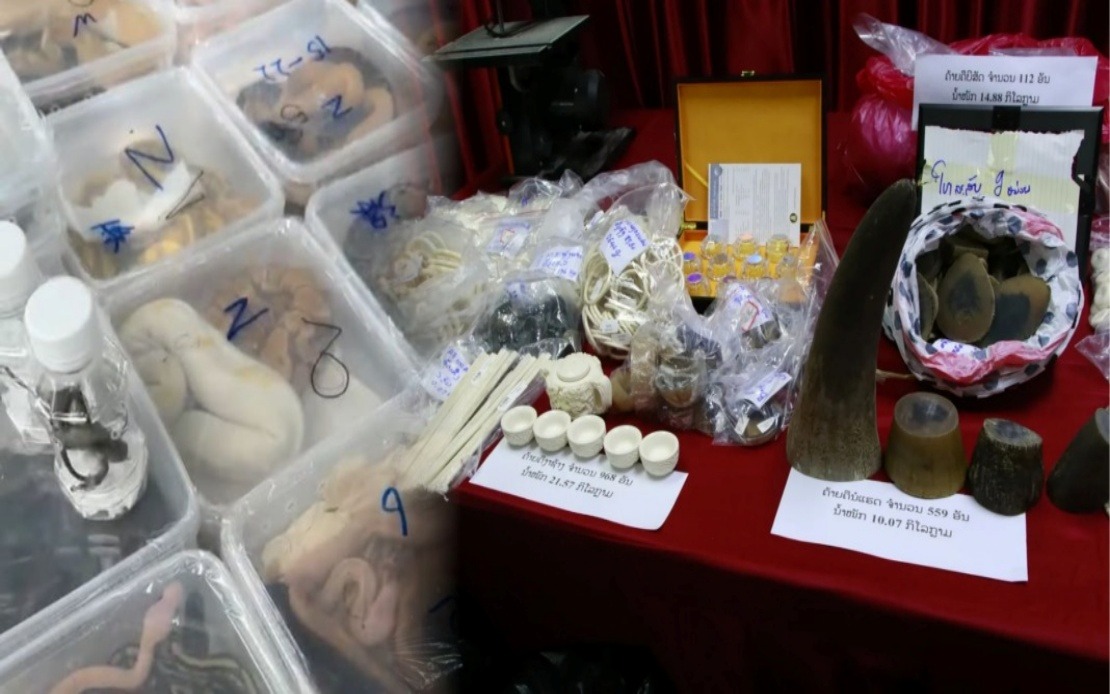
Laos has exposed a major international wildlife trafficking operation following a series of coordinated enforcement actions that have highlighted the scale and sophistication of black-market animal trading networks operating across mainland Southeast Asia. The crackdown, which netted nearly 300 live animals alongside tonnes of illegal wildlife products, underscores the region's critical vulnerability to organised smuggling syndicates that exploit porous borders and inadequate enforcement capacity.
Authorities in Luang Prabang province conducted the first significant seizure, discovering 60 kilogrammes of suspected illegal wildlife materials during an operation targeting trafficking routes used by international smuggling organisations. The haul included ivory-like objects, animal gallbladders, pangolin scales, and rhinoceros horn specimens—high-value commodities commanding premium prices in traditional medicine markets across Asia. Additional confiscations revealed elephant skin powder, bear gallbladder, hornbill heads, and herbal preparations suspected of containing wildlife derivatives, demonstrating the diversity of products flowing through trafficking channels.
Just four days after the Luang Prabang seizure, the Lao Wildlife Enforcement Network achieved an even more impressive interdiction at the Vang Tao International Checkpoint in Champasak Province, which straddles the Thai border near Ubon Ratchathani. Authorities intercepted 294 live animals being transported on an international passenger bus destined for Bangkok, revealing how traffickers brazenly move contraband through regular commercial transport networks. The captured creatures—including multiple turtle and python species, green snakes, gold-ringed cat snakes, and various lizard species—were destined for black-market pet trade, zoological collections, and traditional medicine processing facilities.
These major operations form part of an intensifying enforcement campaign across the region, reflecting growing coordination between Southeast Asian wildlife authorities. In late May, Thai investigators arrested a traditional medicine shop operator in Nakhon Phanom in northeastern Thailand, leading to the seizure of over 100 protected wildlife remains allegedly sourced from Laos. Earlier that month, Thai-Lao border authorities disrupted a trafficking attempt involving 130 kilogrammes of cut elephant ivory and animal carcasses, demonstrating the enormous volumes of material continuously flowing across these frontier zones.
Geographically, Laos occupies a uniquely vulnerable position within Southeast Asia's wildlife trafficking ecosystem. The country shares land borders with five nations—Cambodia, China, Myanmar, Thailand, and Vietnam—making it an ideal transit corridor for organised crime networks seeking to move contraband between distant markets. Wildlife destined for processing in Thailand or Vietnam, sourced from deeper within Myanmar or Cambodia, can be efficiently consolidated and redistributed through Laotian territory, where enforcement infrastructure remains comparatively weak relative to trafficking volumes.
The United Nations Office on Drugs and Crime addressed this persistent challenge in its 2024 World Wildlife Crime Report, noting that despite two decades of international cooperation and bilateral agreements, illegal wildlife trading continues unabated across the globe. The UNODC identified systemic corruption as a critical enabler of smuggling operations, with traffickers exploiting compromised officials at border posts, transportation hubs, and enforcement agencies to move contraband with minimal interruption. Underpaid rangers and police officers operating on Southeast Asian borders frequently lack resources and motivation to combat sophisticated trafficking networks backed by substantial criminal capital.
The monetary dimensions of this illicit trade dwarf many nations' development budgets. The UNODC estimates that global wildlife trafficking generates approximately US$10 billion annually—placing it in direct competition with narcotics trafficking, human smuggling, and arms dealing as a profit generator for transnational organised crime. This staggering valuation reflects extraordinarily high mark-ups on endangered species and wildlife products, particularly for commodities like rhinoceros horn and elephant ivory, which command astronomical prices in East Asian traditional medicine markets where consumers attribute mythical health properties to these materials.
For Malaysia and the broader ASEAN region, the implications of unchecked wildlife trafficking extend far beyond Laos's borders. The same trafficking networks exploiting Laotian routes operate throughout Southeast Asia, threatening species endemic to Malaysian territories. Peninsular Malaysia's remaining tiger populations, Borneo's orangutans, and the region's dwindling populations of pangolins and hornbills face existential pressure from trafficking networks integrated with the international criminal economy. Malaysian enforcement agencies must anticipate that smugglers disrupted in Laos will attempt to reroute operations through alternative frontier zones, potentially targeting Malaysian entry points to supply Southeast Asian consumption hubs.
The operational sophistication revealed in these seizures also warrants serious analysis. Traffickers organised the movement of nearly 300 animals across an international border using passenger bus transport, indicating remarkable confidence in their relationships with transportation operators, border officials, or both. This level of operational tolerance suggests institutional penetration by trafficking networks, where payments or threats maintain systematic access to critical chokepoints. The simultaneity of multiple large seizures may reflect genuine enforcement improvements, but equally could indicate that authorities have merely disrupted one corridor while trafficking networks continue operating through dozens of alternative routes with zero detection.
International frameworks designed to combat wildlife trafficking—including the Convention on International Trade in Endangered Species (CITES)—remain hampered by inconsistent enforcement and insufficient penalties. Many Southeast Asian jurisdictions treat wildlife trafficking as a minor administrative violation rather than a serious criminal offence, resulting in fines that represent negligible costs relative to trafficking profits. Until governments implement mandatory prison sentences for major traffickers and vigorously prosecute corruption within enforcement institutions, smuggling operations will continue expanding to fill the demand for wildlife products in growing Asian markets.
The rescued animals present their own humanitarian challenges. Most seized creatures cannot be returned to the wild, as they originate from non-Lao ecosystems and have been exposed to stress, injury, and disease during trafficking. Rehabilitation facilities across Southeast Asia lack capacity to accommodate hundreds of additional animals, leaving authorities with limited options beyond long-term captive care or euthanasia. This sobering reality underscores that enforcement actions, while symbolically important and necessary, address only symptoms rather than underlying drivers of trafficking demand in consuming markets.
Moving forward, progress on wildlife trafficking will require addressing root causes in consumer markets rather than exclusively focusing on enforcement interdiction. Reducing traditional medicine practitioners' reliance on endangered wildlife through promotion of synthetic alternatives, combined with public education campaigns emphasising the inefficacy of wildlife-derived products, could substantially decrease demand. Simultaneously, Southeast Asian governments must substantially increase compensation for rangers and border officials, implement severe penalties for corruption facilitating trafficking, and establish genuine transnational enforcement units with authority and resources to disrupt trafficking networks operating across multiple jurisdictions. The seizures in Laos demonstrate both the urgency of this challenge and the possibility of significant successes when enforcement mechanisms function effectively.

