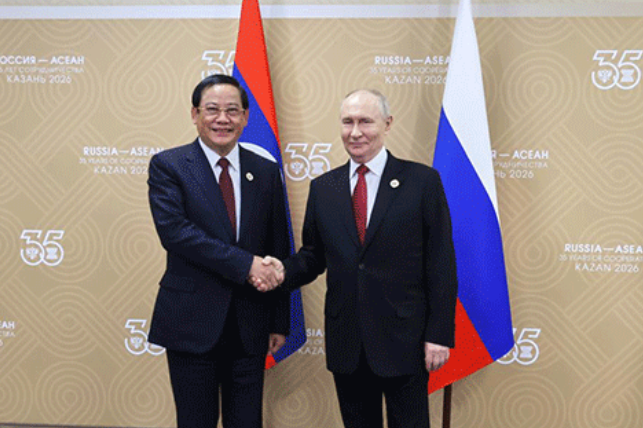
Prime Minister Sonexay Siphandone concluded his first official visit to Russia since assuming office with a meaningful reaffirmation of bilateral ties, meeting Russian President Vladimir Putin on the sidelines of the Russia-Association of Southeast Asian Nations Summit in Kazan. The June 14-17 visit, conducted at the invitation of Russian Prime Minister Mikhail Mishustin, underscores the enduring foundation of cooperation between Vientiane and Moscow and reflects Laos's careful balancing act within Southeast Asia's complex geopolitical landscape.
For Malaysian observers and the wider Southeast Asian region, the Laos-Russia engagement carries particular significance as it demonstrates how smaller nations navigate relationships with major powers while maintaining ASEAN solidarity. The meeting between Sonexay and Putin highlighted Moscow's continued strategic interest in the region at a time when Russia seeks to strengthen ties across Southeast Asia. According to Kremlin statements, Putin emphasised that Russia places considerable value on its partnership with Laos, grounded in reciprocal respect and mutual consideration—language that signals Moscow's commitment to a relationship that extends beyond purely transactional interests.
The most substantive outcome of these discussions was the signing of an intergovernmental agreement on cooperation in the peaceful use of nuclear energy. This accord represents a watershed moment in Laos-Russia relations, establishing the legal framework for constructing a small nuclear power plant utilising Russian technology within Laos. For a developing nation like Laos seeking to meet rising energy demands whilst reducing dependence on hydroelectric exports and fossil fuels, this partnership offers a pathway to diversified energy infrastructure. The agreement's significance extends regionally, as it may influence how other Southeast Asian nations evaluate their own energy security strategies and their relationships with major nuclear technology providers.
Putin's acknowledgement of Laotian President Thongloun Sisoulith's attendance at Russia's Victory Day celebrations in May, and his recognition of Laos's military participation in the 80th anniversary parade commemorating Soviet victory in World War II, underscores the deeply rooted historical dimension of this partnership. These gestures carry symbolic weight beyond ceremonial courtesy; they reflect a shared historical narrative and demonstrate Laos's willingness to engage publicly with Russian commemorative events. For Southeast Asian governments calibrating their international relationships, such visible shows of solidarity have domestic political implications and signal alignment with Moscow.
The cooperation framework extends across multiple sectors, encompassing energy, industry, agriculture, mining, digital economy, banking, transport, tourism, and education. This breadth reflects a maturing partnership that transcends narrow security or resource-extraction paradigms. The emphasis on human resource development through annual scholarships and training opportunities for Laotian nationals, including government officials, reveals Russia's investment in institutional capacity-building—a long-term strategy that cultivates generational ties and influence within Laos's bureaucracy and professional classes.
Ongoing construction of the Laos-Russia Friendship School in Vientiane exemplifies this educational and cultural dimension. Such infrastructure projects, whilst appearing modest in scale, function as visible manifestations of bilateral goodwill and create institutional spaces where Laotian and Russian citizens interact regularly. The school's completion will provide another venue for cultural exchange and soft power projection, allowing Russia to maintain influence over educational narratives and curricula within Laos.
During separate talks with Russian Prime Minister Mikhail Mishustin, Sonexay reiterated Laos's strategic commitment to the partnership, thanking Moscow for sustained assistance in governance and professional development. This exchange between premiers, running parallel to the presidential-level engagement, demonstrates the multifaceted nature of modern bilateral relations and ensures continuity across government hierarchies. The emphasis on mutual trust and expanding cooperation suggests both capitals view this relationship as foundational to their respective regional strategies.
Sonexay's participation in the Russia-ASEAN Summit and his hosting of a Laos-Russia business forum during the gathering served dual purposes: promoting concrete trade and investment opportunities whilst simultaneously elevating Laos's profile as a nation capable of bridging its ASEAN membership with strategic partnerships beyond the region. For Malaysian business interests considering Southeast Asian expansion, the opening of Laotian markets through Russian investment channels represents both opportunities and competitive considerations.
The symbolic gesture of gifting two elephants to Kazan Zoo, presented on behalf of President Thongloun and the Laotian people to commemorate the 65th anniversary of diplomatic relations and Russian Federation Day on June 12, illustrates how cultural diplomacy complements substantive negotiations. Elephants carry profound significance within Laotian national identity, and their gifting to an international zoo amplifies cultural presence whilst creating ongoing international recognition of Laos through a living symbol.
Laos's geopolitical positioning remains complex within Southeast Asia's broader strategic environment. The country shares borders with Thailand, Vietnam, Cambodia, Myanmar, and China, making it a natural crossroads where regional and great-power interests intersect. By strengthening ties with Russia through nuclear cooperation and expanded economic engagement, Laos pursues a diversification strategy that reduces dependency on any single partnership whilst maximising access to technological and financial resources. This approach aligns with broader ASEAN principles of strategic autonomy and non-alignment, even as individual members deepen relationships with external powers.
The Russia-ASEAN Summit itself reflects Moscow's determination to remain active in Southeast Asian affairs despite geopolitical tensions elsewhere. Laos, holding the ASEAN chair at various points and maintaining bridges across the association's internal divides, positions itself as a natural venue and interlocutor for Russian engagement with the region. Putin's acknowledgement of Laos's support in developing Russia-ASEAN cooperation, with 2026 marking the 35th anniversary of formal relations between Russia and the regional grouping, contextualises bilateral ties within the broader architecture of institutional engagement.
For Malaysia and other ASEAN members, the Laos-Russia nuclear energy accord introduces new energy technology considerations into regional discussions around infrastructure development and sustainability. As countries across Southeast Asia grapple with energy transition challenges and seek partnerships with technology providers, the precedent set by Laos may influence procurement decisions and diplomatic engagements elsewhere in the association. The agreement also raises questions about technology transfer, safety standards, and regulatory frameworks that extend beyond bilateral Laos-Russia considerations.
The visit's emphasis on shared perspectives at the United Nations and other international forums suggests alignment on key geopolitical issues, likely including security concerns in the Indo-Pacific region and positions on global economic governance. While Laos maintains formal ASEAN neutrality on major power competition, its strategic partnership with Russia inevitably reflects viewpoints that may diverge from consensus positions emerging elsewhere in Southeast Asia. This complexity characterises contemporary regional diplomacy, where individual nations navigate multiple, sometimes competing relationships whilst maintaining institutional commitments to ASEAN.
Looking forward, the Laos-Russia partnership appears poised for deepening engagement across energy, infrastructure, education, and defence dimensions. The nuclear cooperation framework, in particular, signals a commitment to long-term technological and institutional collaboration that will shape Laotian development trajectories for decades. For Southeast Asia more broadly, the trajectory of Laos-Russia relations offers lessons in how smaller nations can leverage strategic positioning to access resources and technology from major powers whilst maintaining regional commitments and avoiding exclusive alignment that might provoke backlash from neighbours or rival partners.

