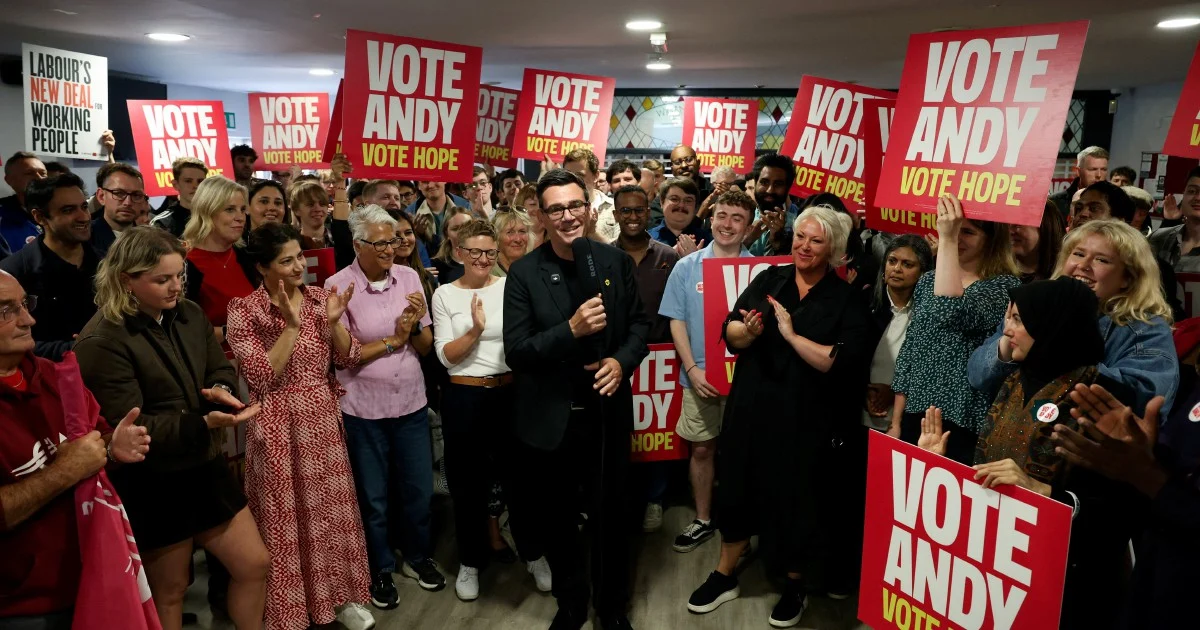
Andy Burnham's attempt to secure a Westminster seat in the Makerfield by-election on Thursday appears to be benefiting from a strategic advantage rarely discussed openly in British politics: the collapse of unified opposition to Labour. Rather than facing a consolidated centre-right challenge, the former Manchester mayor finds himself in a contest where the fractured right-wing landscape could hand him victory regardless of his personal standing or policy platform.
The context matters significantly for understanding British electoral dynamics and their broader implications. Burnham is not merely contesting a routine constituency election; he is explicitly positioning himself as a serious challenger to Prime Minister Keir Starmer's leadership. For the Labour frontbencher to make such an ambition credible, he must first return to the House of Commons, having previously lost his Greater Manchester mayor position and subsequently stepped away from Parliament. The Makerfield seat represents his pathway back to Westminster and, from there, to potentially the highest office.
What makes this moment particularly consequential is the unprecedented split occurring within Britain's conservative voting bloc. The Conservative Party, historically the natural repository of right-leaning voters in constituencies like Makerfield, now competes directly with Reform UK, a populist movement led by Nigel Farage that has captured significant portions of traditionally Tory-supporting demographics. This fragmentation means that opposition votes are being dispersed across multiple candidates rather than concentrated behind a single anti-Labour contender.
Makerfield itself typifies the kind of working-class constituency where such divisions prove most damaging to opposition unity. These industrial heartland seats, particularly in the North West, have historically alternated between Labour and Conservative control, with local economic circumstances and cultural attitudes toward Westminster often determining outcomes. The presence of both an official Conservative candidate and a Reform UK candidate in what should be a straightforward two-way race against Burnham essentially guarantees that the opposition remains divided.
For Malaysian observers of British politics, this dynamic offers instructive parallels about the dangers of fractionalised opposition movements. When political blocs fail to coordinate or when ideological disputes create parallel leadership structures, the primary beneficiary tends to be whichever party maintains organisational unity. Burnham's position benefits from this principle almost incidentally; his actual political appeal or policy platform becomes secondary to the simple arithmetic of vote distribution.
The stakes extend beyond a single seat or even Burnham's personal ambitions. Labour under Starmer currently governs with a substantial majority achieved in the previous general election, yet the party's popularity has declined since then. Burnham represents a potential challenger from within Labour itself, suggesting that internal dissatisfaction with current leadership may be growing. Should he successfully return to Parliament using Makerfield as his vehicle, his profile would be sufficiently elevated to present a credible alternative to Starmer within party circles.
The Conservative-Reform UK split also reflects deeper currents in British political culture that should concern anyone invested in democratic representation. When established parties fracture under populist pressure, the resulting fragmentation often serves to undermine parliamentary majorities and stable governance. Reform UK's existence and growing electoral relevance signals that a significant segment of British voters feels unrepresented by mainstream conservatism, yet without achieving sufficient scale to overtake the Conservative Party itself.
Burnham's own political trajectory has been marked by ambition tempered with setbacks. His unsuccessful campaigns for Labour leadership and his departure from elected office suggested his national political career might have concluded. The Makerfield opportunity allows him to reset this narrative, positioning himself as a politician returning to frontline politics rather than one lingering on the margins. Whether he can actually leverage a Makerfield victory into genuine leadership credibility depends on factors beyond the immediate by-election result.
The broader implications for Britain's political settlement remain uncertain. Should Labour continue governing while Burnham establishes himself as an internal rival to Starmer, the party could face renewed factionalism precisely when it needs to consolidate support. Conversely, if the Makerfield contest demonstrates that voters are increasingly open to alternatives across the political spectrum, it could signal that the next general election will produce results quite different from the comfortable Labour majority currently in Westminster.
For Southeast Asian democracies observing British politics, the Makerfield contest illustrates how electoral mathematics can sometimes matter more than policy substance or leadership quality. The interplay between Conservative and Reform UK fracturing opposition support provides Burnham with an opportunity that his own political standing alone might not have generated. This serves as a reminder that electoral outcomes often reflect broader structural factors—party discipline, vote distribution, and institutional fragmentation—rather than serving as pure referendums on individual politician merit or popular preference.