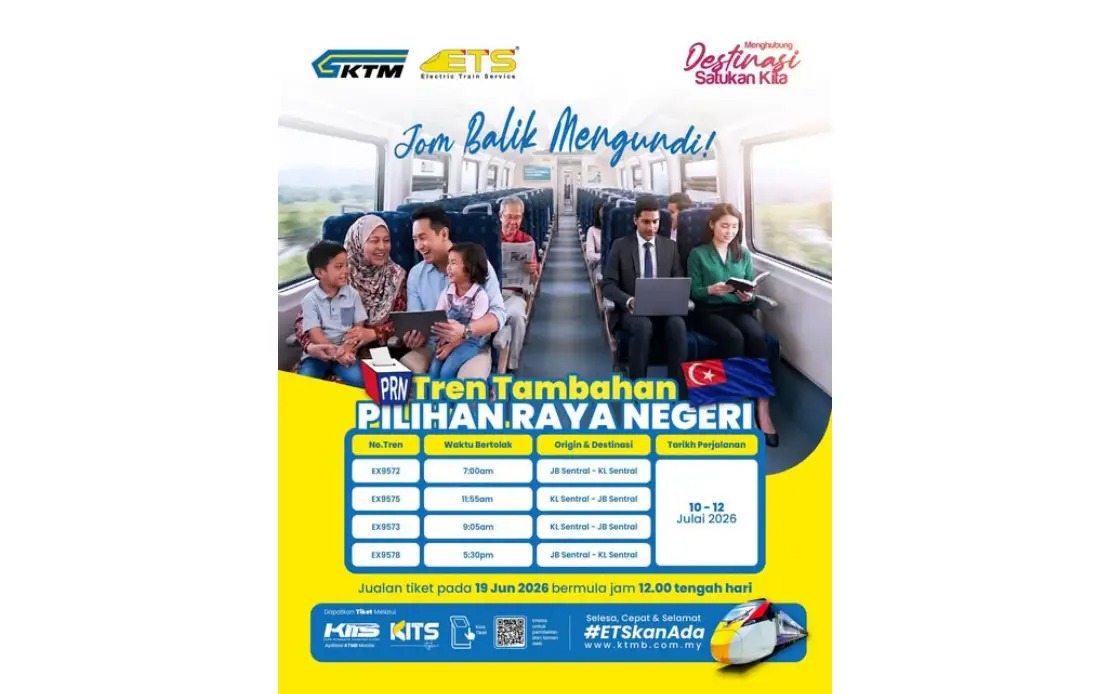
Keretapi Tanah Melayu Berhad (KTMB) has responded to the anticipated travel surge surrounding the Johor state election by introducing supplementary Express Rail Link (ETS) services on southbound routes. The rail operator announced the expanded capacity through social media, signalling an effort to accommodate the large number of voters expected to make their way back to their home constituencies ahead of polling day.
The additional trains will operate between July 10 and 12, bracketing the election day of July 11 set by the Election Commission. This timing reflects a well-established pattern in Malaysian electoral cycles, where significant population movements occur as citizens travel from their workplaces and places of study back to their registered voting locations. The three-day window provides flexibility for voters arriving from different parts of the peninsula, particularly those working in the Klang Valley or studying at universities across Malaysia who need time to reach Johor.
Ticket sales commenced at midday today through multiple channels, reflecting KTMB's attempt to modernise its booking infrastructure and cater to different customer preferences. The mobile-first approach through the KTMB Mobile app aligns with prevailing user behaviour among younger voters, while the traditional KITS Style app, official website at online.ktmb.com.my, and physical ticket kiosks ensure accessibility for all demographics. This multi-platform strategy recognises that not all travellers are equally comfortable with digital booking, particularly among older voters who may prefer face-to-face transactions.
The Johor state election represents a significant political event following the dissolution of the State Legislative Assembly on June 1. Johor's position as Malaysia's second-most populous state, with substantial economic importance and a highly competitive political landscape, means that voter participation rates are typically high. The state's geographic sprawl, with parts of the southern regions located considerable distances from major population centres, necessitates robust transportation infrastructure to ensure electoral accessibility.
The decision to expand rail capacity speaks to the logistical challenges inherent in managing simultaneous voting across a large state with dispersed communities. Many Johor residents work or study outside the state, particularly in the federal territories and Selangor, making train services crucial for enabling democratic participation. Without such provisions, voters might face insurmountable travel burdens, effectively creating barriers to franchise exercise. KTMB's proactive stance thus serves both practical and democratic functions.
For the broader Southeast Asian context, Malaysia's approach to election-related infrastructure demonstrates how democratic nations manage the intersection of mobility and voting rights. The ETS system, which connects major Malaysian cities via high-speed rail, has become integral to the country's electoral infrastructure. By adding capacity during election periods, authorities acknowledge the legitimate spike in demand while maintaining service for regular commuters and cargo operations.
The expansion also reflects increasing coordination between government agencies during electoral periods. KTMB's announcement suggests consultation with the Election Commission regarding anticipated travel patterns and capacity requirements. Such inter-agency planning, while routine in mature democracies, remains important to highlight as evidence of institutional coordination around electoral processes in Malaysia.
From an economic perspective, the additional services represent a modest investment in electoral infrastructure that generates revenue for the rail operator while serving the public interest. During non-election periods, maintaining excess train capacity would be economically inefficient, but the predictable, time-bound surge in demand during elections justifies temporary fleet deployment adjustments.
The emphasis on digital booking platforms also merits attention in the context of Malaysia's digital transformation agenda. By directing voters toward online purchasing, KTMB reduces congestion at physical ticket counters and gathers valuable data on travel patterns. This information can inform future infrastructure decisions and service improvements, creating a feedback loop that enhances transportation planning.
For Malaysian commuters unfamiliar with the booking process, the multiple access points KTMB provides lower friction significantly. First-time users can visit ticket kiosks for guidance, while regular travellers can streamline their bookings through the mobile application. This tiered approach acknowledges varying levels of digital literacy across Malaysia's diverse population.
The Johor election, set for July 11, will ultimately determine the state's political direction. The availability of affordable, convenient transportation to voting locations ensures that geographic distance does not disadvantage voters. Whether this expanded capacity proves sufficient will only become clear once actual booking patterns emerge, but KTMB's proactive approach suggests confidence that demand can be managed effectively within the announced service additions.