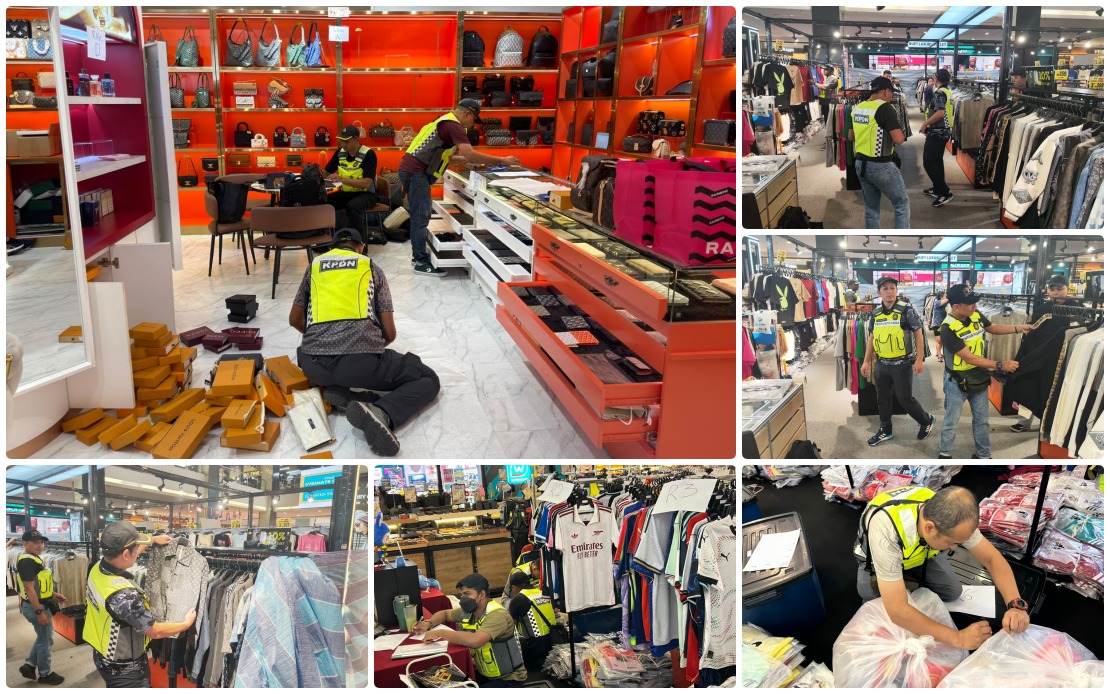
Malaysia's Ministry of Domestic Trade and Cost of Living (KPDN) has struck a significant blow against intellectual property crime in the southern states, executing coordinated raids on three Johor Bahru premises on June 15 that resulted in the seizure of suspected counterfeit branded merchandise worth RM600,000. The enforcement action targeted vendors who had been operating what authorities characterize as a sophisticated distribution network, supplying knockoff luxury items through major retail channels and to downstream traders across the region.
Datuk Azman Adam, the KPDN's enforcement director-general, outlined the scope of the investigation at a press briefing in Putrajaya on June 19, revealing that the agency's Putrajaya Enforcement Division had conducted an exhaustive month-long intelligence operation before moving in. The raids exposed premises that were openly displaying and selling merchandise bearing the trademarks of established international brands without any authorization from the legitimate trademark proprietors. The scale of the seizure indicates the operation had evolved beyond simple retail sales into what officials believe was an organized distribution enterprise supplying other traders across multiple tiers of the supply chain.
The confiscated inventory encompassed an extensive range of counterfeit luxury goods, including designer clothing, handbags, wallets, belts, and perfumes alongside relevant business documentation. The breadth of product categories underscores how counterfeit operations have evolved to replicate entire lifestyle brands rather than focusing on single product lines. This diversification strategy makes such networks particularly attractive to retailers seeking to offer comprehensive knockoff ranges that appeal to price-conscious consumers seeking the appearance of luxury branding without the authentic price tags.
Authorities detained four local individuals—comprising the owner and facility custodian of the premises—for further questioning as part of their ongoing investigation. Their roles in managing the operational logistics of the business suggest a level of organizational structure that extends beyond opportunistic selling. The investigation's focus on business management practices indicates KPDN is attempting to dismantle the infrastructure supporting these operations rather than merely confiscating isolated inventory.
The legal framework underpinning the enforcement action derives from Section 102(1)(c) of the Trademark Act 2019, which specifically addresses the possession, custody, or control of goods bearing improperly applied trademarks for trading purposes. This statutory provision represents Malaysia's legislative commitment to protecting intellectual property rights and maintaining market integrity. The preliminary inspection and verification conducted by representatives of the complainant yielded sufficient evidence to establish reasonable cause that trademark infringement had occurred, meeting the evidentiary threshold required for formal charges.
The sentencing guidelines for conviction under this legislation are notably stringent, reflecting policymakers' assessment that trademark counterfeiting constitutes a serious economic crime warranting substantial punishment. For individuals convicted on a first offence, the law prescribes a maximum fine of RM10,000 per counterfeit item or imprisonment extending to three years, with both penalties potentially applied concurrently. This structure means a distributor with hundreds of counterfeit items faces cumulative financial exposure in the millions of ringgit, creating genuine deterrent effects for would-be offenders evaluating the risk-reward calculus of participation in such schemes.
Repeat offenders face dramatically escalated consequences, with fines rising to RM20,000 per item and imprisonment potentially extending to five years. This graduated penalty structure acknowledges that recidivist participation in counterfeiting demonstrates a deliberate disregard for intellectual property law and represents a more entrenched threat to market integrity. The severity reflects parliamentary determination that sophisticated counterfeiters deserve treatment as serious commercial criminals rather than mere regulatory violators.
Corporate entities and business structures involved in counterfeit operations confront even more draconian financial penalties, with first-time fines capped at RM15,000 per item and escalating to RM30,000 for subsequent offences. The distinction between individual and corporate penalties reflects recognition that organized commercial enterprises engaged in systematic counterfeiting represent a qualitatively different threat than individual opportunistic traders. The doubling of corporate penalties incentivizes legitimate businesses to maintain robust supply chain controls and authentication protocols rather than risk association with counterfeit networks.
The enforcement action assumes particular importance within the Southeast Asian context, where Malaysia functions as a significant regional hub for both legitimate trade and illicit commercial activity. The presence of major port facilities, highway infrastructure, and logistics networks makes Johor especially vulnerable to counterfeit goods trafficking originating from or transiting through the state. Thailand, Vietnam, and Indonesia have emerged as significant sources of counterfeit merchandise destined for Malaysian markets, and effective enforcement in Johor directly impacts the entire regional market's integrity.
KPDN's enforcement director-general explicitly signaled the agency's determination to sustain and intensify its crackdown efforts, stating that the ministry would continue conducting operations with uncompromising dedication against any parties engaged in manufacturing, distributing, or retailing counterfeit goods that violate intellectual property rights. This rhetorical commitment, backed by concrete enforcement action, serves multiple purposes: it reassures legitimate brand owners of government protection, deters potential counterfeiters through demonstrated enforcement capacity, and signals to consumers that authorities take market integrity seriously.
The counterfeit goods market represents a substantial threat to Malaysia's formal economy and brand reputation. Consumer deception erodes trust in retail markets, while the tax evasion inherent in informal counterfeit sales represents revenue loss to government coffers. Additionally, association with high-volume counterfeiting damages Malaysia's positioning as a trustworthy commercial hub within ASEAN, potentially undermining legitimate trade relationships and foreign investor confidence.
The Johor operation exemplifies how intelligence-driven enforcement, rather than reactive responses to complaint-driven investigations, generates substantial seizures and dismantle organized networks. The month-long intelligence gathering phase proved essential to identifying the scale of operations and the distribution relationships connecting the raided premises to downstream retailers. This investigative methodology, if systematically applied across other Malaysian states, could substantially degrade counterfeit distribution networks.
Moving forward, the efficacy of this enforcement approach will depend on sustained institutional commitment and resource allocation to counterfeit investigation and prosecution. Public awareness campaigns explaining the consumer and economic harms of counterfeiting, complemented by aggressive prosecution of detained individuals and corporate entities, would amplify the deterrent effects of seizure operations. Malaysia's positioning as a regional economic leader necessitates demonstrated commitment to intellectual property protection and market integrity enforcement.

