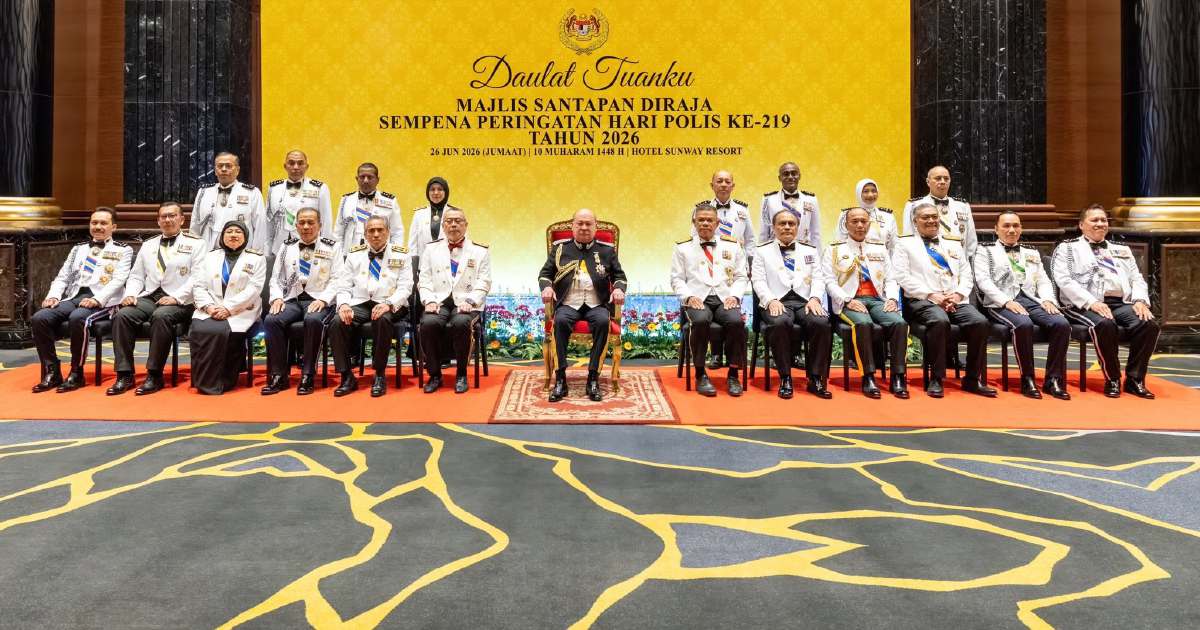
His Majesty Sultan Ibrahim, King of Malaysia, attended a grand royal banquet held in Subang Jaya last evening to commemorate the 219th Police Day celebration, an occasion that underscores the significance of Malaysia's police force in maintaining national security and public order. The event brought together senior police leadership, government officials, and distinguished guests to mark two centuries of service spanning from the force's establishment through to its present-day operations across the country.
The monarch's attendance at the banquet carries symbolic weight in Malaysia's constitutional framework, as the Yang di-Pertuan Agong serves as the supreme head of state and patron of key national institutions. By personally participating in the Police Day commemoration, His Majesty demonstrated the Crown's continued endorsement of the Royal Malaysia Police's mission and its role as a pillar of national stability. Such royal patronage has long been an integral component of how Malaysia's police service connects with the broader Malaysian public and reinforces the force's institutional legitimacy.
Police Day itself represents an annual opportunity for reflection on the achievements, challenges, and evolution of law enforcement in Malaysia. The 219-year marker reflects the considerable historical depth of organized policing in the region, tracing back through different colonial and post-independence eras. Throughout these decades, the force has adapted to shifting security threats, modernized its operational capabilities, and expanded its responsibilities to address contemporary challenges ranging from cybercrime to transnational smuggling operations.
The royal banquet format traditionally serves multiple functions within Malaysia's state ceremonial calendar. Beyond the celebratory aspects, such events provide a platform for recognizing the contributions of police personnel who have served with distinction, acknowledging the sacrifices made by officers and their families, and reaffirming the government's commitment to supporting law enforcement. The gathering also creates opportunities for dialogue between senior police command and political leadership on matters affecting public safety and security policy.
For Malaysian readers and the broader Southeast Asian context, the prominence given to Police Day reflects regional concerns about maintaining public order in an era of evolving security challenges. Southeast Asia as a whole faces interconnected threats including organized crime networks, illegal migration, and border security concerns that demand sophisticated law enforcement responses. Malaysia's police force, as one of the region's major law enforcement agencies, plays a critical role in addressing these transnational issues through cooperation with counterparts across neighbouring countries.
The timing of the Police Day celebration also coincides with ongoing discussions within Malaysia about police reform and modernization. Recent years have seen increased attention to community policing approaches, officer training standards, and the integration of technology into law enforcement operations. The royal banquet serves as a moment to celebrate institutional identity while the force continues navigating broader questions about enhancing professionalism, transparency, and public trust.
Subang Jaya, the location chosen for the banquet, is a significant urban centre in the Klang Valley and an important area for Malaysian law enforcement operations. The city has experienced considerable development and demographic growth, presenting both opportunities and challenges for police resource allocation and community safety initiatives. Hosting the national Police Day commemoration in this location reflects its importance within Malaysia's policing landscape.
The presence of diverse state and national leadership at such events underscores the collaborative nature of Malaysia's approach to public security. Police operations exist within a broader ecosystem that includes various federal and state agencies, the judiciary, and local government authorities. Royal occasions like the Police Day banquet create platforms for these stakeholders to align on security priorities and demonstrate institutional cohesion to the public.
For members of the police force themselves, royal recognition carries particular significance in a constitutional monarchy. The personal attendance of the Yang di-Pertuan Agong acknowledges the demanding and sometimes dangerous nature of police work, the dedication required across all ranks, and the nation's appreciation for law enforcement's contribution to social stability. Such gestures contribute to police morale and reinforce the sense that their efforts are valued at the highest levels of the state.
Looking forward, the symbolic endorsement provided through such royal events may gain increasing importance as Malaysia's police force contends with evolving public expectations around accountability, digital-age crime fighting, and community engagement. The force must balance traditional law enforcement functions with emerging requirements for transparency and modern policing standards, and institutional validation from the monarchy helps anchor these institutions during periods of organizational change.
The 219th Police Day celebration ultimately represents a moment of national reflection on how Malaysia maintains order and security amid rapid social, economic, and technological change. The royal banquet's significance extends beyond ceremonial formality to embody the state's commitment to supporting the institutions responsible for public safety, a commitment that remains essential for regional stability and citizen confidence in Malaysia's governance structures.

