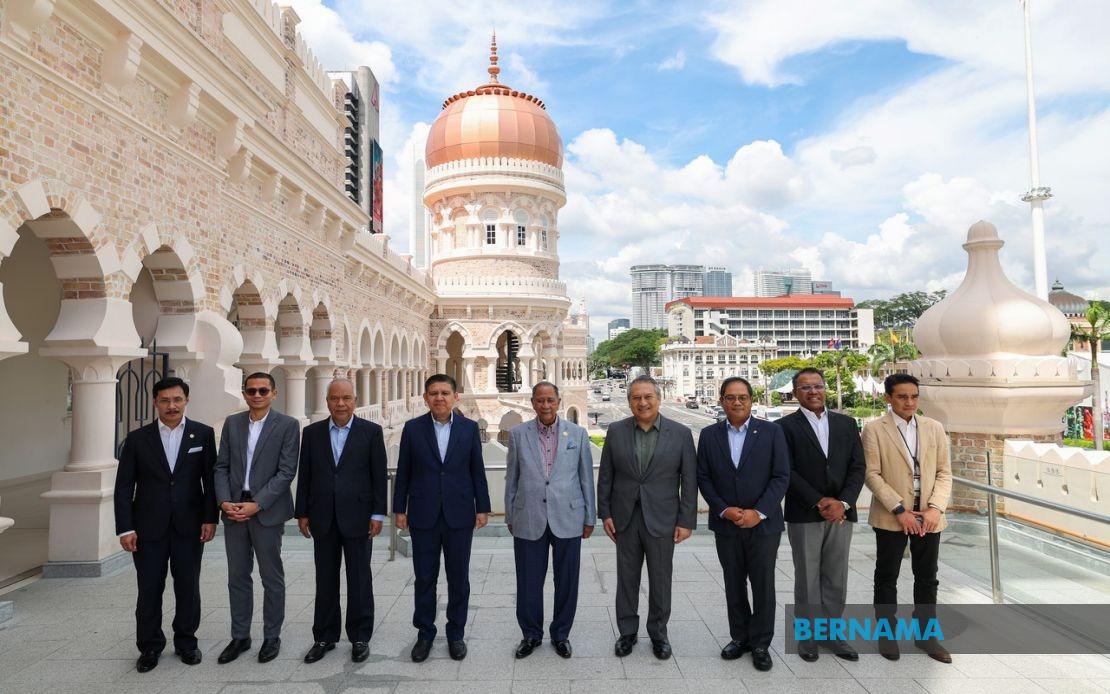
The Sultan of Kedah, Al Aminul Karim Sultan Sallehuddin Sultan Badlishah, made an official visit to the Sultan Abdul Samad Building in Kuala Lumpur on June 24, underscoring the continued significance of the nation's most iconic heritage structure. His Royal Highness arrived at the historic complex at approximately 10:30 am, where he was welcomed by Khazanah Nasional's managing director Datuk Amirul Feisal Wan Zahir. The visit demonstrated royal patronage of the extensive conservation efforts undertaken at the building, which stands as a testament to Malaysia's colonial and post-independence eras.
The Sultan's itinerary included a comprehensive tour of the Confluence Hall, a newly established gallery space that chronicles the origins and expansion of Kuala Lumpur through carefully curated exhibits. During this segment of his visit, Think City's senior manager Mariana Isa provided the royal guest with detailed explanations of the displays, contextualising the city's transformation from a tin-mining settlement to a modern metropolis. This educational component of the tour reflected the broader preservation mandate that extends beyond mere structural restoration to encompassing the storytelling and cultural interpretation of Malaysia's urban development.
From there, His Royal Highness proceeded to the Visionary Hall, an exhibition space featuring scale models and interactive multimedia presentations depicting various aspects of Kuala Lumpur's future trajectory and historical development. The Sultan then accessed the balcony overlooking the Porte Cochere, the building's distinctive covered entrance that has framed countless significant moments in the nation's political history. These curated vantage points allowed the royal visitor to appreciate both the architectural grandeur of the building and the narratives embedded within its spaces.
A notable element of the royal visit included an inspection of the School of Hard Knocks, an operational social enterprise run by Royal Selangor that provides training and employment opportunities. This component underscored how heritage conservation in Malaysia increasingly incorporates contemporary social missions alongside preservation objectives. Following the tour, His Royal Highness participated in a light luncheon before departing the building at approximately 1:15 pm.
Khazanah Nasional's leadership articulated the deep significance of the royal visit for the nation's heritage preservation agenda. Datuk Amirul Feisal emphasised that the sultan's inspection carried profound symbolic weight, affirming institutional commitment to maintaining historical consciousness among Malaysians. He characterised the preservation initiative as extending far beyond the physical restoration of stonework and interiors to encompassing the broader project of safeguarding and transmitting the historical narratives that define the nation's identity. The acknowledgment from the Kedah Sultan demonstrated cross-state royal endorsement for heritage conservation efforts centred in the federal capital.
Since opening to the general public on February 2, the Sultan Abdul Samad Building has attracted approximately 200,000 visitors, indicating substantial public interest in engaging with Malaysia's architectural and political heritage. This visitor volume suggests growing appetite among Malaysians and international tourists to understand the physical spaces where pivotal national moments unfolded. The building's reopening thus represents not merely a restoration project but a mechanism for democratising access to heritage and historical education.
The building's restoration formed part of Phase One conservation work that concluded in January, when His Majesty Sultan Ibrahim, King of Malaysia, officiated the completion of these extensive restoration works. The initiative operated under the Khazanah Heritage Fund programme, demonstrating sustained institutional investment in preserving the nation's architectural patrimony. The eleven-month conservation period involved meticulous technical work to stabilise and restore the structure whilst maintaining its historical integrity.
Originally constructed as the Secretariat Building during the British colonial administration, the Sultan Abdul Samad Building transcends its architectural significance to embody Malaysia's transition from colonial rule to independent statehood. The structure witnessed the momentous lowering of the Union Jack flag and the inaugural raising of the Federation of Malaya flag in 1957, making it an irreplaceable physical witness to decolonisation. No photograph or written account can substitute for the visceral experience of standing within the spaces where such transformative events occurred, which partly explains the building's enduring symbolic resonance for Malaysians.
The royal visit also reflected broader patterns in Southeast Asia regarding heritage preservation as a state priority. As regional nations increasingly recognise the economic and cultural returns on heritage investment, Malaysia's model of combining public access, educational programming, and ongoing restoration demonstrates a comprehensive approach to conservation. The Sultan of Kedah's participation in the BSAS tour contributes to a narrative of inter-state cooperation and unified commitment to preserving shared regional historical understanding.
For Malaysian constituencies, the restoration and public reopening of the Sultan Abdul Samad Building represents tangible effort to maintain historical landmarks and ensure younger generations can engage directly with the physical settings of national formation. The presence of royal endorsement, whether from the King of Malaysia or the Sultan of Kedah, signals that heritage preservation commands institutional priority across the federation's political structures. The building now functions simultaneously as museum, educational institution, and symbolic anchor for national identity.

