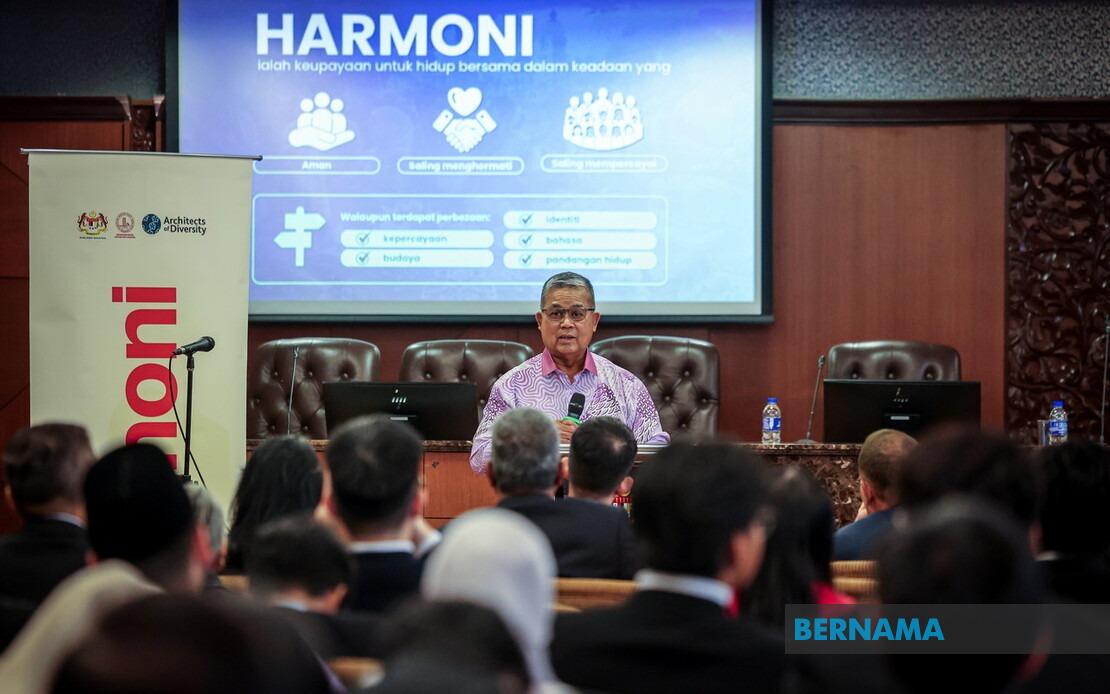
Malaysia's Department of National Unity and National Integration (JPNIN) is advancing plans for a Community Tension Index designed to systematically measure levels of social cohesion across the country while tracking emerging issues around racial and religious sensitivities. The initiative represents a strategic shift towards data-driven governance in managing the complex dynamics of Malaysia's multicultural society.
Minister of National Unity Datuk Aaron Ago Dagang outlined the rationale behind the project during remarks at the 2026 Harmony Symposium, organised by the Secretariat of the Malaysian Parliamentary Cross-Party Group on Racial and Religious Harmony at Parliament House. The minister emphasised that the index would provide empirical foundations for government decision-making, allowing policymakers to identify tensions early and implement targeted intervention strategies before grievances escalate into broader conflict.
The timing of the initiative reflects growing concerns about the transformation of national unity challenges in the digital age. Between January 1, 2025 and January 31, 2026, Malaysia's Communications and Multimedia Commission (MCMC) removed 1,493 pieces of online content deemed to breach sensitivities related to religion, royalty and race—collectively referred to as 3R issues. This enforcement activity underscores the scale of problematic content circulating across digital platforms and highlights the government's determination to police online spaces that threaten social harmony.
Aaron drew particular attention to structural features of social media that amplify polarisation and hinder constructive dialogue. The phenomenon of filter bubbles—where algorithms personalise content to show users primarily information aligned with their existing beliefs—creates self-reinforcing echo chambers that narrow exposure to diverse viewpoints. This technological dynamic compounds the challenge of maintaining national unity in a society comprising multiple ethnic and religious communities with distinct interests and sensitivities. The minister's analysis reflects growing international recognition that social media platforms can inadvertently function as forces fragmenting rather than unifying communities.
The Community Tension Index represents one pillar of JPNIN's broader strategy for safeguarding social cohesion. By establishing quantifiable metrics for measuring community relations, the government aims to move beyond anecdotal assessments towards rigorous monitoring that can inform policy adjustments in real time. Such an index could track indicators ranging from inter-community relations to instances of discrimination, religious sensitivity incidents and shifts in public sentiment on sensitive issues. This data infrastructure would enable the government to detect warning signs of growing tension before they manifest as major incidents.
Complementing the index is JPNIN's parallel initiative to establish a National Harmony Commission (SKN). The proposed institution would function as a dedicated mechanism for conflict prevention, mediation and resolution, operating according to principles designed to preserve harmony while addressing underlying grievances. Aaron explained that the commission would also have investigative powers concerning matters that could undermine national cohesion, positioning it as an institutional safeguard against festering tensions. In Malaysia's context, where sensitivity around 3R issues can quickly escalate disputes, such an institutionalised approach offers the potential for neutral arbitration.
Developing the National Harmony Commission has involved substantial preparatory work. JPNIN has conducted extensive engagement sessions with diverse stakeholders—including representatives from various communities, civil society organisations, religious bodies and political parties—to gather feedback on the commission's proposed structure, mandate and operational procedures. This consultative approach recognises that legitimacy and effectiveness of such an institution depend on broad acceptance across Malaysia's plural society. By soliciting input from multiple quarters, JPNIN aims to ensure that the commission commands respect and cooperation from the communities it serves.
The initiatives announced by Aaron carry particular significance for Malaysia's regional standing. As a Southeast Asian nation with considerable ethnic and religious diversity, Malaysia's management of intercommunal relations serves as a model—positive or cautionary—for neighbouring countries grappling with similar challenges. Singapore, Thailand and Indonesia all face comparable pressures from digital polarisation and religious sensitivities. Malaysian innovations in systematic monitoring and institutional design for harmony maintenance could offer lessons for regional peers, while also positioning Malaysia as a thought leader in managing diversity in the digital era.
For ordinary Malaysians, the Community Tension Index and proposed National Harmony Commission represent governmental acknowledgement that preserving unity requires proactive, sophisticated approaches. Rather than treating tensions as inevitable features to be suppressed reactively, these initiatives suggest a commitment to understanding the roots of division and intervening constructively. Citizens who feel their concerns are being systematically monitored and fairly addressed through neutral institutional mechanisms may develop greater confidence in the state's commitment to equitable governance across communities.
The emphasis on early intervention and conflict prevention also reflects lessons learned from social harmony challenges elsewhere globally. Rather than waiting for tensions to explode into violence or legal violations, the index-based approach aspires to identify friction points while they remain manageable through dialogue and adjustment. For Malaysia's business community and foreign investors, a government demonstrating sophisticated capability for managing social cohesion offers greater predictability and stability than reactive crisis management.
Moving forward, the success of these initiatives will depend significantly on technical execution and political will. The Community Tension Index must be designed with sufficient rigour to capture genuine shifts in community sentiment rather than merely reflecting government preferences. The National Harmony Commission will need sufficient independence and transparent procedures to command credibility across Malaysia's plural landscape. Moreover, these mechanisms must be accompanied by broader policy frameworks that address substantive grievances—not merely their perception—if they are to achieve lasting impact.
The government's commitment to these institutional developments suggests recognition that Malaysia's unity cannot be taken for granted in an era of digital fragmentation. By combining data-driven monitoring with dedicated conflict resolution capacity, JPNIN is attempting to build systematic resilience into Malaysia's approach to managing diversity. Whether these initiatives prove effective will become evident as the Community Tension Index matures and the National Harmony Commission, if established, begins operating within Malaysian society.

