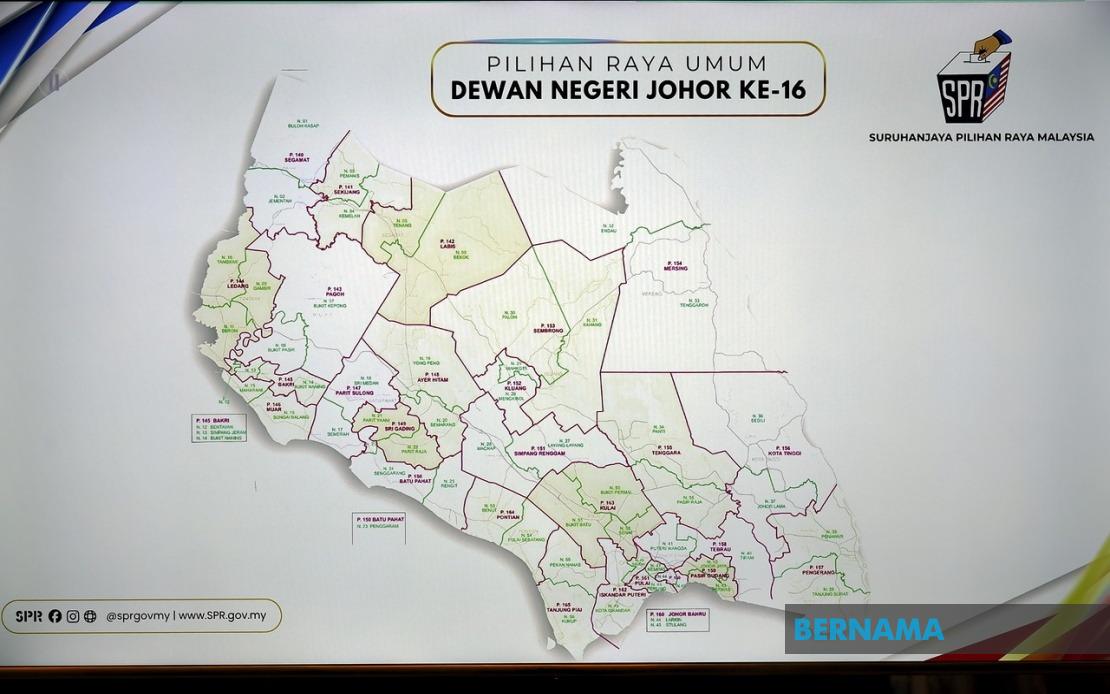
Johor steps into one of its most consequential electoral contests tomorrow as candidates from competing political coalitions converge to formally register their bids for the 56 state assembly seats. The nomination process, running from 9 am to 10 am across designated registration centres, represents the official opening of what is expected to be a fiercely contested race with significant implications for the state's political direction and the broader dynamics of Malaysian politics heading into the next phase of governance.
The stakes surrounding this election are amplified by the sheer size of the electorate and the competitive intensity already evident from party strategies. The Election Commission has registered 2,727,926 eligible voters across Johor, comprising more than 2.7 million ordinary citizens alongside 12,041 military personnel and their spouses, and 12,710 police officers and their families. This voter base will ultimately decide the outcome through ballots cast on July 11, with early voting opportunities available on July 7 for those unable to participate on election day.
Pakatan Harapan approaches this contest with comprehensive coverage, fielding candidates in all 56 constituencies. The coalition's distribution reflects its organisational structure, with Parti Keadilan Rakyat contributing 20 nominees, Amanah 19, and the Democratic Action Party 17. This unified approach signals the opposition coalition's determination to make significant inroads in a state where Barisan Nasional has traditionally maintained strongholds, though recent political realignments have created new competitive openings.
Barisan Nasional matches Pakatan Harapan's full-slate strategy with its own comprehensive candidate roster. UMNO, the coalition's dominant component, fields 36 candidates, while the Malaysian Chinese Association contributes 16 and the Malaysian Indian Congress four. This distribution underscores the coalition's confidence in its grassroots machinery, though it also reflects the demographic challenges facing its partners, particularly the MIC, which faces declining electoral support from the Indian community.
Perikatan Nasional, increasingly assertive in Malaysian electoral politics, presents a more fragmented offering that nonetheless demonstrates ambition across the state. The Pan-Malaysian Islamic Party contests 11 seats, Bersatu 16, and the Malaysian Indian People's Party five. This coalition's strategy appears focused on strategic contestation rather than comprehensive coverage, suggesting calculations about resource allocation and competitive capacity in specific constituencies where the coalition perceives electoral advantages.
The field extends beyond the three major coalitions, introducing additional variables into the electoral equation. The Malaysian United Democratic Alliance will contest four seats, building on its previous electoral success, while the Socialist Party of Malaysia fields a single candidate and Parti Bersama Malaysia makes its electoral debut across 15 constituencies. These smaller players may influence outcomes in closely contested seats, particularly in areas where their platforms resonate with specific voter segments or where they fragment votes in ways that benefit larger competitors.
Election administrators have initiated preparatory measures to ensure the nomination process operates smoothly tomorrow. The Election Commission has advised prospective candidates to verify their nomination documentation in advance at returning officer offices or the State Election Office, a precaution designed to prevent last-minute procedural complications that could disqualify candidates or create confusion during the registration window. Additionally, candidates are encouraged to settle deposit payments ahead of nomination day and retain receipts as evidence when submitting their official papers.
Anticipation of electoral misconduct has prompted the Malaysian Anti-Corruption Commission to activate enforcement mechanisms specifically designed to detect and deter corrupt practices throughout the campaign period. The MACC has established five 24-hour operations rooms stationed in Tampoi, Batu Pahat, Kluang, Segamat, and Mersing, providing public channels for reporting suspected corruption, abuse of power, or violations of electoral law. This enforcement apparatus reflects growing concern about maintaining electoral integrity as competition intensifies.
The dissolution of the Johor State Legislative Assembly on June 1 initiated the election timeline that culminates tomorrow with candidate registration. The previous 2022 election established the baseline from which this contest proceeds. In that election, Barisan Nasional secured 40 of 56 seats, Pakatan Harapan took 12, Perikatan Nasional secured three, and Malaysian United Democratic Alliance captured one, establishing clear territorial advantages that today's coalitions will contest or defend.
For Malaysian observers and stakeholders in Southeast Asia's larger political environment, the Johor election carries significance beyond state-level governance. The outcome will influence the composition of the federal government if it affects Dewan Rakyat dynamics, while the campaign itself will test evolving political narratives around corruption, economic management, and communal representation. The campaign period before July 11 will reveal whether the substantial organisational investments by competing coalitions translate into voter behaviour changes or merely reinforce existing patterns.
The electoral contest ahead reflects deeper currents within Malaysian politics, where established coalitions face challenges from reorganised competitors, where traditional bases show signs of fragmentation, and where voter preferences increasingly diverge from historical patterns. Johor's size, demographic diversity, and strategic location make it a significant indicator of broader political trends. The nomination day proceedings beginning tomorrow will formalise the candidates who will carry these competing visions forward, setting the stage for what promises to be an energetic campaign culminating in a closely watched electoral outcome that may reshape state politics.

