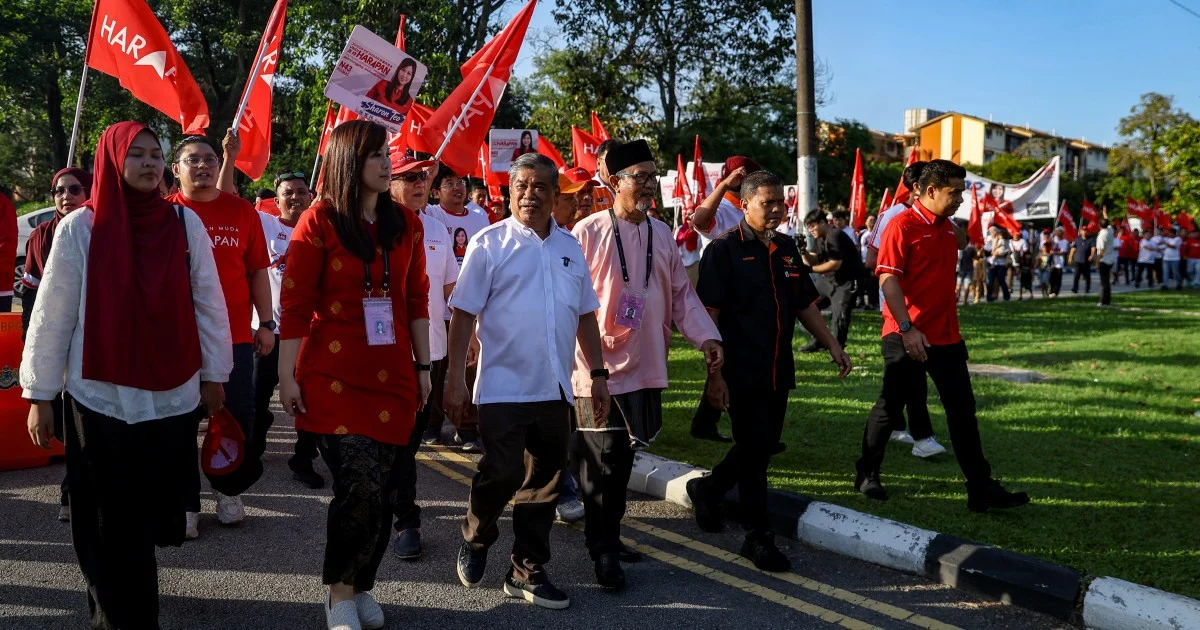
Supporters of the Pakatan Harapan coalition gathered at the Permas state constituency nomination centre in Pasir Gudang to demonstrate their backing for the opposition alliance's candidacy in the upcoming Johor state election. As Sharon Teo arrived at Dewan Muafakat Taman Mawar to formally register as a candidate, crowds of well-wishers greeted her with enthusiastic chants calling for voters to back Pakatan Harapan in the state polls. The scene underscores the coalition's efforts to mobilise grassroots support in one of Johor's key battleground constituencies.
Permas has emerged as a significant electoral battleground in recent Johor political contests, reflecting the state's shifting political dynamics. The constituency encompasses parts of Pasir Gudang, an industrial and residential area that has become increasingly important to both major political coalitions. The turnout of supporters at Teo's nomination filing suggests that Pakatan Harapan is investing considerable organisational effort in contesting what could prove to be a closely fought seat. The visible enthusiasm from party workers and supporters serves as a barometer of grassroots energy within the coalition's machinery at state level.
Sharon Teo's candidacy represents Pakatan Harapan's broader strategy of fielding candidates across diverse constituencies in Johor. The coalition has been working to rebuild its presence in the state following previous electoral setbacks, and nomination of candidates in competitive seats like Permas indicates strategic prioritisation. The public reception she received during the nomination process offers early indication of potential voter receptivity to the coalition's message in this particular area, though nomination day enthusiasm does not necessarily predict electoral outcomes.
Johor state elections carry considerable significance for Malaysian national politics, as the state remains economically important and demographically substantial. Control of the state government influences policy direction on matters ranging from education and healthcare to economic development and infrastructure investment. Pakatan Harapan's performance in Johor has direct implications for the coalition's overall strength in federal politics, making state-level contests increasingly consequential beyond their immediate local importance.
The chanting of slogans during nomination proceedings reflects a time-honoured feature of Malaysian electoral campaigns, where public displays of support serve multiple purposes simultaneously. Such demonstrations energise party workers, signal confidence to undecided voters, and generate grassroots momentum that extends beyond the immediate venue. For media observers and political analysts, the scale and intensity of support at nomination centres often provides preliminary data about which constituencies might prove most competitive and where resources may need concentration during the campaign period.
Permas presents particular complexities for electoral analysis given Johor's diverse demographic composition and historical voting patterns. The constituency encompasses varied socioeconomic communities, from industrial workers to residential estates, each potentially responsive to different political messaging and priorities. Pakatan Harapan's challenge involves crafting appeals that resonate across this spectrum while maintaining internal coalition coherence, a task that becomes more complicated when coalition partners hold competing interests across different constituencies.
The nomination process itself marks the formal commencement of the election campaign, after which campaigning intensifies substantially across all constituencies. Candidates utilise the interim period to build name recognition, conduct grassroots organising, and develop localised policy platforms addressing constituency-specific concerns. The visible support for Teo at the nomination centre provides her campaign with positive momentum entering this intensive phase, though substantial campaigning remains before polling day determines actual electoral outcomes.
Johor elections historically demonstrate that early indicators such as nomination day enthusiasm do not guarantee corresponding electoral success. Voter behaviour in state elections sometimes diverges significantly from expectations based on grassroots activity or leadership attention. Local issues often dominate voter calculus at state level, with considerations of national politics taking secondary roles. The coalition must therefore translate initial nomination day support into sustained voter engagement through the campaign period, addressing specific concerns that resonate with Permas residents.
Pakatan Harapan's broader electoral strategy in Johor extends beyond individual candidacies to encompass statewide messaging about governance, economic management, and policy direction. Sharon Teo's nomination in Permas forms part of this larger narrative, with individual constituency contests contributing to overall state-level competition. The coalition's success will ultimately depend on how effectively it communicates its vision across multiple constituencies while maintaining adequate resources and organisational capacity to contest effectively against ruling coalition candidates.
The public reception at Permas demonstrates that opposition political activity continues despite previous setbacks in Johor state politics. Pakatan Harapan retains organisational structures and maintains supporter networks capable of mobilising for nominations and subsequent campaigning. Whether this grassroots capacity translates into electoral advances remains an open question, dependent on multiple factors including campaign effectiveness, voter sentiment on specific issues, and turnout patterns on election day. The next weeks will reveal whether nomination day enthusiasm represents genuine electoral momentum or simply represents routine campaign theatre.

