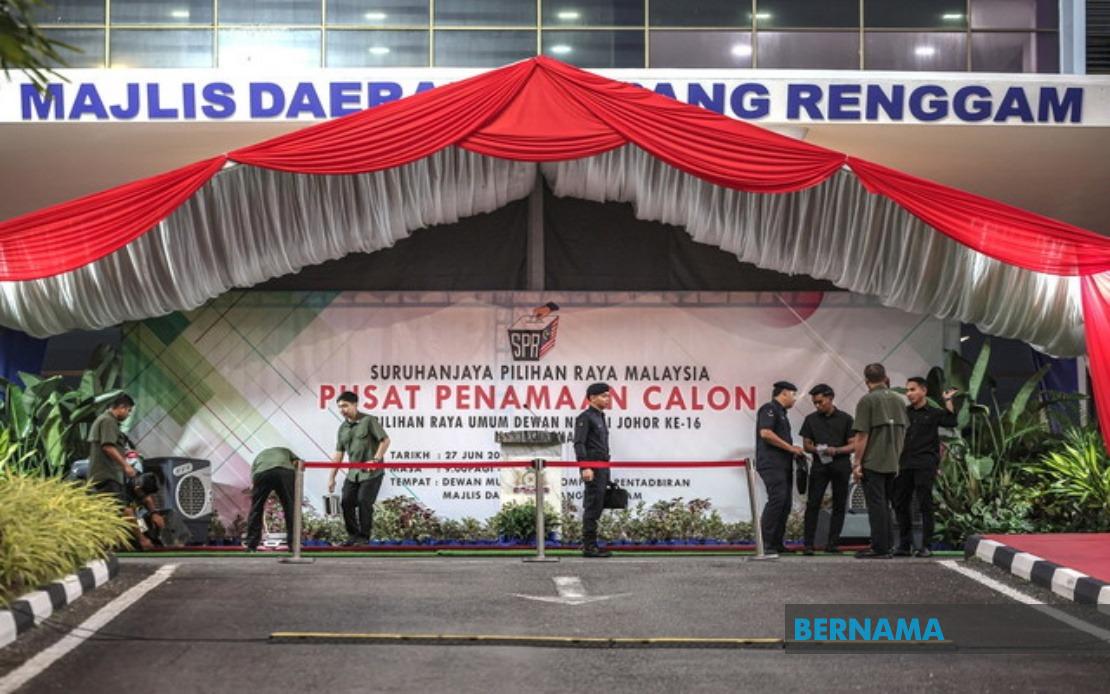
The machinery for Johor's 16th state election shifted into gear this morning as 56 nomination centres across the state began accepting candidates' paperwork at 9am sharp. This coordinated opening marked the official start of the formal candidacy process, with the returning officers at each centre poised to receive nomination documents from hopeful contestants seeking seats in the state assembly. The one-hour submission window closing at 10am created a tightly compressed timeframe that required candidates, their proposers, and seconders to complete all necessary formalities before the eligibility verification phase could commence.
The nomination procedure itself allows for flexible submission arrangements, permitting candidates to file their papers personally alongside both a proposer and seconder, or with just one support person, or even solo if necessary. This flexibility acknowledges the logistical challenges candidates may face in coordinating multiple individuals' attendance at specific locations within such a narrow window. The returning officers would then cross-reference all documentation against electoral rolls and constitutional requirements, ensuring only legitimate aspirants proceed to the contest proper.
Once the verification machinery completes its work, Johor enters a structured 14-day campaign window extending until 11.59pm on 10 July, according to parameters established by the Election Commission. This period constitutes the official campaigning phase when parties can mobilise supporters, stage rallies, and broadcast their messages through established channels. The timetable reflects careful administrative planning, with early voting scheduled for 7 July and the main polling day set for 11 July, giving voters and election officials relatively tight coordination between campaign closure and actual balloting.
The enthusiasm among political party supporters was evident from the pre-dawn hours, with loyalists gathering from 6.30am to demonstrate backing for their respective candidates. This early mobilisation underscores the competitive intensity of state-level elections in Malaysia's second-largest state by population, where control of the state assembly carries significant implications for resource allocation, development priorities, and political influence within the broader federal context. The visible show of support also serves as an informal barometer of organisational capacity and grassroots engagement among contending parties.
Weather conditions presented a complicating factor on nomination day itself. The Malaysian Meteorological Department had forecasted scattered rainfall across several districts including Johor Bahru, Muar, Batu Pahat, Kota Tinggi, Pontian, Tangkak and Kulai during the morning hours, potentially creating logistical difficulties for candidate teams. The afternoon outlook suggested thunderstorms were probable across most districts, including the state capital, Segamat, Kluang and Kota Tinggi. Conversely, Segamat, Kluang and Mersing districts were expected to experience clearer conditions, offering some respite in certain areas.
Security arrangements reflected the Elections Commission's commitment to maintaining order throughout the nomination process. Police personnel, reinforced by auxiliary volunteers from the People's Volunteer Corps (RELA), established cordons around nomination centre perimeters to manage pedestrian and vehicular traffic flows. This visible security presence aimed to prevent any confrontations or disruptions that might undermine the legitimacy of the electoral process or intimidate candidates and voters.
The Johor electorate comprises a substantial voter population spanning diverse demographic and geographic segments. According to Elections Commission data, 2,727,926 voters hold eligibility to participate in this election, encompassing 2,703,175 ordinary civilian voters alongside 12,041 military personnel and their spouses, and 12,710 police personnel and their family members. This breakdown reflects the composition of Malaysian electorates, where security force personnel and their dependents constitute recognised voting blocs with specific interests and concerns. The total figure underscores Johor's significance as an electoral battleground, representing a substantial proportion of Malaysia's overall registered voters and making outcomes here consequential for national political trajectories.
For the broader Southeast Asian context, Johor's elections warrant attention as Malaysia's regional elections frequently signal shifting political currents within the federation. State-level contests often serve as testing grounds where national parties refine messaging, test campaign strategies, and gauge voter sentiment on issues beyond purely state concerns. The composition of the Johor state assembly following these elections could influence calculations within the federal government, particularly regarding coalition stability and the balance of power between competing national coalitions.
The compressed nomination timeline also illustrates standard Malaysian electoral practice, where administrative efficiency and security considerations drive procedural design. The one-hour submission window, while seemingly restrictive, permits elections officials to conduct verification and candidate listing within predictable timeframes, reducing opportunities for procedural disputes or legal challenges based on documentation ambiguities. The 14-day campaign period provides adequate time for meaningful electoral competition without extending election-related disruptions across excessively protracted periods that might destabilise governance or burden public resources unduly.
As candidates formalised their participation through nomination submissions, they simultaneously acknowledged acceptance of Electoral Code of Conduct provisions governing campaign behaviour, financial transparency, and respectful political discourse. These commitments carry legal force within Malaysia's regulatory framework, with violations exposing candidates to disqualification or post-election sanctions. The nominations process therefore represents not merely a procedural gateway but a substantive commitment to constitutional electoral norms.

