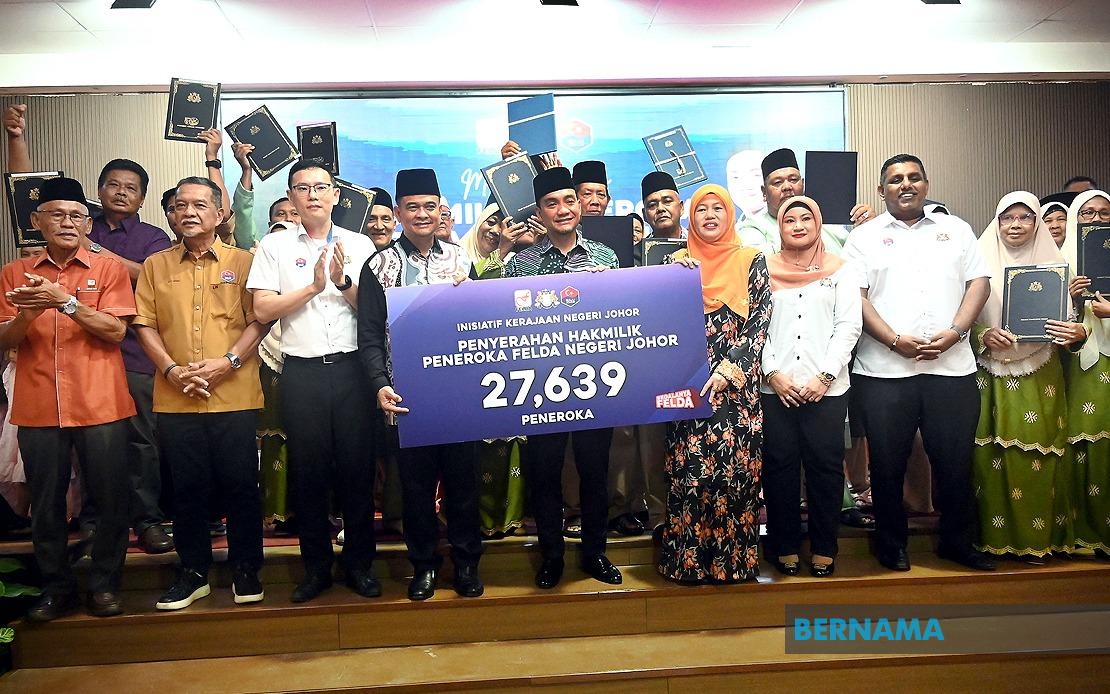
The Johor state government has achieved a near-complete resolution of a protracted land titling issue that has troubled Federal Land Development Authority (FELDA) settlers for years, settling 27,639 applications out of 27,642 in total. The milestone was marked on June 23 at a formal land title presentation ceremony in Kluang, where Menteri Besar Datuk Onn Hafiz Ghazi handed over documents to 210 settlers from Kluang, Kota Tinggi and Mersing, cementing what officials describe as a watershed moment for rural development in the state.
The resolution of these land title disputes carries particular weight because it addresses one of the most fundamental concerns among FELDA communities: the security of land ownership. For decades, settlers operating plantations and maintaining residential holdings within these schemes have faced bureaucratic delays and administrative bottlenecks in securing formal title documentation, creating uncertainty about inheritance rights, collateral value, and long-term economic planning. The near-complete clearance of the backlog therefore represents both tangible relief for affected families and symbolic validation of their claims to the land they have cultivated.
According to Datuk Onn Hafiz Ghazi, the achievement reflects a deliberate policy orientation within the Johor administration to prioritise resolution of property rights issues within FELDA settlements. He framed the initiative as integral to the state's broader rural development agenda, signalling that land security and settler welfare form cornerstone elements of the Johor government's regional economic strategy. This positioning is significant because it moves FELDA issues from the margins of policy discourse into the mainstream of state governance priorities, ensuring continued attention and resource allocation to these communities.
The practical implications for the 27,639 settlers who have now received their land titles are substantial. Legal ownership documentation enables farmers to access credit from financial institutions using their land as collateral, facilitates the transition of property between generations without protracted disputes, and provides the foundation for improved agricultural productivity and investment. For many rural families, these titles represent the difference between economic stagnation and genuine opportunity for wealth accumulation and business expansion.
The presentation ceremony itself, attended by Johor Agriculture, Agro-based Industry and Rural Development Committee chairman Datuk Zahari Sarip, underscores the multi-agency coordination required to execute such a resolution. Land titling involves historical records verification, surveying work, legal documentation, and coordination between state land offices and FELDA authorities—a complex machinery that requires sustained administrative commitment to overcome institutional inertia. The successful processing of over 27,000 applications indicates either improved operational efficiency or dedicated resource mobilization within the state apparatus.
From a Malaysian perspective, the Johor resolution carries relevance beyond the three districts directly involved. FELDA schemes operate across multiple states, and land titling issues are not unique to Johor. The demonstrated capacity to resolve such a significant backlog may serve as a model for other state governments grappling with similar problems. Additionally, the initiative demonstrates how state-level administrations can take ownership of issues historically associated with federal land agencies, potentially creating healthier intergovernmental coordination on rural development matters.
The three districts receiving the bulk of these titles—Kluang, Kota Tinggi and Mersing—each have distinct economic profiles within Johor's broader landscape. Kluang is historically known for pineapple cultivation and agro-industrial activity, Kota Tinggi includes significant oil palm plantations, and Mersing has a more mixed agricultural base alongside tourism activity. Securing land titles across this geographic and sectoral diversity addresses challenges affecting different farming communities with varying production specializations, demonstrating that the resolution was comprehensive rather than narrowly targeted.
The remaining 0.01 per cent of unresolved applications—just three cases out of 27,642—suggests either exceptional complexity requiring further investigation or administrative closure of applications where applicants could not be located or verified. The near-universal resolution rate indicates that the government did not simply defer difficult cases but worked through them systematically. This distinguishes the achievement from scenarios where backlogs are merely shifted rather than genuinely resolved.
Looking forward, the completion of this titling exercise creates the foundation for subsequent policy interventions. With land ownership clarified, the state government can now focus on agricultural extension services, productivity improvements, market access enhancement, and infrastructure development within these schemes. FELDA settlers, secure in their legal standing, can plan longer-term investments in their holdings and participate more actively in broader agro-economic development initiatives within Johor and the wider region.
The Menteri Besar's explicit commitment to treating FELDA settlements as ongoing state government priorities suggests that this titling resolution, while substantial, is positioned as a baseline rather than an endpoint. Continued attention to settler welfare, infrastructure maintenance, commodity price support mechanisms, and access to credit facilities will likely remain on the policy agenda. This framing prevents the narrative from becoming one of administrative completion and closure, instead sustaining political momentum for rural development as a sustained state commitment.
For Malaysian readers observing the rural development landscape, the Johor achievement illustrates how persistent administrative problems affecting thousands of smallholder farmers can be tackled through coordinated state action and political priority assignment. The resolution demonstrates that when government machinery is directed toward resolving specific, identifiable grievances affecting defined communities, the results can be demonstrable and transformative. This carries lessons for how other unresolved land and property rights issues affecting rural populations might be approached across the country.

