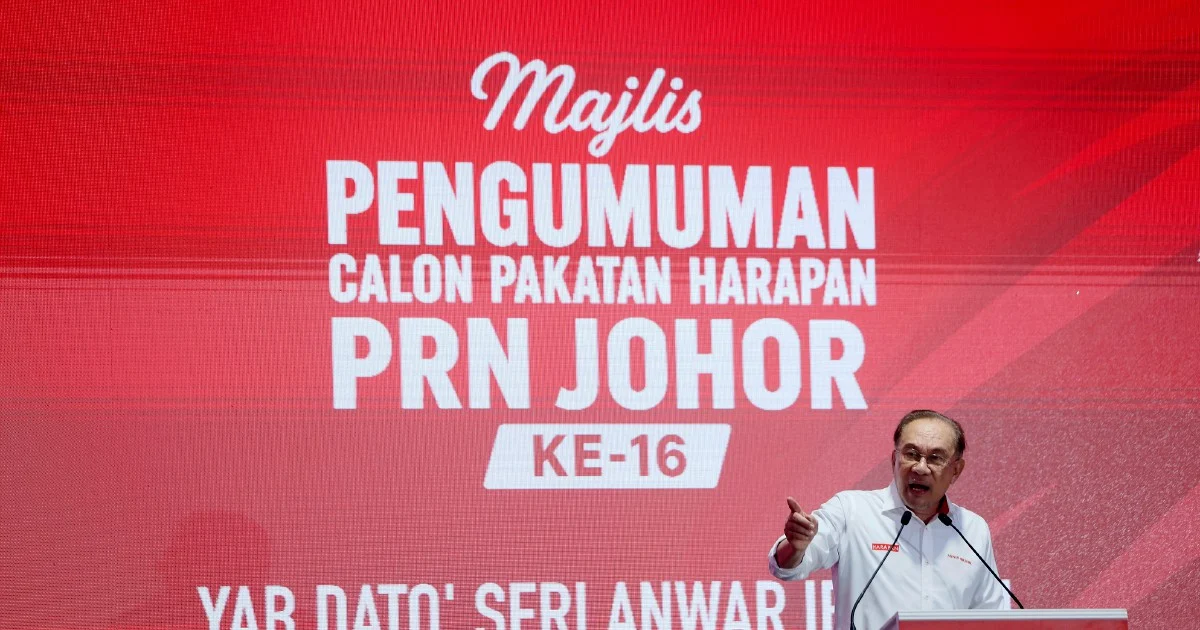
Prime Minister Datuk Seri Anwar Ibrahim has underscored the federal government's commitment to equitable resource distribution, highlighting that Johor has benefited from substantially higher federal funding allocations than the revenue it contributed to national coffers across the past three years. Speaking at an event in Tangkak, the PM indicated that Johor received approximately RM16 billion from the federal government during this period, whilst the state generated around RM14 billion in revenue contributions—a net positive transfer of RM2 billion to the southeastern state.
This assertion carries significant weight in the context of Malaysia's ongoing federalism debates and intergovernmental fiscal relations. Resource distribution between the federal and state governments remains a contentious issue in Malaysian politics, with smaller or less economically developed states often advocating for higher allocations whilst larger contributors question the equity of such arrangements. Johor's position is particularly noteworthy as the state straddles both categories—it maintains a substantial industrial and agricultural base that generates considerable federal revenue, yet simultaneously houses significant pockets of less-developed areas that require infrastructure and social investment.
The RM2 billion differential that Anwar highlighted represents more than a mere accounting exercise; it reflects deliberate policy choices to channel development resources to regions requiring targeted intervention. Federal allocations encompass infrastructure projects, education facilities, healthcare facilities, and welfare programmes that extend beyond simple revenue redistribution. These funds address market failures and geographic disadvantages that prevent certain areas from reaching their full economic potential, thereby contributing to broader national development objectives.
Johor's situation illustrates the complex interplay between states' fiscal capacities and federal redistribution mechanisms. The state economy encompasses the Port of Tanjung Pelepas, palm oil production, petrochemical industries, and increasingly, technology manufacturing. These revenue-generating sectors concentrate primarily in specific geographic zones, leaving other areas reliant on federal support to provide basic services and create economic opportunities. The federal government's apparent strategy of directing RM2 billion more than Johor contributed attempts to address this spatial inequality.
For Malaysian policymakers and Southeast Asian observers, the PM's statement carries implications for how federal systems balance growth incentives with equity concerns. A purely transactional approach—where states receive allocations proportional to their tax contributions—would concentrate resources in already-developed areas, potentially widening disparities. Conversely, aggressive redistribution might discourage economic activity in contributing states. The current approach, as articulated by the PM, suggests a middle path aimed at maintaining growth incentives whilst channelling resources toward development needs.
The three-year timeframe mentioned by Anwar likely encompasses the period following Malaysia's 2022 general election, during which the current federal administration took office. This period witnessed significant fiscal pressures from post-pandemic economic recovery and the government's need to balance multiple spending priorities. Within this constrained context, the decision to allocate above-contribution levels to Johor signals particular importance attached to the state's development agenda and perhaps recognition of political sensitivities in the southern region.
Regional context matters considerably here, as Johor's proximity to Singapore and its role as a gateway to Peninsular Malaysia create strategic imperatives beyond simple fiscal mathematics. Infrastructure investments, business continuity, and economic competitiveness in this crucial corridor benefit the entire nation. Federal allocations that exceed revenue contributions may represent investments in regional competitiveness rather than simple welfare transfers, supporting industries and logistics networks that generate employment and economic activity across state boundaries.
The transparency with which Anwar presented these figures—comparing revenue contribution against federal allocation—reflects a broader government approach of demonstrating accountability in resource distribution. In an era of scrutiny over government spending and increasing demands for fiscal responsibility, providing concrete numbers on inter-governmental transfers helps establish that allocation decisions follow rational, defensible principles rather than political patronage. This approach particularly matters given ongoing discussions about Johor's role within the federal structure and occasional debates about whether resource transfers reflect appropriate national priorities.
The RM16 billion allocated to Johor from federal sources encompasses multiple streams—development expenditure, statutory grants, special grants, and project-based funding. Breaking down these categories would reveal how federal priorities are operationalized at the state level and whether allocations target infrastructure, human capital development, business support, or social safety nets. Such granular analysis would provide greater insight into whether the RM2 billion net transfer represents truly growth-oriented investment or primarily consumption-based support.
Moving forward, the federal government's continued capacity to maintain or expand allocations to Johor and other states depends on overall fiscal health and competing national priorities. Economic growth trajectories, inflation pressures, debt servicing obligations, and emerging crises all influence available resources for state development. The PM's statement, therefore, should be understood not merely as a scorecard of past transfers but as an indicator of current policy direction regarding federal-state resource allocation in a period of economic and political transition.
For investors and businesses operating in Johor, this statement signals federal commitment to the state's development infrastructure and commercial environment. When senior government figures publicly articulate higher allocations to a particular state, it typically indicates confidence in that region's growth prospects and willingness to fund the basic services and infrastructure that private enterprise requires. This represents reassurance to both local and foreign investors regarding the state's medium-term development trajectory and the government's willingness to support necessary enabling conditions.

