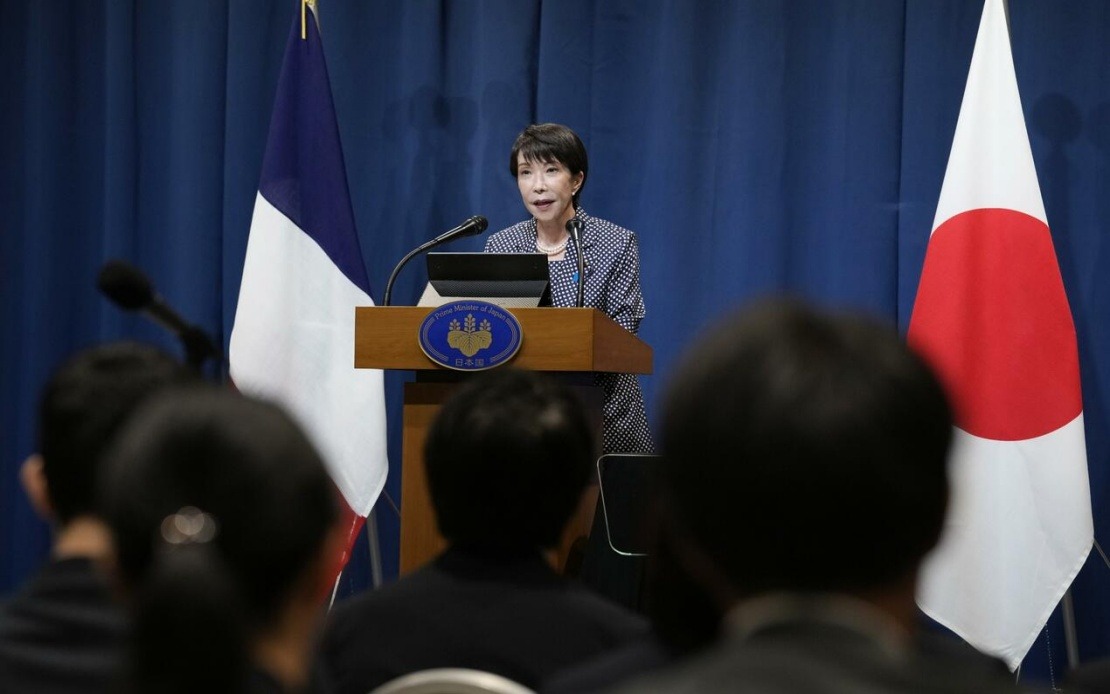
Japanese Prime Minister Sanae Takaichi's political fortunes have weakened as her cabinet's approval rating slipped to 55.8 percent, representing the lowest level of public confidence recorded since she assumed office in October of the previous year. The decline, revealed through a Kyodo News telephone survey conducted over the weekend, reflects broader anxieties coursing through the Japanese electorate over persistent economic headwinds and strategic questions about national security commitments in an increasingly volatile geopolitical landscape.
The erosion of support occurs within the context of deepening uncertainty regarding how Japan should respond to regional instability stemming from tensions between major powers in the West Asian region. This anxiety has particular resonance for Japan, a resource-dependent economy heavily reliant on stable access to international shipping lanes for its energy imports and trade flows. The question of whether Tokyo should position its military assets in support of international maritime security efforts has emerged as a flashpoint for public debate, with respondents divided on the appropriate level of involvement.
According to the Kyodo survey, just over half of respondents—54.7 percent—expressed opposition to deploying the Japanese Self-Defence Forces to key international waterways for the purpose of ensuring secure passage of commercial shipping. This majority stance contrasts with the 36.6 percent who believe such military engagement is warranted. The survey was conducted in the immediate aftermath of diplomatic developments that eased some regional tensions, specifically a preliminary peace agreement between the United States and Iran that included provisions for Tehran to reopen the Strait of Hormuz to international traffic.
The timing of the survey provides crucial context for interpreting Japanese public opinion. The announcement of the U.S.-Iran preliminary accord and Iran's commitment to restore access through the Strait of Hormuz appeared to defuse some immediate concerns about potential maritime disruption. Nevertheless, the public's cautious stance toward direct Japanese military involvement suggests that even diplomatic breakthroughs have not entirely reassured households about potential medium-term security risks or the cost of regional engagement.
Beyond questions of military deployment and strategic positioning, the poll revealed that consumer purchasing power remains the primary concern animating Japanese households. The persistent elevation of prices for everyday goods has created sustained pressure on family budgets and, by extension, public satisfaction with government economic management. This cost-of-living anxiety has manifested in strong public interest in targeted fiscal measures designed to alleviate pressure on household expenditures, particularly for essential items.
The survey results indicate substantial receptiveness to tax relief measures specifically targeting food and beverages, goods that consume a significant share of typical household budgets. A plurality of respondents—43.9 percent—endorsed the concept of reducing the consumption tax on food and beverages from its current rate of 8.0 percent to 1.0 percent, provided such a measure could be implemented efficiently without creating administrative complications or causing broader fiscal disruptions. This represents a pragmatic approach to tax relief, where respondents acknowledged both the desirability of price relief and the practical constraints facing policymakers.
A smaller but still notable segment of the electorate has embraced a more ambitious fiscal position. Some 22.6 percent of survey respondents expressed support for eliminating the consumption tax on food and beverages entirely, reducing it to zero. This position aligns with policy commitments made by Japan's ruling coalition parties, which have positioned themselves as champions of household financial relief in an environment of persistent inflation and wage stagnation.
The divergence between these two positions—partial reduction to 1.0 percent versus complete elimination—reflects broader political tensions within Japan's governing consensus. While both approaches share the objective of reducing price burdens on ordinary families, they differ substantially in their fiscal implications and the scope of burden-sharing across different segments of society. The fact that nearly two-thirds of respondents favoured some form of consumption tax reduction on food items demonstrates the political salience of this issue and its potential to shape electoral outcomes.
For Malaysian observers and policymakers, the Japanese experience offers instructive lessons about the political economy of sustained inflation and its corrosive effects on public confidence. Japan's sophisticated economy and strong institutional framework have not insulated it from the political consequences of elevated consumer prices, suggesting that no country is immune to public discontent when household budgets come under pressure. The willingness of Japanese voters to support targeted tax relief measures reflects a preference for pragmatic solutions that address immediate hardship without necessarily embracing sweeping systemic changes.
The intersection of regional security concerns and domestic economic anxiety evident in Japan's political landscape mirrors dynamics evident across much of Asia, where countries balance strategic commitments and military modernisation with domestic demands for improved living standards and fiscal relief. Japan's public appears to be drawing a distinction between these two domains, suggesting that security concerns, while present, remain secondary to immediate economic pressures.
Prime Minister Takaichi's declining approval rating, though still at a majority level, suggests that her cabinet faces mounting headwinds in sustaining public support through the medium term. The combination of unresolved economic challenges and ongoing strategic uncertainties creates an environment where political vulnerability could deepen if either domain deteriorates further. Whether the Takaichi government can reverse this trend will depend largely on its capacity to demonstrate progress on household cost-of-living concerns and to navigate regional security questions in ways that maintain public confidence.

