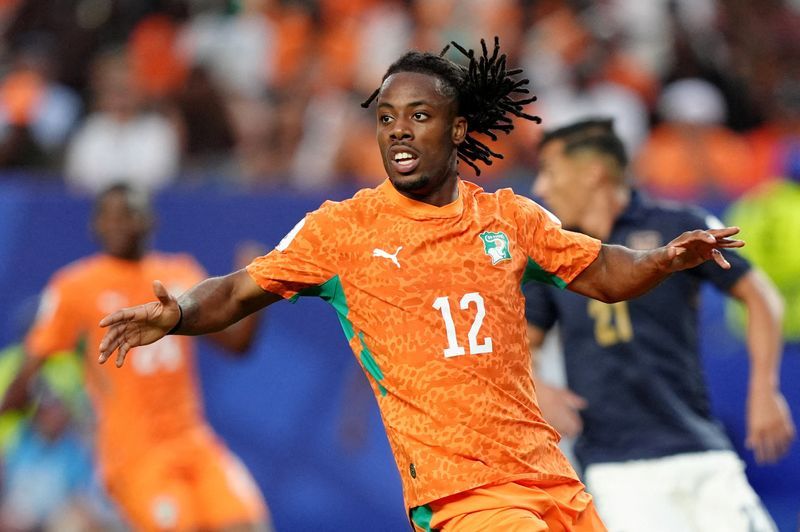
Ivory Coast will face Germany in a crucial World Cup Group E encounter on Saturday in Toronto without striker Elye Wahi, after the Ivorian Football Federation announced on Thursday that the player would not be joining the squad's journey to Canada. The decision comes amid a swirling backdrop of uncertainty surrounding the Nice player, who has recently drawn scrutiny from French authorities investigating suspected irregularities in a Ligue 1 match—a complication that has cast a shadow over the talented forward's participation in the tournament.
The official explanation offered by the FIF centres on administrative hurdles rather than disciplinary action. According to the federation's statement, the requisite Canadian entry authorizations for Wahi have not yet been secured, preventing him from crossing the border for the Group E showdown. This technical explanation underscores the broader complications that can ensnare international footballers when national security and sports governance intersect, particularly when investigations are underway in their home countries or across multiple jurisdictions.
The backdrop to Wahi's absence, however, reveals deeper concerns within European football. French investigators flagged suspicious betting patterns connected to a yellow card the forward received during a Ligue 1 fixture in May while representing Nice. Such betting anomalies have become a growing worry across major European leagues, with authorities increasingly vigilant about potential match manipulation and corruption schemes that exploit the volatility of seemingly minor incidents—a single booking can dramatically shift odds and create lucrative opportunities for organised betting syndicates.
The FIF sought to balance its response, issuing a statement that maintained public confidence in Wahi while acknowledging the delicate situation. Federation officials emphasized they have neither received formal notification of legal proceedings against the player nor have any administrative charges been filed. By framing the exclusion purely as a border documentation matter, the FIF appears to be protecting Wahi's reputation while navigating the complications that arise when a player becomes entangled in sporting investigations.
For Ivory Coast, the loss of Wahi represents a meaningful tactical adjustment heading into a critical match. Germany, the tournament's defending champions, arrives in Toronto with commanding momentum after demolishing Curacao 7-1 in their opening Group E assignment. In contrast, Ivory Coast secured a narrow 1-0 victory over Ecuador, a result that leaves them level on points but potentially vulnerable in the midfield and attacking departments without one of their primary scoring weapons.
The situation illustrates the complex intersection of international sport, legal procedure, and diplomatic protocol that modern footballers must navigate. While Wahi's omission is formally attributed to administrative processing delays, the timing—occurring just days after the French investigation became public—suggests that obtaining travel clearance from Canadian immigration authorities may have proven problematic given the pending inquiry. Nations and their security agencies often exercise heightened caution when admitting individuals under investigation, even when no charges have been formally laid.
Wahi will remain in the United States during the Canadian leg of the tournament, a measure that keeps him geographically close to the squad while maintaining separation from the match venue. This arrangement is not uncommon in scenarios where players face administrative or legal complications; it preserves their availability for subsequent fixtures should their status change, while allowing federation officials time to resolve outstanding bureaucratic issues.
The incident reflects broader concerns within European professional football regarding match integrity. Betting-related investigations have ensnared players across multiple leagues in recent seasons, with authorities in France, Italy, Spain, and elsewhere heightening scrutiny of unusual wagering activity. The detection of suspicious patterns around a single yellow card demonstrates the sophisticated monitoring systems now in place, though it also raises questions about whether enforcement efforts are sufficiently coordinated across national and international bodies to effectively deter coordinated corruption schemes.
From a regional perspective, this situation serves as a cautionary tale for Southeast Asian football administrators and players. As professional opportunities expand across Europe for talent from this region, awareness of corruption investigations and their potential consequences becomes increasingly vital. Wahi's predicament shows that even marginally involved players can face significant disruptions to their careers, with administrative consequences sometimes preceding or overshadowing formal legal determinations.
The Group E fixture will now proceed without one of Ivory Coast's attacking assets, potentially reshaping the tactical approach the West African nation adopts against a formidable German side. Depending on how the travel authorization situation develops, Wahi's availability for subsequent group matches remains uncertain, leaving the player in a state of limbo that could have lasting repercussions for both his tournament experience and career trajectory.