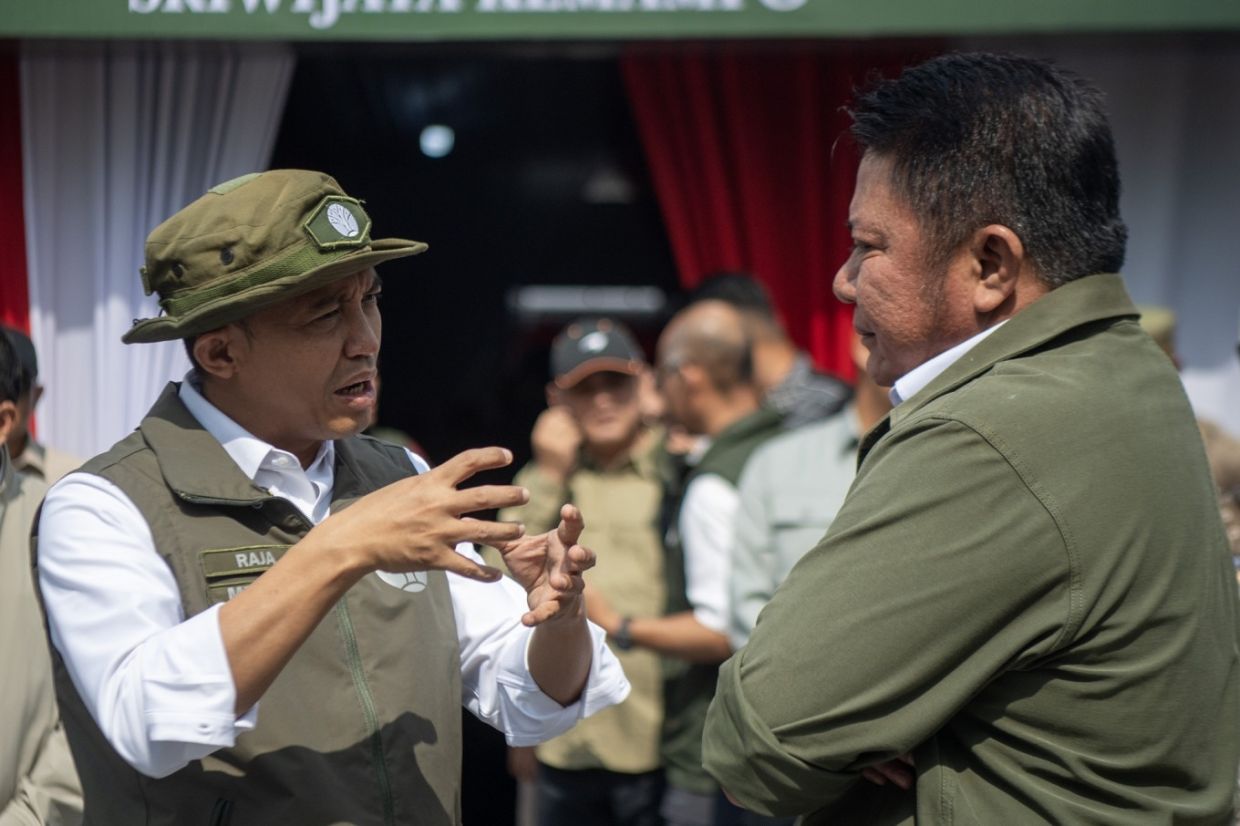
Indonesia's Corruption Eradication Commission (KPK) has reopened scrutiny of Forestry Minister Raja Juli Antoni following suspicions that he may not have completely returned kickbacks allegedly offered by a regional official. The anti-corruption agency's spokesperson Budi Prasetyo disclosed on Thursday that investigators are examining reported discrepancies in the sums that the minister initially declared and the total amount he received from Suhardiman Amby, the regent of Kuantan Singingi in Riau province. This development marks an intensification of an already-complicated corruption matter that threatens to undermine public confidence in Indonesia's environmental governance at a sensitive moment for the incoming administration.
The alleged transaction traces back to a June 2 administrative meeting attended by the minister and Suhardiman. During that encounter, the regent purportedly handed Raja Juli an envelope containing Singapore dollars valued at S$14,000 (US$10,919). Additional ministry personnel are suspected of accepting separate payments totalling S$12,500 from various Kuantan Singingi officials. Budi stated that KPK staff continue verifying whether the amounts the minister reported align with what he genuinely possessed, indicating that the agency harbours doubts about the completeness of his earlier disclosures.
Raja Juli's account of events, initially presented to the KPK on July 3, claimed that he rejected the envelope on receipt and returned it ten days after the initial transfer at the Kuantan Singingi Police headquarters on June 12. He maintained that accepting such a gift would have been improper given his official position. However, the KPK's continued investigation suggests investigators are not entirely persuaded by this narrative. Indonesian law requires public officials to report improper gifts connected to their duties to the anti-corruption commission within 30 days of receipt, rather than through police channels. Officials convicted of illicitly accepting gifts face penalties of up to 20 years' imprisonment and substantial fines reaching Rp 1 billion (US$55,867).
The KPK has established that preceding the June encounter, Raja Juli held at least three additional meetings with Suhardiman during April, May, and June. Budi declined to specify whether these separate sessions were coordinated or independent, leaving open the possibility of a deliberate pattern of engagement between the minister and the regent. This timeline raises questions about the frequency and nature of interactions, potentially indicating either systematic corruption or at minimum an unusually intense working relationship between ministerial and local government figures.
Understanding the broader context of these interactions requires examining what prompted the initial contact. Kuantan Singingi's administration has submitted multiple proposals to the Forestry Ministry requesting reclassification of more than 1,800 hectares of limited production forest (HPT) within the regency. Such conversions carry significant environmental and economic implications, as they would alter how this state-managed land is utilised. The KPK is investigating whether the alleged bribes functioned as inducements to facilitate approval of these forest reclassification requests, suggesting the corruption probe touches on matters of national environmental consequence.
Suhardiman, a politician affiliated with President Prabowo Subianto's Gerindra Party, was arrested and designated as a suspect by the KPK in late June on separate bribery allegations. He is accused of receiving kickbacks from regional secretary Zulkarnain in exchange for appointing the latter to his administrative position. The anti-corruption body subsequently broadened its investigation to examine whether Suhardiman also attempted to bribe the Forestry Ministry regarding forest conversion permits, substantially widening the scope and severity of potential wrongdoing.
For Raja Juli, who additionally serves as secretary-general of the Indonesian Solidarity Party (PSI), this investigation represents a serious reputational challenge. Members of the House of Representatives Commission IV, which oversees forestry policy, demanded clarification from the minister regarding the bribery allegations. However, Raja Juli declined to attend a scheduled meeting with Commission IV on July 14, with deputy chair Alex Indra Lukman from the Indonesian Democratic Party of Struggle (PDI-P) explaining that the minister was observing umrah, the Islamic minor pilgrimage, during that period. His absence fuelled speculation and criticism from lawmakers already concerned about the integrity of the ministry's decision-making processes.
The Forestry Ministry has issued statements affirming its commitment to cooperate fully with the KPK's investigative process and pledging to supply any requested documentation or information. Officials emphasised that the ministry has not yet approved any forest status changes for Kuantan Singingi, noting that the regency's three most recent proposals remain either rejected outright or under continued verification. This position suggests the ministry is attempting to distance itself from any accusation that corrupt influence has shaped forestry decisions, though the allegations themselves pose questions about whether such influence was attempted even if ultimately unsuccessful.
The ministry possesses authority to reclassify state forests for various land-use categories, including modifications to limited production forest designations which technically permit restricted extraction for settlement or industrial development. This technical authority, combined with the substantial financial interests potentially involved in forest reclassification decisions affecting thousands of hectares, creates conditions susceptible to corrupt approaches by regional actors seeking to unlock economic value from state land.
For Malaysian observers, this case offers instructive parallels. Both Indonesia and Malaysia navigate tensions between environmental protection and regional economic development aspirations, with forest conversion requests frequently emerging from local governments seeking to expand extractive or developmental opportunities. The mechanisms through which such requests proceed—and the potential for corruption to influence approvals—remain relevant across Southeast Asia, where comparable governance challenges persist. Indonesia's willingness to investigate senior ministerial figures demonstrates institutional capacity within the KPK, though questions linger about whether such scrutiny applies uniformly across political affiliations.
The investigation's trajectory remains uncertain. Should the KPK substantiate that Raja Juli failed to return the entirety of received kickbacks, the political and legal ramifications would extend beyond a single minister to encompass broader questions about the Forestry Ministry's integrity under his leadership. Conversely, should investigators conclude their suspicions lack merit, the minister's vindication might not fully restore his damaged credibility given the sustained public controversy.
This episode underscores how corruption allegations—whether ultimately substantiated or not—can damage institutional legitimacy and public confidence in environmental decision-making precisely when such confidence is essential for implementing sustainability policies. As Indonesia advances forest management reforms under new political leadership, the resolution of these allegations will signal whether the administration intends serious anti-corruption action or whether such investigations become politicised tools.

