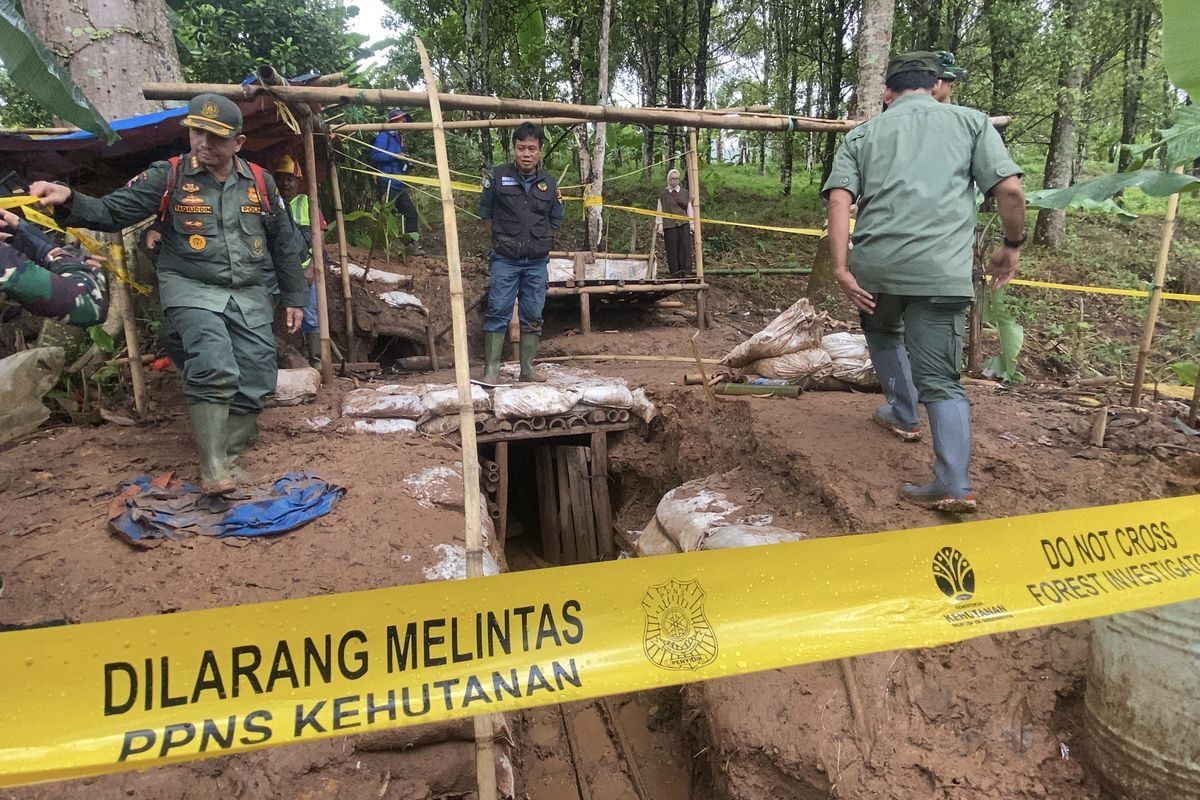
Indonesia's energy ministry has moved to prosecute 24 foreign nationals accused of orchestrating an illegal gold mining operation in the resource-rich Maluku region, marking a significant enforcement action against what authorities characterize as an increasingly organized form of transnational criminal activity. The charges were announced by energy ministry official Jeffri Huwae late Thursday, following months of investigation into the scheme concentrated around the Gunung Botak area, where suspects allegedly erected an extensive network of mining infrastructure designed to exploit the region's mineral wealth.
The case reveals the sophisticated planning underlying these operations. Rather than operating as loosely coordinated prospectors, the accused individuals were allegedly engaged in deliberate infrastructure development, constructing access roads and establishing processing facilities that would enable large-scale extraction and refinement of gold. This organizational structure suggests involvement by criminal syndicates with capital, technical expertise, and supply chain networks capable of moving materials and personnel across international borders. The ministry's decision to highlight infrastructure development indicates that authorities have evidence of systematic, pre-planned operations rather than opportunistic mining activities.
Indonesia's legal framework provides substantial deterrents for such conduct. Those convicted under applicable mining legislation face maximum prison sentences of five years, a penalty structure designed to address the serious nature of resource theft from state assets. The charges against 24 individuals signal that prosecutors believe they have gathered sufficient evidence to pursue convictions, though the ministry has not yet disclosed details about the specific legal provisions being invoked or the anticipated timeline for trial proceedings.
The investigation has produced a partial enforcement result. Twelve of the charged individuals remain in custody within Indonesian territory, having been apprehended during operational sweeps. However, their twelve colleagues have evaded capture and currently reside beyond Indonesia's jurisdictional reach, complicating the prosecution process and raising questions about whether international cooperation mechanisms will be engaged to pursue extradition or mutual legal assistance. The ability of half the suspect group to escape suggests either operational gaps during the apprehension phase or prior warning that enabled coordinated flight.
State news agency Antara reported last month that the detainees were predominantly Chinese nationals, though the energy ministry's formal statement notably declined to specify nationalities or other identifying details. These individuals allegedly operated under the organizational cover of PT Harmoni Alam Manise, a locally registered company whose involvement raises questions about the depth of complicity or negligence among domestic business structures that facilitate foreign criminal enterprises. The use of Indonesian intermediaries to legitimize foreign operations represents a common evasion technique.
Beyond the foreign nationals, two Indonesian citizens have also been charged as criminal suspects in connection with the scheme. Their involvement underscores how illegal mining operations typically depend on local partnerships—whether through corruption, coercion, or voluntary participation. These domestic facilitators provide crucial services including land access, regulatory navigation, and connections to distribution networks, making their prosecution essential to disrupting supply chains that make illegal mining economically viable.
The gold quantities extracted from the Gunung Botak operation remain undisclosed, preventing assessment of the economic scale or national resource loss involved. This withholding of information may reflect ongoing investigation or evidentiary concerns, but it complicates public understanding of the operation's significance relative to Indonesia's broader illegal mining problem. The absence of production figures also leaves unclear whether this represents an isolated criminal venture or a larger pattern of undocumented extraction.
Indonesia has contended with recurring illegal mining operations involving foreign operatives. Last year, police in Papua province's Senggi district arrested four Chinese nationals engaged in unauthorized mining activities, demonstrating that such incidents recur with regularity across multiple regions. Papua's remote geography and indigenous communities make it particularly vulnerable to incursion by well-resourced criminal groups capable of navigating challenging terrain and establishing operations in areas with limited government presence.
The Maluku case carries particular significance because the region represents a critical node in Indonesia's mineral economy, and enforcement actions there carry symbolic value in demonstrating state capacity to regulate extractive industries. For Malaysia and Southeast Asian nations sharing similar resource management challenges, Indonesia's approach illustrates the institutional, investigative, and diplomatic complexities of addressing transnational organized mining crimes. Regional cooperation frameworks become essential when suspects flee across borders, requiring coordination that often moves slowly given competing national priorities and limited bilateral extradition mechanisms in Southeast Asia.
The prosecution's progression will test Indonesia's ability to build cases against foreign defendants, manage international legal dimensions, and sustain convictions. Successful outcomes could establish precedent and deter future schemes, while acquittals or lengthy delays might signal to criminal enterprises that the risk-reward calculus favours continued operations despite enforcement actions.

