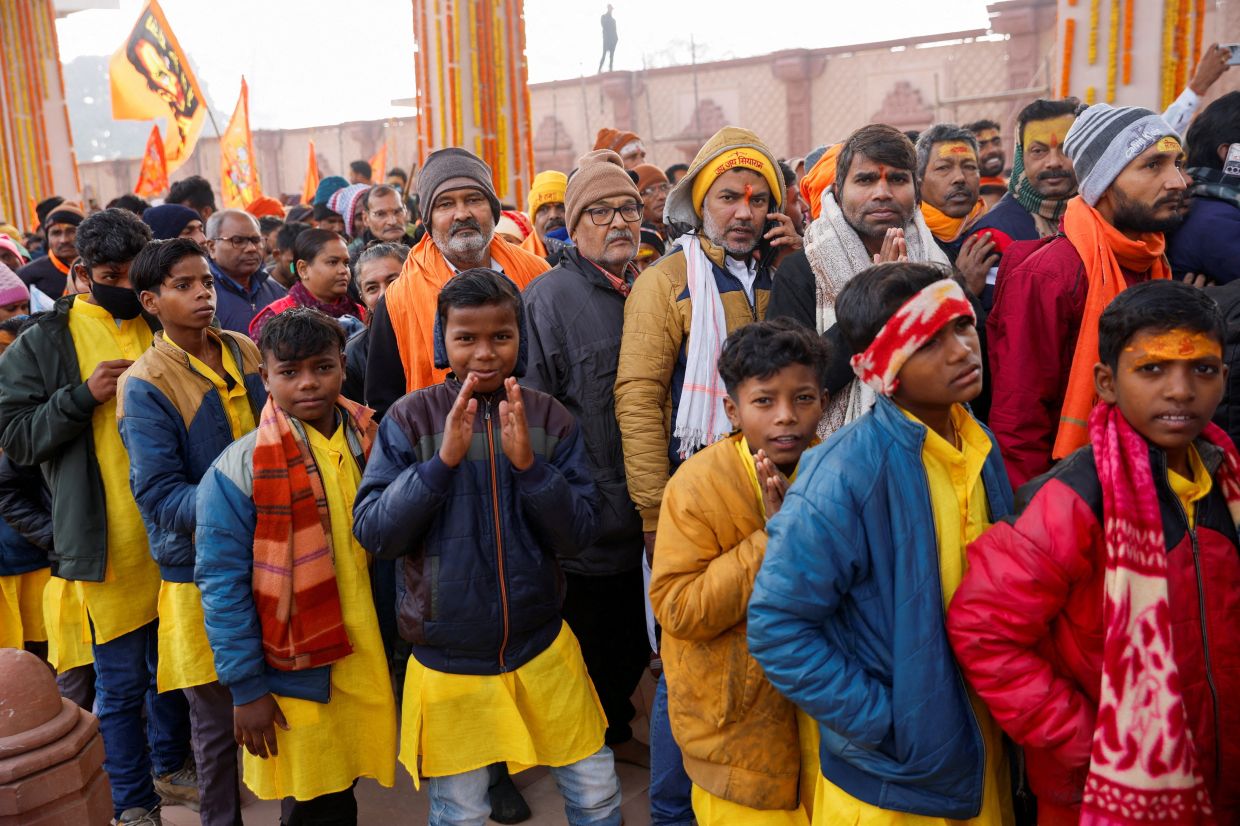
A criminal investigation into allegedly stolen donations at India's prominent Ram temple has reignited concerns about how major pilgrimage sites safeguard the substantial financial contributions entrusted to them by millions of devotees. The police launched their probe in June, culminating in the arrest of eight individuals tasked with handling contributions at the revered shrine located in Ayodhya in northern India. Though officials have remained silent on the precise sum involved, media accounts suggest the alleged embezzlement could exceed 30 million rupees, equivalent to approximately US$314,000. The case illuminates the vulnerability of religious institutions managing enormous cash flows with insufficient oversight mechanisms, a vulnerability that extends across India's spiritual landscape.
For ordinary devotees, the revelation strikes at the heart of their faith and sacrifice. Ashok Prasad Kushwaha, an auto-rickshaw driver from Delhi who has journeyed to the Ram temple three times over the past two years, articulated the emotional impact of such breaches. He explained that when worshippers present offerings at temples, they do so with the conviction that their contributions will advance religious and charitable objectives. The discovery that donations could be diverted for personal gain transforms what believers experience as an act of spiritual devotion into what feels like a personal violation, particularly for those of modest means who have contributed out of deep conviction.
This incident represents merely one chapter in a broader narrative of financial mismanagement that has plagued India's major pilgrimage destinations. The Badrinath shrine and the Tirumala Tirupati Devasthanams, which operates as one of the world's wealthiest temple trusts with estimated assets valued at US$31 billion, have both faced comparable controversies. These recurring scandals suggest systemic vulnerabilities rather than isolated lapses, indicating that the challenge of maintaining integrity within religious financial systems requires comprehensive structural reform rather than case-by-case corrective measures.
The complexity intensifies when considering the sheer scale at which contemporary religious institutions operate. The Ram temple, inaugurated in 2024 by Prime Minister Narendra Modi, has rapidly established itself as one of India's most consequential religious destinations, consistently welcoming approximately 90,000 visitors daily. This extraordinary volume of foot traffic generates continuous streams of contributions in multiple forms—currency, precious metals, ornamental items—creating logistical and security challenges that rival those of major commercial enterprises. The operational scope of such institutions now transcends traditional temple functions, yet governance frameworks have struggled to evolve accordingly.
Rahul Easwar, a Hindu activist and grandson of a former chief priest at Kerala's Sabarimala temple, articulated the fundamental problem: the absence of comprehensive transparency and accountability mechanisms within these religious bodies. He advocates for institutional reforms including mandatory donation receipts, digital accounting infrastructure, surveillance systems monitoring contribution-handling procedures, and independent external oversight. The specific vulnerabilities that enabled the alleged theft at the Ram temple—including inadequate counting protocols and surveillance failures—exemplify the exact governance gaps that Easwar identifies as requiring urgent remediation. Without structural intervention, similar incidents will likely recur at temples and pilgrimage sites nationwide.
The Ram temple's specific circumstances carry particular sensitivity given its extraordinary historical and religious significance. The site occupied the centre of one of independent India's most protracted religious disputes, involving competing claims rooted in Hindu theological traditions asserting that the deity Ram was born there over seven millennia ago, and the historical fact that the Babri mosque stood at the location, constructed by a sixteenth-century Mughal emperor. The demolition of the mosque in 1992 by Hindu mobs precipitated nationwide communal violence claiming more than two thousand lives. The Supreme Court's 2019 judgement awarding the disputed property for temple construction culminated in an unprecedented national fundraising campaign that generated approximately US$341 million. Against this backdrop of extraordinary public investment and emotional investment, any suggestion of financial misconduct assumes heightened significance.
The economic dimensions of India's religious sector further underline the urgency of governance reform. Consultancy analysis values India's spiritual and religious market at US$70.14 billion in 2025, with projections indicating expansion to US$135.41 billion by 2034. This expanding economic footprint creates mounting financial stakes while institutional controls remain fragmented and inconsistent. The absence of a uniform national regulatory framework governing financial transparency across religious institutions creates a patchwork of accountability standards, with oversight varying substantially depending on which state jurisdictions and applicable tax regulations oversee particular temples. Legal expert Sonam Chandwani observes that this fragmentation prevents establishment of consistent financial standards across India's diverse religious landscape.
Mass religious events present particularly acute governance challenges within this decentralized framework. The Kumbh Mela pilgrimage gatherings, which attract millions of devotees across short timeframes, generate enormous volumes of donations collected under conditions of extreme logistical complexity. Managing contributions during such events without sophisticated institutional systems and trained personnel creates environments conducive to theft, misappropriation, and simple accounting errors. These large-scale gatherings exemplify scenarios where religious institutions require operational infrastructure matching that of substantial government agencies or multinational corporations, yet many continue functioning with governance models designed for smaller, traditional worship spaces.
Political analyst Anurag Naidu emphasizes that India's religious institutions have fundamentally transformed in character and operational scope, transcending their historical role as places of worship to function as complex organizations managing substantial capital, real estate, and community services. This transformation demands corresponding institutional evolution. The financial controls and independent oversight mechanisms necessary for legitimacy and trustworthiness in managing public contributions now constitute operational necessities rather than optional enhancements. Without systemic reform establishing transparent accounting, regular independent audits, and robust internal controls, these institutions risk eroding the faith—both spiritual and financial—that worshippers have extended across generations.

