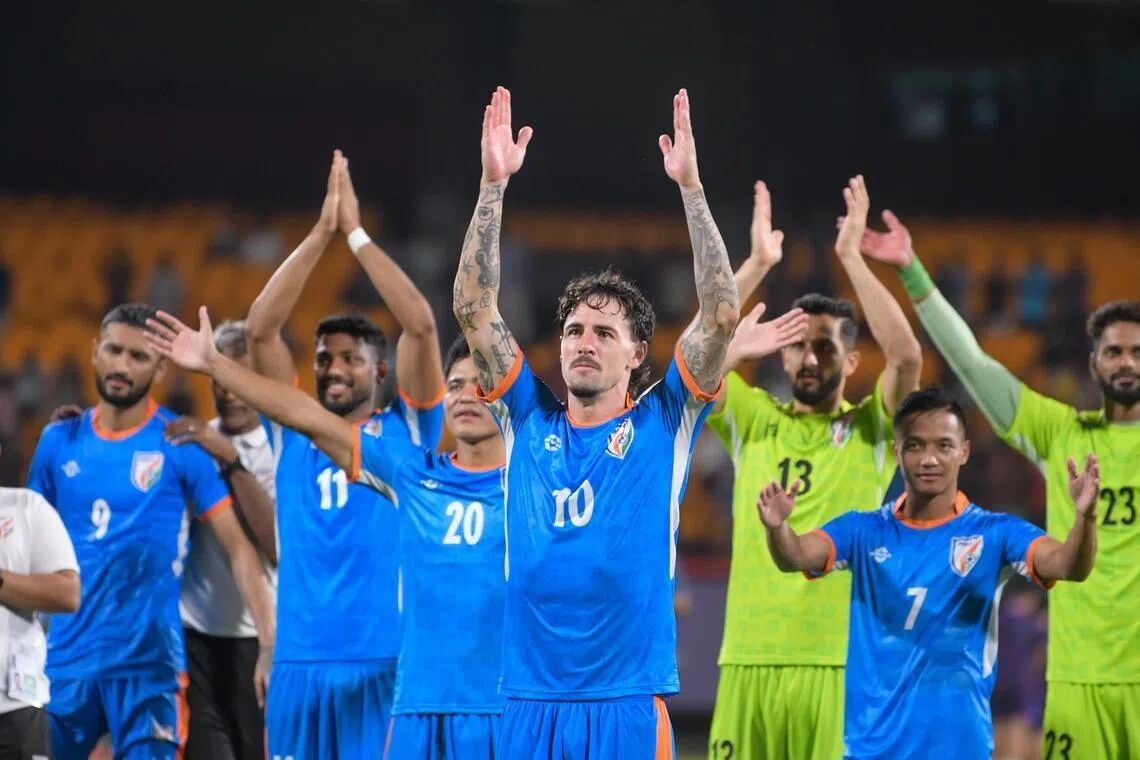
India's government is exploring a radical overhaul of its sports eligibility rules that could fundamentally reshape the composition of national teams across multiple disciplines. The Ministry of Youth Affairs and Sports has forwarded a detailed proposal to the Prime Minister's Office for a Sports Passport framework designed to permit athletes of Indian descent—including Overseas Citizens of India (OCI) and Persons of Indian Origin (PIO)—to compete for India without surrendering their existing citizenship or acquiring full Indian nationality. The move comes as Indian football enthusiasts continue to lament the absence of their nation's team from the FIFA World Cup 2026, while tracking Indian-origin players representing competing nations: Tahsin Mohammed Jamshid playing for Qatar, Diogo Costa for Portugal, Sarpreet Singh for New Zealand, and Samuel Moutoussamy for the Democratic Republic of the Congo. With India's men's football team ranked 139th globally and the women's team at 69th, the proposal represents an ambitious attempt to tap into the world's largest diaspora population of over 37 million people.
The timing of this initiative reflects mounting frustration within Indian sports administration and among the sporting public. For decades, from the independence era through the early 2000s, overseas Indians did represent their homeland across swimming, rugby and tennis competitions. However, this changed decisively in 2008 when the sports ministry implemented a strict mandate requiring all representatives to hold an Indian passport, a decision intended to protect opportunities for domestic players competing against better-resourced overseas counterparts. The new proposal seeks to reverse this policy by creating a carve-out specifically for sporting competition, allowing what amounts to a dual sporting identity without requiring dual citizenship—a nuance that addresses India's absolute prohibition on dual nationality, unlike neighbouring nations such as Malaysia, Singapore and Japan.
Sports lawyer Nandan Kamath, managing trustee of the GoSports Foundation, contextualises the proposal within international sporting norms. He points out that FIFA regulations already permit footballers to represent any nation with which they can demonstrate meaningful ancestral or residential connections, creating an inherent contradiction between India's citizenship laws and global sporting conventions. The discrepancy has become increasingly evident as nearly a quarter of all players at the ongoing World Cup represent nations other than their birthplaces, compared with just ten percent in the early 2000s. For India, this framework would essentially create a legitimate pathway around rigid citizenship restrictions by designating sport as a special category worthy of exception, enabling the nation to compete on level ground with countries like Bahrain, Spain and Turkey that already operate similar athlete-attraction mechanisms.
The proposal forms part of India's broader National Sports Policy 2025 and appears directly connected to preparations for the nation's bid to host the 2036 Olympic Games, according to experts involved in the discussions. Government strategists recognise that international sporting success would strengthen India's Olympic candidacy while simultaneously addressing a persistent vulnerability: despite possessing 1.4 billion people, the country consistently underperforms in global sports beyond cricket. This underperformance stems from bureaucratic inefficiency, inadequate grassroots infrastructure, and the overwhelming dominance of cricket that absorbs resources and attention at the expense of developing competitive teams in football, basketball and tennis—the very sports the Sports Passport framework specifically targets.
The recent experience of Tahsin Mohammed Jamshid illustrates both the potential and the current limitations of this approach. The nineteen-year-old Keralite, born in Doha to parents who moved to Qatar for employment, became the first Indian passport holder to appear in a World Cup—playing for Qatar through its Mission Passport system. This document enables foreign-born athletes to represent Qatar in international competitions without granting citizenship rights, permanent residency, or financial benefits available to nationals. Tahsin's trajectory exemplifies what India seeks to replicate: leveraging Indian-origin talent playing abroad to strengthen national squads. However, it also demonstrates the current awkwardness of the arrangement, where an athlete possesses Indian documentation yet competes for another nation, a situation the Sports Passport would regularise and legalise.
The infrastructure for considering overseas recruitment exists within Indian sports administration, though implementation remains cumbersome. Ryan Williams, an Australian forward with Indian and Anglo-Indian heritage through his mother, spent over a year navigating bureaucratic processes before acquiring Indian citizenship and joining the Bengaluru team in the Indian Super League. Within four minutes of his AFC Asian Cup qualifier debut against Hong Kong, Williams scored the fastest goal ever recorded by an Indian debutant, immediately justifying his inclusion. Yet Kunaal Majgaonkar, former head of content and media at JSW Sports, notes that the lengthy and uncertain naturalisation process meant few foreign players would replicate Williams' commitment. A Sports Passport would circumvent this requirement, streamlining recruitment and reducing personal sacrifice for participating athletes.
The proposed framework carries significant implications for team sports, particularly football where professionalisation and global player mobility are most advanced. Majgaonkar acknowledges that acquiring foreign-born professional talent in a highly commercialised sport like football would prove transformative for India's competitive standing. The Indian Super League has demonstrated that overseas players can attract investment, media attention and improve on-field quality. However, critics raise concerns about the sustainability of such an approach. Arata Izumi, who became the first Japanese passport holder to surrender his citizenship for Indian nationality in 2012, cautions that importing parachuted-in foreign players undermines the concept of a genuine national team rooted in domestic development. His cautionary perspective reflects apprehension that the Sports Passport could become a shortcut addressing symptom rather than cause, potentially demoralising local athletes competing for limited positions.
The proposal's acceptance faces organisational and political hurdles beyond its conceptual merits. The sports ministry and All India Football Federation declined to provide comment when contacted about the framework's status or timeline. However, Khel Now quoted officials indicating that the detailed proposal sent to the Prime Minister's Office suggested a decision timeline of six to eight months, indicating the proposal remains under active consideration at the highest government levels. The scale of India's sporting infrastructure deficit and bureaucratic challenges means that even approved policy changes often face implementation delays, particularly when coordination across multiple sporting federations becomes necessary.
Regionally, the Sports Passport proposal carries implications for Southeast Asian sports dynamics and recruitment patterns. Malaysia and Singapore, which also prohibit dual citizenship, could face increased competition for Indian-origin athletes from their own diasporas if India successfully formalises the scheme. The precedent would potentially influence sporting nationality discussions across the region, particularly among nations with significant emigrant populations seeking competitive advantage in international tournaments. India's massive diaspora and growing economic influence mean that any successful Indian sports recruitment programme could reshape regional competition balances, particularly in football where cross-border player movement remains limited compared to European and South American contexts.
The broader strategic rationale underlying the proposal extends beyond immediate sporting victories. India's government views the diaspora as a strategic asset requiring sustained engagement, particularly as overseas Indians accumulate wealth and influence in their adopted countries. Offering overseas Indians the opportunity to represent their ancestral homeland in sports provides symbolic recognition of cultural connection while potentially encouraging broader economic and political engagement with India. The National Sports Policy 2025 explicitly frames diaspora engagement as a national objective, and the Sports Passport represents a concrete mechanism for operationalising this vision within the sporting sphere.
If implemented, the Sports Passport would require careful calibration to balance competing objectives: attracting talent while preserving domestic player development, maintaining team cohesion while incorporating foreign-born athletes, and creating genuine pathways while avoiding appearance of mercenary recruitment. International experience suggests such systems work most effectively when integrated with broader player development infrastructure rather than functioning as standalone recruitment mechanisms. Australia and New Zealand, for instance, successfully integrate overseas-qualified players within comprehensive domestic development pathways, whereas Gulf states often struggle with sustainability when recruitment exceeds domestic infrastructure capacity.
The proposal also raises questions about identity and sporting representation that extend beyond performance metrics. For decades, Indian sports fans have maintained emotional connections to Indian-origin athletes competing internationally, celebrating their successes regardless of which flag they wore. The Sports Passport potentially transforms this relationship, converting aspirational identification into direct representation. This shift carries cultural and psychological dimensions beyond athletic competition, particularly given the diaspora's historical importance to Indian national identity and contemporary geopolitical significance.

