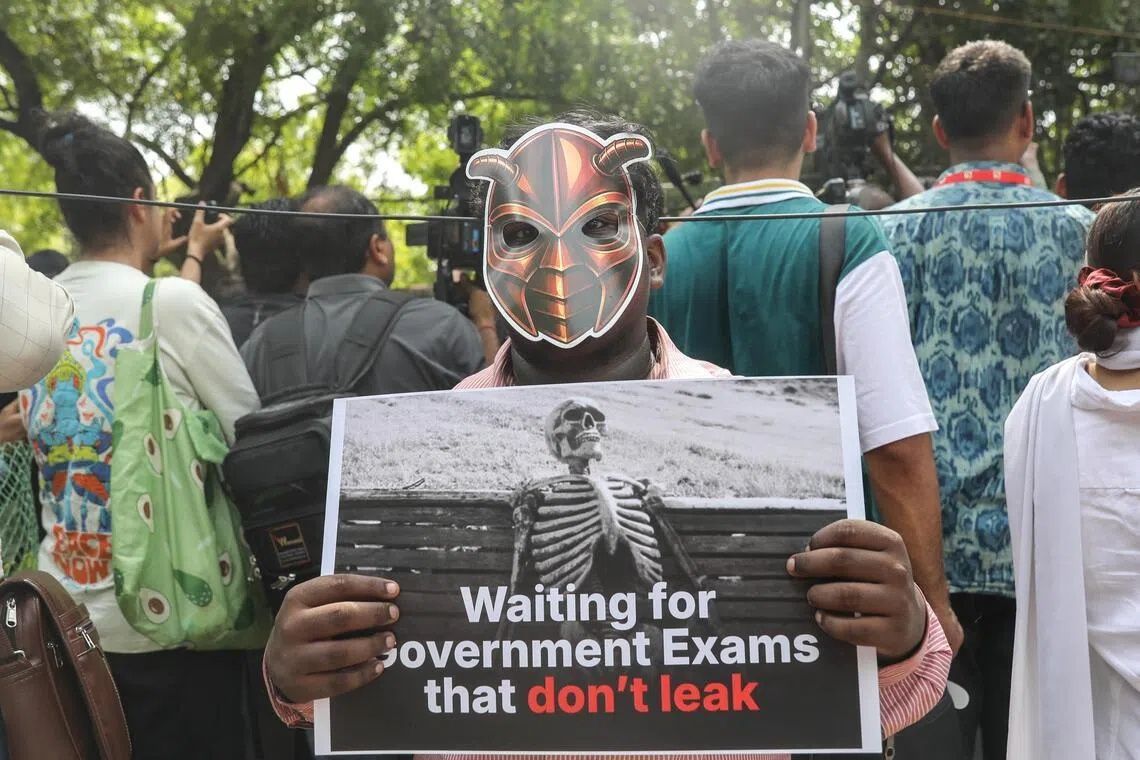
India's medical education system faces a critical juncture as 2.2 million aspiring doctors prepare to sit a crucial re-examination on Sunday, June 21, under what authorities describe as the tightest security protocols ever implemented for a competitive entrance test. The retesting of the National Eligibility cum Entrance Test comes after the cancellation of May's administration, when examination papers were leaked days before the scheduled test date, setting off a firestorm of criticism across the country and exposing deep vulnerabilities in the nation's examination infrastructure.
The fallout from the exam leak has extended far beyond simple administrative inconvenience. Students and parents expressed fury over the disruption to their carefully planned educational timelines, while Indian media outlets reported tragic cases of teenage suicides linked to the anxiety and uncertainty created by the scandal. These deaths underscored the immense psychological pressure that characterises India's ultra-competitive entrance examination system, where roughly 2.2 million candidates vie annually for approximately 100,000 undergraduate medical seats. The scale of competition has created a high-stakes environment where individual performance on a single examination can determine life trajectories, making any breach of test integrity a matter of profound national concern.
The controversy surrounding the medical exam leak did not emerge in isolation. Running parallel to the NEET scandal was another examination system failure involving the online marking process for high school tests administered to nearly two million students. In that separate incident, allegations emerged that incorrect grades had been assigned to students or that results had been matched to wrong candidates, amplifying public frustration with the education bureaucracy. The twin crises created a perfect storm of institutional distrust, with parents and students questioning whether the systems meant to fairly assess their abilities had become fundamentally compromised.
This wave of public anger has manifested in unexpected political expressions. A satirical movement called the "Cockroach People's Party" gained traction in May, attracting millions of online followers and channelling youth frustration into demands for accountability from the highest levels of the education ministry. The party's central demand focused on the resignation of Education Minister Dharmendra Pradhan, reflecting widespread sentiment that leadership failures had enabled the systemic breakdowns in examination security and administration. Such grassroots political mobilisation demonstrates how education policy failures can rapidly translate into broader crises of institutional confidence.
Investigations into the paper leak have revealed sophisticated criminal networks exploiting examination vulnerabilities for profit. India's Central Bureau of Investigation arrested the alleged mastermind behind the leak, identified as a chemistry lecturer, exposing how insider involvement remains a critical weak point in the examination system. The involvement of what authorities characterised as organised criminal networks highlighted how the immense financial value of examination results—given the competition for limited medical college seats—creates powerful incentives for corruption and fraud throughout the ecosystem.
Technology played a dual role in both enabling and now attempting to prevent examination fraud. The National Testing Agency disclosed that messaging applications, particularly Telegram, had been weaponised by cheating syndicates to rapidly distribute leaked examination questions to paying customers. This exploitation of encrypted communication platforms underscored how digital innovation, when combined with human vulnerabilities, can undermine even carefully designed testing systems. In response, authorities took the controversial step of restricting access to Telegram during the examination period, a move that drew scepticism from technology industry observers.
Telegram founder Pavel Durov publicly questioned whether such restrictions would prove effective, arguing instead that the fundamental problem lay not with specific applications but with insiders willing to leak examination materials for financial gain. His comments highlighted an important truth about examination security: technical measures and app bans address symptoms rather than root causes. As long as the financial incentives for leaking examination papers remain substantial, determined actors will find alternative communication channels and distribution methods to facilitate fraud, suggesting that meaningful reform must address both supply-side governance and demand-side cultural factors.
The National Testing Agency has responded to the catastrophe with an ambitious security overhaul for the retest. Authorities have deployed more than 200,000 officials including police personnel across examination centres nationwide, creating a visible security presence intended to deter fraud and reassure candidates. The security framework incorporates multiple technological layers designed to prevent both internal leaks and external tampering. Biometric authentication systems will verify candidate identities, AI-enabled camera surveillance will monitor examination halls for suspicious behaviour, and GPS tracking systems will monitor question paper movement from printing facilities to examination centres, creating an auditable chain of custody.
These measures represent a significant escalation in examination security infrastructure, though their effectiveness ultimately depends on consistent implementation across thousands of examination centres spread throughout a country of India's continental scale. The complexity of administering a fair examination to 2.2 million candidates simultaneously, spread across diverse locations with varying institutional capacities, presents logistical challenges that no amount of technology can fully resolve without complementary investments in human oversight and institutional integrity.
The examination system's vulnerability to fraud reflects broader structural issues within India's educational ecosystem. The intense competition for medical college seats has fuelled a massive coaching industry that generates enormous profits while often perpetuating socioeconomic inequalities in educational access. This competitive intensity simultaneously creates the financial incentives that motivate examination fraud and the desperation among candidates that makes them susceptible to offers of leaked papers or unfair advantages. Addressing examination integrity therefore requires engagement with these systemic pressures rather than reliance on security measures alone.
For neighbouring Southeast Asian nations observing India's examination crisis, the situation offers important cautionary lessons about the risks of extremely competitive entrance examination systems and the importance of robust institutional safeguards. Malaysia and other regional countries with their own competitive examination systems have watched India's struggles with interest, recognising that similar vulnerabilities could affect their own educational infrastructure if governance standards slip or technological security measures are inadequately implemented.
The retest scheduled for Sunday represents not merely a logistical rescheduling but a test of institutional credibility for India's educational establishment. The massive security deployment signals to candidates and parents that authorities have taken the breach seriously and have invested substantially in preventing recurrence. Nevertheless, the underlying challenge remains: creating examination systems that are simultaneously rigorous, secure, and perceived as fair by the millions of students whose futures depend on their results. Whether India's reforms prove sufficient will have implications for educational policy discussions throughout the region.

