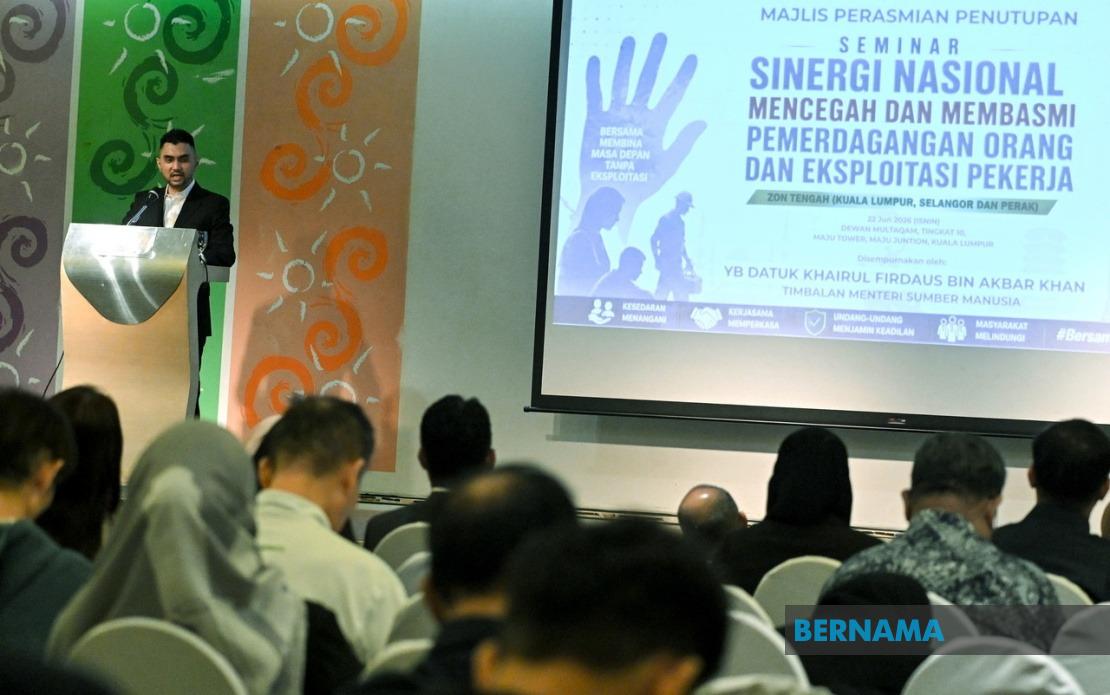
The number of human trafficking and labour exploitation victims being rescued in Malaysia has trended downward since 2023, a development that Deputy Human Resources Minister Datuk Khairul Firdaus Akbar Khan attributes to strengthened government enforcement and prevention strategies. Speaking at the conclusion of the National Synergy Seminar on Preventing and Eradicating Human Trafficking and Labour Exploitation in the Central Zone in Kuala Lumpur, he presented data indicating tangible progress in the nation's crackdown on these crimes, though he cautioned that reported figures may understate the true scale of the problem.
According to statistics compiled by the Peninsular Malaysia Manpower Department (JTKSM), the trajectory shows considerable fluctuation. In 2023, enforcement operations culminated in the rescue of 70 victims. This number fell dramatically to just 10 in 2024, before climbing back to 17 in 2025. Through May of the current year, authorities have rescued only four individuals, a figure Khairul Firdaus acknowledges reflects a positive direction even as uncertainty clouds the complete picture.
The minister emphasised the importance of interpreting these statistics with appropriate caution. While declining rescue numbers suggest improved preventive measures and deterrence, he recognised that many cases may never surface in official records. This gap between reported and unreported cases represents a persistent challenge in combating human trafficking, a crime characterised by concealment and victim isolation. The acknowledgment reflects Malaysia's understanding that statistical success must be tempered by awareness of hidden exploitation networks that continue to operate beyond enforcement visibility.
To address labour crimes comprehensively, the government has mobilised substantial enforcement resources across the country. Between January and May this year alone, authorities conducted 386 labour-related enforcement operations nationwide. Of these operations, investigators initiated 311 investigation papers, indicating a systematic approach to identifying, documenting, and prosecuting suspected violations. This operational intensity underscores the government's determination to create consequences for trafficking networks and labour exploiters.
Malaysia's commitment extends beyond domestic law enforcement into the international arena. The government has aligned its anti-trafficking agenda with protocols ratified under the International Labour Organisation (ILO), positioning the nation within a broader framework of global labour standards and forced labour prevention. This alignment signals Malaysia's intention to meet international benchmarks while contributing to regional and worldwide efforts against labour exploitation, a concern that spans Southeast Asia's interconnected economies.
The National Synergy Seminar represents a multi-phased awareness campaign designed to build capacity and knowledge among stakeholders across the country's regions. The Central Zone programme, which concluded with Khairul Firdaus's remarks, follows earlier seminars held in the North Zone in Sungai Petani, Kedah on May 18 and the South Zone in Kluang, Johor on June 8. This geographic distribution ensures that frontline workers, government officials, and civil society representatives across Malaysia receive consistent messaging and training on identifying and responding to trafficking indicators.
Approximately 1,000 participants attended these seminars collectively, creating platforms for information exchange, strategy discussion, and collaborative problem-solving. These gatherings serve multiple purposes: raising awareness among those most likely to encounter victims, building institutional knowledge about trafficking patterns and labour exploitation mechanisms, and fostering inter-agency cooperation necessary for effective intervention. The breadth of participation suggests government efforts to embed anti-trafficking consciousness throughout Malaysia's administrative and community structures.
For Malaysian readers and the broader Southeast Asian context, these developments carry significant implications. Malaysia functions simultaneously as a destination and transit country for trafficking victims, a reality shaped by regional migration patterns and economic disparities. The emphasis on labour enforcement reflects recognition that trafficking often manifests through exploitative work arrangements rather than solely through coercion or sexual abuse. The declining rescue statistics, while encouraging, must be understood against Malaysia's role in global labour supply chains and migration corridors.
The government's multi-pronged approach—combining enforcement operations, international treaty compliance, public awareness seminars, and investigation infrastructure—represents a maturing policy framework. However, the acknowledged gap between reported and unreported cases suggests room for expansion in victim identification mechanisms, whistleblower protections, and support services for those rescued. Regional cooperation remains crucial, given that many victims move across Southeast Asian borders, requiring coordinated responses among neighbouring countries with aligned legal standards and enforcement capacity.
Khairul Firdaus's characterisation of current progress as grounds for cautious satisfaction reflects pragmatic policymaking. The declining trend validates existing strategies while the caveat about hidden cases prevents complacency. Moving forward, Malaysia's challenge lies in maintaining enforcement momentum whilst expanding prevention mechanisms that reach vulnerable migrant populations, irregular workers, and isolated communities least likely to report exploitation. Success will ultimately depend not merely on rescue numbers but on preventing initial vulnerability to trafficking through regional economic development, improved labour migration governance, and sustained cross-border cooperation that addresses root causes driving trafficking demand.

