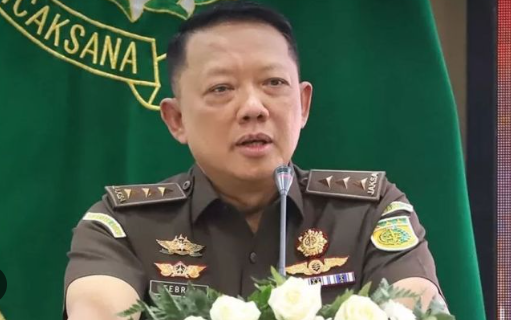
President Prabowo Subianto arrived in office with a forceful anti-corruption agenda, publicly demanding that government officials "clean themselves up" or face law-enforcement action. Yet barely into his term, his signature campaign promise faces a critical test in the form of Febrie Adriansyah, the nation's former deputy attorney general for special crimes, who until recently held tremendous institutional power as Indonesia's most influential anti-corruption prosecutor. When police seized approximately US$26 million in cash and gold bars from a property Febrie owns and named him a suspect in money-laundering investigations, they simultaneously transferred the cases to the Attorney General's Office—the institution where Febrie spent much of his career. This unusual maneuver has triggered alarm among constitutional scholars and legal observers who question whether Indonesia's existing laws even permit such a transfer and whether the move signals an attempt to shield a prominent official rather than hold him accountable.
The decision to shift active police investigations to prosecutors has become the most contentious aspect of the entire case, overshadowing even the allegations themselves or questions about why Febrie has remained free during the investigation. Former Constitutional Court Chief Justice Mahfud MD has warned publicly that Indonesia's criminal procedure code contains no legal provision for transferring an ongoing police inquiry to prosecutors, and that such an arrangement could expose the entire prosecution to pretrial challenges that would collapse the case entirely. Legal experts view this institutional transfer as deeply problematic, not merely as a procedural technicality but as a fundamental betrayal of investigative integrity. The controversy deepens because Febrie's long tenure at the Attorney General's Office means that many of his former colleagues—individuals whose careers he shaped, whose advancement he influenced, and whose professional loyalties may remain entangled with his own—would now be responsible for investigating him. Zaenur Rohman, an anti-corruption scholar at Gadjah Mada University, has characterized the transfer as "a political settlement aimed at easing tensions" between police and prosecutors, one devoid of legal foundation and designed to manage institutional friction rather than pursue justice.
The apparent reluctance to detain Febrie despite the seriousness of the allegations contrasts sharply with the speed at which authorities arrested another suspect in the related case. Immigration authorities have merely banned him from leaving Indonesia for 20 days at police request, while he remains at an undisclosed location. Police have not offered public explanation for why detention was not pursued, instead emphasizing that their officers continue to verify evidence, conduct forensic testing on the seized gold bars, and coordinate with international partners including the FBI, the US Secret Service, and embassies in Singapore and Washington to authenticate the foreign currency recovered during raids. This divided responsibility—with police conducting technical work while prosecutors formally control the investigation—creates ambiguity about who actually directs the inquiry and raises suspicions that the arrangement allows both institutions to claim credit while avoiding accountability if the case unravels.
The institutional tensions exposed by this investigation reflect deeper structural problems within Indonesia's law-enforcement architecture. Police, prosecutors, and the Corruption Eradication Commission (KPK) all possess overlapping authority in corruption cases, creating perpetual competition for influence, visibility, and control over politically sensitive matters. Successive Indonesian presidents have attempted to manage these rivalries by preventing any single institution from accumulating excessive power, but the arrangement frequently produces exactly the kind of turf disputes now evident. Recent legal changes have intensified these dynamics: a 2025 revision to Indonesia's military law permits active-duty military officers to serve at the Attorney General's Office without first retiring, while a separate 2025 amendment expanded the Attorney General's Office's ability to seek military protection for prosecutors—a function previously monopolized by police. These changes effectively brought the military deeper into the mix, further fragmenting investigative authority across competing power centers.
Lawmakers have responded to public concern by forming a working group specifically to monitor how authorities handle the Febrie case, with some parliamentarians explicitly calling on the Attorney General's Office to establish an independent investigative team to manage the matter. Such calls implicitly acknowledge that the conventional institutional framework is incapable of handling a case involving a senior prosecutor investigated by his own institution. The independent body approach would theoretically isolate the investigation from careerism, institutional loyalty, and the personal relationships that inevitably compromise judgment when former colleagues investigate one another. Coordinating Minister Yusril Ihza Mahendra defended the case transfer on procedural grounds, arguing it would enhance investigative efficiency, yet simultaneously acknowledged public apprehension that the arrangement amounted to "oranges eating oranges"—an Indonesian expression capturing the fear that one institution will ultimately protect its own rather than pursue impartial justice. Yusril claimed that President Prabowo had personally met with both the police chief and attorney general to direct them on managing the transfer, suggesting presidential involvement in what should remain an independent prosecutorial decision.
Febrie's institutional stature amplifies the significance of his case. As head of the Attorney General's Office's Special Crimes Division, he personally oversaw Indonesia's most consequential corruption investigations, directing probes into Pertamina, Timah, Garuda Indonesia, and Prabowo's own signature free-meals programme. His influence extended to high-profile inquiries involving former Education Minister Nadiem Makarim and numerous other politically sensitive matters. Few prosecutors in recent Indonesian history have wielded comparable power to shape investigations, influence judicial outcomes, and determine which officials face scrutiny and which escape attention. The implications of his potential wrongdoing therefore extend beyond personal culpability to questions about the integrity of major investigations he oversaw and whether his conduct systematically corrupted the cases passing through his office. Febrie's acknowledged ownership of the raided property yet denial that the seized currency and precious metals belong to him creates an obvious credibility problem: how assets of such magnitude come to reside in property one owns yet claims to have no knowledge of requires extraordinarily convincing explanation.
Prabowo's anti-corruption campaign has previously demonstrated a flair for public spectacle, with authorities regularly holding televised press conferences to showcase seized cash, gold bars, and luxury assets recovered from suspected corrupt officials. This theatrical dimension serves political purposes—demonstrating the president's commitment to fighting graft while building public momentum for the campaign. Yet the Febrie investigation reveals the internal contradictions within such a strategy. When the target is a prominent prosecutor rather than a distant businessman or mid-level minister, the machinery of performative anti-corruption becomes uncomfortable and difficult to deploy. Public attention to institutional failures and legal irregularities crowds out the narrative of decisive action against wrongdoing. The free-meals programme investigations illustrate these tensions particularly clearly: when the Attorney General's Office's initial investigation into the programme named an active police brigadier general as a suspect, the police apparently retaliated by investigating Febrie, who had overseen that very prosecutor's work on the meals initiative. The Attorney General's Office subsequently issued instructions halting regional prosecutors' data collection related to the programme, suggesting that institutional rivalries had become more urgent than program integrity.
Aditya Perdana, a political lecturer at the University of Indonesia, observed that "the events don't explicitly prove institutional conflict, but the sequence tells a story." That story tracks not just the Febrie investigation itself but the constellation of competitive responses and defensive institutional maneuvers surrounding it. Armed soldiers appeared around Febrie's South Jakarta residence during police raids, triggering public alarm about military deployments in what should remain a civilian legal matter. Prabowo subsequently called for "introspection" from all sides in weekend remarks, a calculated political statement designed to signal presidential awareness of institutional tensions while avoiding explicit acknowledgment of institutional failure. The National Police chief appeared publicly alongside the attorney general the following Monday, both denying any organizational rift, yet such denials ring hollow against the mounting evidence of competing agendas and mutual recrimination.
Jacqui Baker, a senior lecturer in Southeast Asian politics at Murdoch University, frames the deeper issue confronting Indonesia: "The powers of criminal investigation, particularly in corruption cases, are jealously fought over by law-enforcement agencies because they lie at the core of their political and economic power." This observation explains why technical questions about case transfer procedures acquire such political weight and why institutional rivalries consistently contaminate investigations into high-level wrongdoing. Indonesia's fractured law-enforcement system creates inherent incentives for agencies to use corruption investigations as mechanisms for advancing institutional interests, settling organizational scores, and consolidating power. The Febrie case exemplifies how such structural problems manifest in practice: rather than concentrating authority in a single accountable body capable of impartial investigation, Indonesia maintains competing institutions with overlapping jurisdiction, creating conditions where political calculation routinely overwhelms prosecutorial integrity.
For Malaysian and broader Southeast Asian observers, the Febrie investigation offers instructive lessons about the vulnerabilities of anti-corruption campaigns lacking adequate institutional insulation from political influence and inter-agency competition. When presidents inherit or fail to restructure fragmented law-enforcement systems, anti-corruption momentum inevitably falters when investigations reach protected or institutionally powerful individuals. The case demonstrates that public commitment to fighting graft, while necessary, proves insufficient without reformed institutional architecture that genuinely isolates investigators from careerism and organizational loyalty. Indonesia's inability to cleanly investigate its own senior prosecutors after years of anti-corruption rhetoric suggests that structural obstacles to accountability run deeper than individual will or political promises. The challenge facing Prabowo and all regional leaders attempting credible anti-corruption campaigns involves establishing genuinely independent investigative mechanisms insulated from the very institutional pressures that typically derail investigations involving powerful officials. Until such reforms occur, high-profile anti-corruption initiatives risk becoming instruments of inter-agency competition and political theater rather than genuine efforts to hold all officials equally accountable to law.

