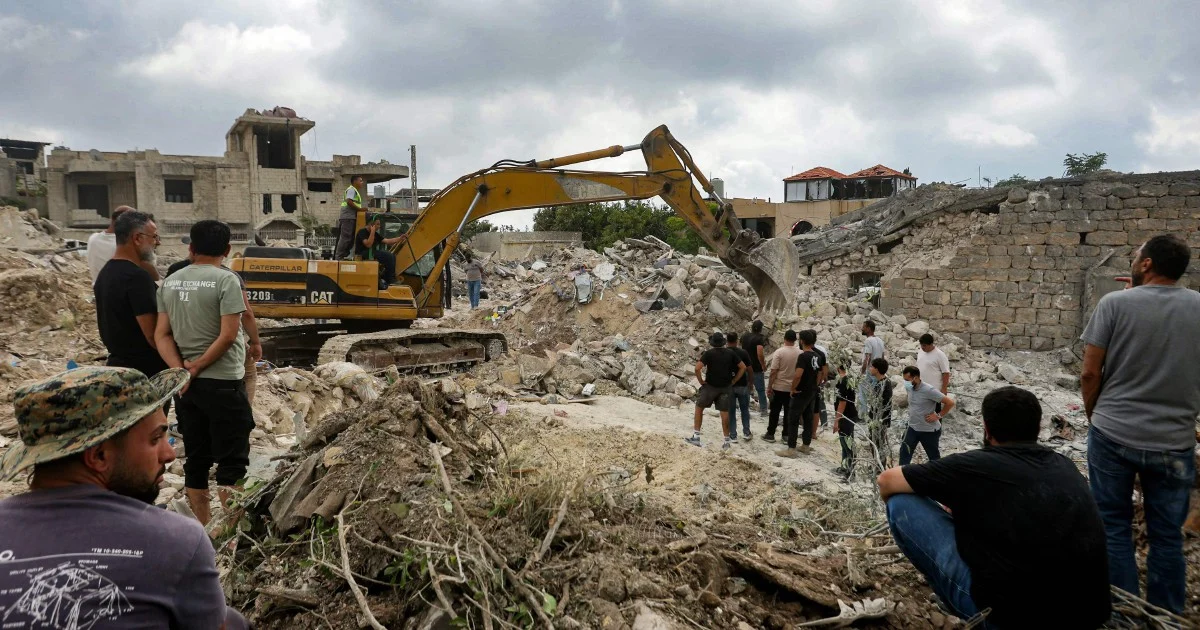
Hezbollah's political leader Naim Qassem delivered a categorical rejection on Sunday of any arrangement permitting Israeli forces to establish a designated security corridor or buffer zone within Lebanese territory, directly contradicting assurances made by Israeli Prime Minister Benjamin Netanyahu, who stated that Israeli troops would remain deployed in the southern regions for whatever duration proves necessary to achieve Israeli security objectives.
The fundamental disagreement between the two parties reflects the deepening impasse over the terms governing Israel's military operations in Lebanon, a country already destabilised by regional tensions and internal political fragmentation. Qassem's unequivocal stance indicates that Hezbollah views the concept of a formalised Israeli security zone as incompatible with Lebanese sovereignty and national dignity, setting the stage for continued confrontation rather than negotiated settlement.
Netanyahu's insistence that Israeli soldiers will remain stationed in southern Lebanon indefinitely suggests Jerusalem intends to maintain military control of the region regardless of international pressure or Lebanese objections. This position fundamentally challenges the legitimacy of Lebanon's government to exercise full authority over its own territory, a sensitive issue given the country's fractured political system and historical experience with foreign military occupation.
The rhetoric from both sides has hardened considerably, moving away from the possibility of compromise. Hezbollah's rejection dismisses outright any framework that would legitimise an Israeli presence, even if presented as temporary or limited in scope. This contrasts sharply with any implied flexibility that might emerge from diplomatic channels, suggesting the organisation regards such proposals as attempts to formalise what would otherwise be regarded as illegal occupation.
For Malaysian and Southeast Asian observers, this escalation carries significance beyond the immediate Lebanese context. The standoff exemplifies how regional powers navigate territorial disputes and military positioning in zones of strategic importance, with implications for understanding similar tensions elsewhere in Asia, including maritime disputes in the South China Sea and border complications across the region.
Lebanon's position remains extraordinarily precarious, caught between pressure from Israeli military actions and constrained by its own institutional weaknesses. The central government has limited capacity to enforce its authority across all Lebanese territory, particularly in regions where Hezbollah maintains substantial influence and parallel governance structures. Any resolution to the current crisis must somehow navigate this reality without effectively partitioning the country or legitimising factional control of national territory.
International actors, including the United States and European nations, have expressed concern about the escalating rhetoric and military positioning. However, meaningful diplomatic intervention requires cooperation from all parties, which appears increasingly unlikely given the hardened positions articulated by Netanyahu and Qassem. Regional powers including Iran, Syria, and Saudi Arabia also maintain competing interests in the Lebanese sphere, complicating external mediation efforts.
The security zone concept itself carries troubling historical precedent. Israel's previous establishment of a security zone in southern Lebanon, maintained from 1982 until 2000, left a legacy of occupation, civilian casualties, and delayed development in the affected regions. Lebanese communities affected by that experience view proposals for renewed security arrangements with profound suspicion and historical memory of suffering.
Hezbollah's organisational capability and military arsenal present a significant complicating factor. Unlike more fragmented opposition groups, Hezbollah maintains disciplined armed units and demonstrated capacity to conduct sustained military operations. This organisational strength underpins its confidence in rejecting Israeli proposals outright, rather than engaging in extended negotiations that might ultimately validate the Israeli military presence through the negotiation process itself.
The rejection also reflects broader calculations about regional prestige and alliance dynamics. Hezbollah derives legitimacy from its resistance positioning and anti-Israeli stance among significant portions of Lebanese and broader Arab populations. Accepting any Israeli security zone, even temporarily, would undermine this foundational narrative and potentially weaken its political standing relative to other Lebanese factions.
For Lebanon's already struggling economy and civilian population, the continuation of military tension carries immediate costs. The country faces severe economic challenges, including currency collapse, banking system instability, and massive refugee populations. Renewed conflict or protracted military standoff further complicates reconstruction efforts and deters foreign investment essential for economic recovery.
The diplomatic path forward appears narrowed considerably by these latest declarations. Qassem's categorical rejection leaves minimal space for face-saving compromises, while Netanyahu's indefinite timeline eliminates the possibility of framing Israeli withdrawal as time-limited. Without external diplomatic pressure intensifying or circumstances on the ground shifting dramatically, the current frozen conflict dynamic seems likely to persist, with occasional escalations and humanitarian consequences accumulating for Lebanese civilians.

