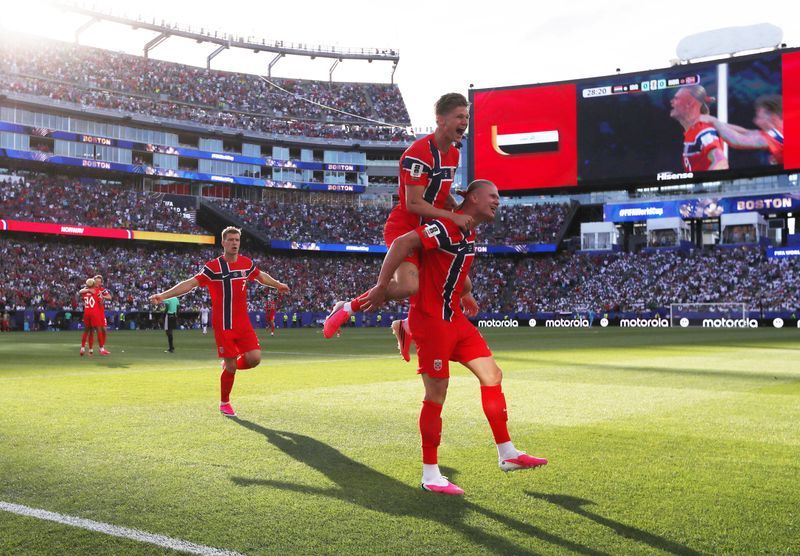
Erling Haaland made an unmistakable statement in his World Cup debut, propelling Norway to a dominant 4-1 triumph over Iraq with a clinical first-half double that showcased the prolific finishing that has defined his rise through European football's elite tiers. The Norwegian striker's arrival on world football's grandest stage carried the weight of national expectation, yet he delivered with the kind of assured composure that has become his hallmark.
Haaland's two-goal haul extends an extraordinary sequence of goalscoring debuts across the sport's most demanding competitions. From his maiden appearance in Germany's Bundesliga through to his first Champions League outing and subsequent ascent in English football's Premier League, the 23-year-old has consistently marked each new arena with immediate impact. His World Cup introduction merely adds another chapter to this remarkable narrative of early assertion, suggesting that his tournament campaign may prove pivotal in Norway's ambitions.
The evening in Qatar highlighted the symbiotic relationship at the heart of Norway's tactical approach under manager Stale Solbakken. While Haaland's individual brilliance captured headlines, his effectiveness is fundamentally rooted in the team's structural commitment to feeding him in dangerous positions. Norwegian Prime Minister Jonas Gahr Stoere had articulated this philosophy on the eve of the contest, emphasising that despite Haaland's undeniable talent, collective purpose rather than individual heroics wins matches. The early passages of the encounter vindicated this assessment, as Norway frequently moved the ball forward with intent, though execution occasionally wavered through sloppy passing and loose positioning.
Haaland's opening goal arrived through a textbook poacher's instinct, arriving at the optimal moment to convert David Moller Wolfe's inviting cross from the right flank. His second stemmed from applied pressure rather than finesse—sensing hesitation in Iraq's back line, he closed down a weak defensive pass and blocked the goalkeeper's desperate clearance attempt, bundling the loose ball goalward with characteristic predatory awareness. These weren't merely clinical finishes; they reflected a forward fully attuned to the rhythm of play and reading defensive vulnerabilities with precision.
For a nation absent from World Cup competition for 28 years, Norway's opening statement carried profound symbolic weight. The intervening decades of qualification heartbreak and false dawns had created an understandable hunger among supporters and officials alike. Yet the path to this victory was neither smooth nor unconvincing, revealing technical deficiencies that opponents with superior tactical discipline may readily exploit. Captain and creative orchestrator Martin Odegaard, typically the fulcrum of Norwegian attacking play, appeared subdued throughout proceedings, failing to impose the usual creative authority his position demands. Defensive lapses proved momentarily costly when Aymen Hussein capitalised on inattentiveness to haul Iraq level, a reminder that Haaland alone cannot shoulder entire tactical responsibility.
The final scoreline of 4-1 understated the contest's competitive texture during early phases, when Iraq mounted organised resistance and threatened to frustrate their favourites more substantially. Norwegian midfielder and team captain Odegaard's unexpected ineffectiveness in the middle of the park meant that creative responsibility often defaulted to Haaland's positioning and movement rather than conventional playmaking. This dependency on an individual's initiative, while productive on this particular evening, represents a vulnerability that group rivals will undoubtedly attempt to exploit through disciplined marking and midfield control.
Norway's three-point haul positions them atop their group standings temporarily, ahead of France following the latter's 3-1 victory over Senegal contested simultaneously. However, group composition and remaining fixtures will determine whether this opening advantage translates into knockout progression. Haaland himself recognised post-match that substantially improved performance levels will prove essential as the tournament progresses, indicating awareness that opening-match dominance against a relatively modest opponent cannot provide false confidence moving forward. The mathematical advantage proves ephemeral when measured against the quality that awaits in subsequent rounds.
For Malaysian and Southeast Asian observers, Norway's campaign offers intriguing benchmarking opportunities. The Scandinavian nation, despite possessing world-class individual talent in Haaland, has struggled for extended periods to maintain sustained World Cup presence—a reflection of fierce regional competition and limited player development pathways compared to wealthier footballing nations. Similarly, regional teams competing at World Cup level must balance reliance on singular talismanic figures against the collective tactical discipline and depth that separates genuine contenders from tournament participants. Haaland's performance underscores that elite individual ability matters enormously, yet contextualises why nations with broader talent cultivation systems consistently advance further.
Haaland's celebration following the final whistle radiated the kind of infectious enthusiasm that endears global stars to supporters worldwide. His comment regarding his uncertainty about the time back in Norway while hoping the nation was celebrating revealed the emotional connection between diaspora athletes and their home nations during World Cup tournaments. For a player who rarely engages substantially with media obligations, his relaxed post-match demeanour suggested genuine satisfaction with the statement his team had made. Yet his acknowledgement that the team need not manufacture complications moving forward—his reference to "no banana skins"—indicates tactical maturity beyond his tender years.
The path ahead for Norway demands significant refinement across multiple dimensions. While Haaland's finishing prowess provides an unmistakable attacking advantage, Solbakken must address midfield creativity, defensive discipline, and the structural vulnerabilities that permitted Iraq's equaliser despite overall dominance. Should Odegaard elevate his contributions and supporting players locate greater consistency, Norway possess the pieces to progress deeper than their 28-year absence might suggest. Conversely, opponents facing them in subsequent fixtures now possess clear evidence that Haaland cannot be contained through conventional means, necessitating tactical innovation and collective defensive sophistication.